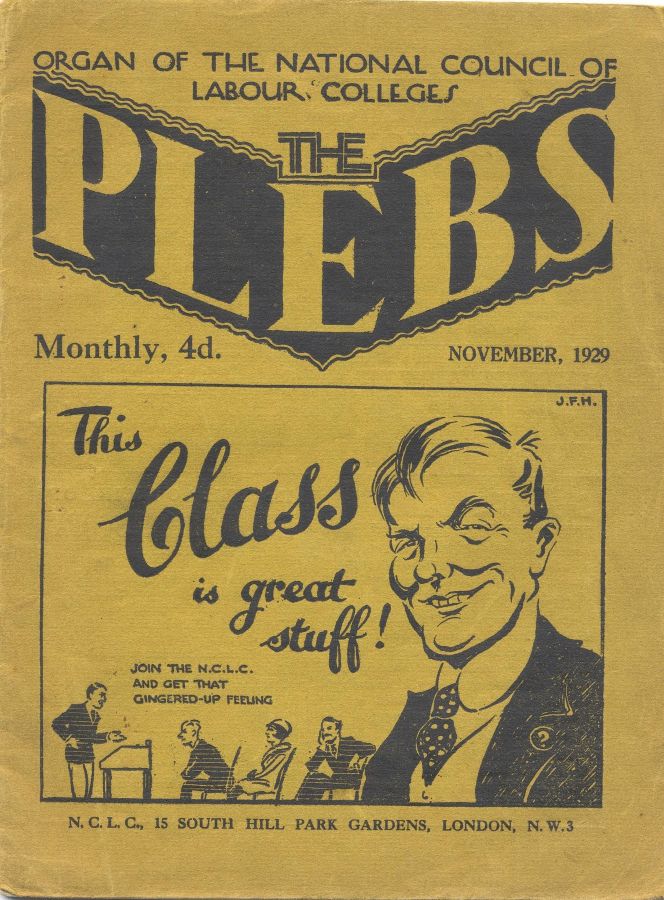
Writing for an audience of labor educators in the U.S., Calverton reports on the work of National Council of Labour Colleges and other workers’ education projects in Britain.
‘Labor Education In England’ by V.F. Calverton from Labor Age. Vol. 16 No. 9. September, 1927.
IN a country in which “labor” is part of the common vernacular, and in which there is a standing unemployment of over one million and a quarter workers, the problem of labor education has a significance that it seldom attains in America. The labor situation is grave. The dole system, by which the unemployed are given a pittance to avoid starvation, is ineffective. Begging is rife. London is crowded with men, women, and girls selling matches and other trifles in a vain endeavor to eke out a livelihood. Unrest is everywhere intense. In the proletarian district on the south side of London, where I have been living, the sentiment of protest is spirited and acrimonious. In the business districts the unemployed turn to almost any device in order to earn a stray penny or occasional shilling. Along Shaftesbury Avenue, and on Charing Cross Road, I found men standing in the middle of the street, amid the bewildering race and whirl of traffic, pirouetting on their hands, and then balancing their heads on bottles—in the manner of an amateur acrobat, all in an attempt to attract an audience from which they could raise a little money for their next meal.
These introductory remarks about the economic situation in general, it will soon be seen, have a direct relation to the matter of labor education and working-class institutions. The present Anti-Trade Union Bill which has already been passed in the House of Commons and at the present time is under debate in the House of Lords, has aroused terrific opposition among the working-classes. Of course, difficulties, splits, and dissensions among certain of the unions have weakened somewhat the labor offensive. The General Strike of last year has still left its effect upon the finances of the unions.
A Recent Difficulty
The recent dispute about the London Labor College, for example, arose from the financial difficulties in the N.U.R. (National Union of Railwaymen) that were originally created by the General Strike. The London Labor College, the only resident labor college in England with the exception of Ruskin College at Oxford, was really organized and still is governed by two unions: the Railwaymen and the Miners. No other unions are represented on its board of governors. At the present time, for instance, among its twenty students, all are members of either of these two unions, with the exception of two students, one of whom is a delegate from the Upholsterers’ Union. The recent attempt to “smash” the London Labor College has several subtle and devious origins. The external reason, however, was definitely economic. J.M. Thomas, the well-known labor leader, who is ordinarily a great power in the N.U.R., defended a motion to withdraw the financial support of the Union from the London Labor College. The passage of this motion was equivalent to destroying the College. Without the financial assistance of the Railway men, the College could not continue. Fortunately for the College Thomas was rebuked by a sharp vote in favor of continuation of support for the institution. Thomas had based his argument upon the fact that the funds of the N.U.R. had been so seriously consumed by the General Strike that the Union really could not afford to continue its support of the College. In reality it was an attempt on the part of Thomas to destroy the institution.
The London Labor College, founded in 1909 under the title of the Central Labor College, is now affiliated with the National Council of Labor Colleges. It is important to distinguish its approach from that of the Ruskin Labor College at Oxford. Ruskin College aspires to the impartial outlook. While labor in sympathy, it refuses to take a radical stand. The London Labor College, on the other hand, takes a definite radical position. It is Marxist in its entire approach. While not connected with any political party, the college is emphatically left in spirit. The purpose of the college is clearly stated in its foreword:
“In general the aim is to turn out well-informed organizers and propagandists to assist in the educational, industrial, and political work of the Labor Movement.”
The Labor College
The London Labor College is smaller in capacity than Brookwood Labor College. At maximum it can only handle thirty-six students; at the present time it only has twenty students on its rolls. Its courses have a wide, effective range and continuity. The curriculum is attractively diversified. There is a course in Method, the Science of Understanding, which undertakes an analysis of the Nature of Thought, Nature of Things, and includes a fairly extensive study of the dialectical philosophy of Dietzgen in relationship to the work of Marx and Engels. There are other courses in Historical Materialism, History of Socialism in England, Industrial History of England, Industrial Revolution, Economics, Economic Geography, History of Philosophy, and Literature. The work at the College covers a period of two years. The candidate for entrance, or for scholarship examinations, must have had two years continuous membership in his Trade Union, must give evidence of having had an elementary education, and he must promise to “place his services at the disposal of either his own organization or of the General Labor Movement, on the termination of his residence at the College.”
It is the National Council of Labor Colleges, nevertheless, that has made labor education in England a widespread, growing, significant thing. This Council, of which J.P.M. Millar is General Secretary and A.A. Purcell is the Honorary President, is representative of Independent Working Class Education in England. It reveals something of the successful fight for unity in the British Labor Movement. The English Bourgeoisie has attempted to thwart labor education by the same method that is being employed in the United States, namely by the Adult Education Movement. In 1921 £17,500 was to be given every year for adult education. Today over £52,000 is expended annually. This National Council of Labor Colleges, as an integral part of the British labor movement, has steadily and successfully fought this insidious type of adult education.
Thousands of Courses
The N.C.L.C. has more Trade Union Educational schemes than have all the other working class organizations in the country. In 1923 there were only nine unions affiliated with the N.C.L.C.; in 1926 there were thirty-five. The N.C.L.C. arranges “Educational Schemes” for the unions, and with the smaller trade union branches, trades councils and the like, it has mapped out thousands of programs and courses. In 1926, for instance it had organized 153 District Labor Colleges. These colleges, of course, are not to be confused with the London Labor College; these colleges are part-time, course-arrangement affairs. The London Labor College is a whole-time, resident institution. The N.C.L.C., in addition, has a Correspondence Course Department which had enrolled in 1926 1,459 students. Tutors are trained by the N.C.L.C. for the work that it is their task to perform. A regular National Training Centre for Tutors has already been organized. This is naturally part of the important attempt of the working-class to get its teachers out of its own group instead of depending upon other social classes for its instructors.
Radical
The N.C.L.C. is as definitely radical in its approach as the London Labor College. In fact, the London Labor College is but one of the branches affiliated with its work. In the curriculum of the N.C.L.C. are over thirty subjects; among the more curious, from the point of view of American working-class education, are: Esperanto, Evolution, History of the Family, Marxism, Psychology, Theory of History, Bourgeois and Marxian Economics, Literature and Social Conditions. To be sure, there is the expected range of trade union topics which must be the principal background of a sound, working-class educational program.
Altogether there is a unity of attitude in this problem of proletarian education in England that is at once inspiring and significant. It is an education that fortifies the labor movement for the great task that confronts it in the future.
Labor Age was a left-labor monthly magazine with origins in Socialist Review, journal of the Intercollegiate Socialist Society. Published by the Labor Publication Society from 1921-1933 aligned with the League for Industrial Democracy of left-wing trade unionists across industries. During 1929-33 the magazine was affiliated with the Conference for Progressive Labor Action (CPLA) led by A. J. Muste. James Maurer, Harry W. Laidler, and Louis Budenz were also writers. The orientation of the magazine was industrial unionism, planning, nationalization, and was illustrated with photos and cartoons. With its stress on worker education, social unionism and rank and file activism, it is one of the essential journals of the radical US labor socialist movement of its time.
PDF of full issue: https://www.marxists.org/history/usa/pubs/laborage/v16n09-sep-1927-LA.pdf

