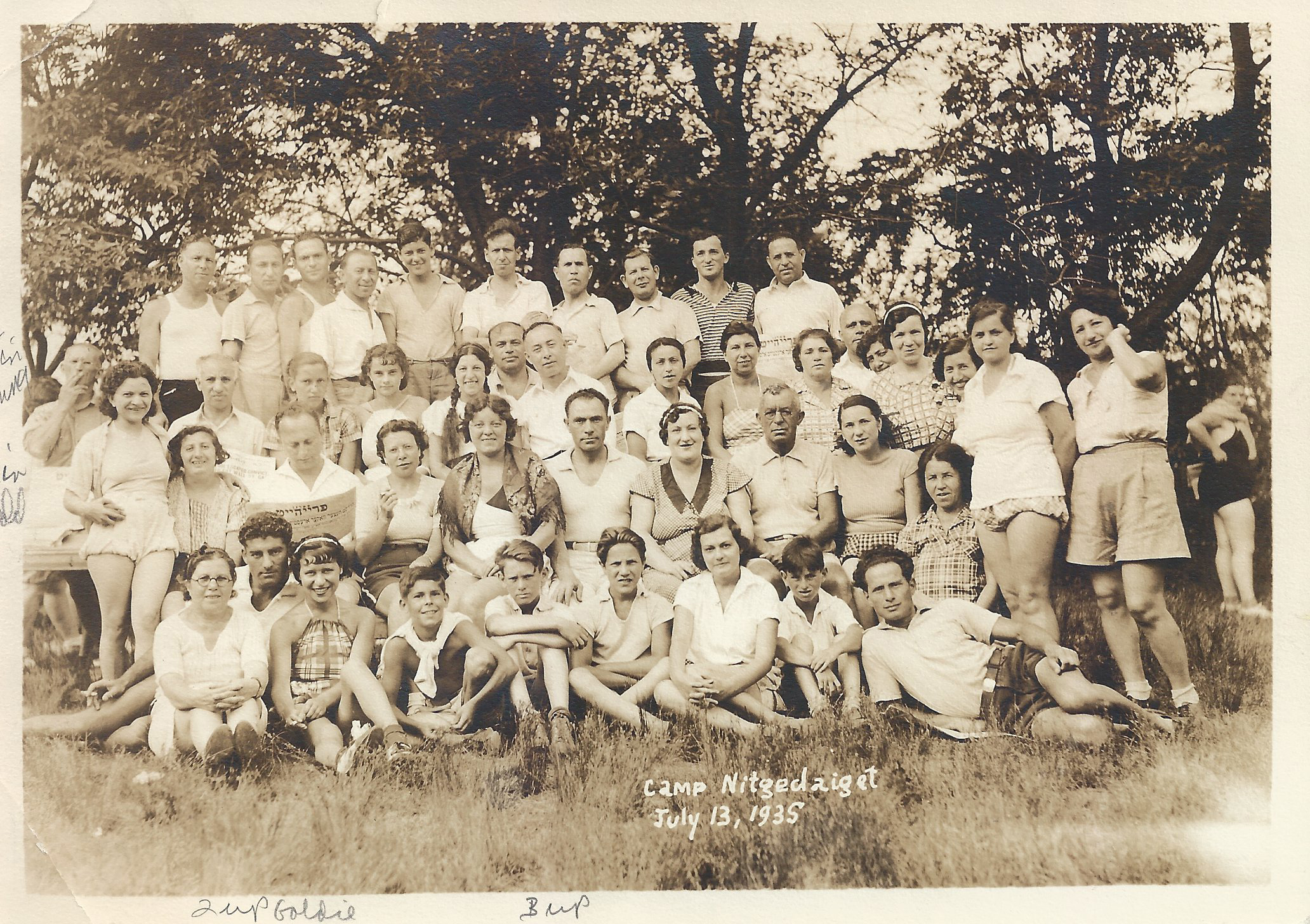
Far more than swimming, summer at Beacon, New York’s Camp Nitgedaiget, from a Yiddish phrase meaning “don’t worry,” one of a number of Communist-run retreats.
‘Nitgedaiget: A Cooperative Rest Home’ by Harry Bender from The Daily Worker. Vol. 5 No. 194. August 16, 1928.
White Collar Slaves in Wall St.; Pup Tents on the Hudson; the “Daily” in Need
Scene 1: Wall Street, 12.30 p.m., July 3, 1928. A crowd of workers—mostly white-collar slaves—fills the street. A man rises on top of an automobile. “Comrades and fellow-workers,” he begins. But before he can say much more, he is pulled down by a squad of police, kicked, manhandled and hustled off to jail. Some of the clerks in the crowd jeer and hiss the speaker.
And in the background, all over the broad United States, 110,000,600 people prepare to celebrate the birth of liberty in these same broad states. The man who had tried to make a speech in Wall Street also celebrates the birth of liberty—in jail.
Scene 2: The casino of Camp Nitgedaiget. Beacon, N.Y., 10.45 a.m., Sunday, Aug. 12, 1928. The casino is filled with workers of various trades. A man enters thru the doorway. Everyone rises spontaneously. Out of several hundred throats bursts in vigorous rhythm the song of freedom, the rallying cry of the workers of the world—the International. The man mounts the stage to loud cheers. “Comrades and fellow-workers,” he begins. It is the same man who only a little over a mouth before had tried to make a speech in Wall Street. But the speech he is making now is different, and his audience, though part of the same class, is different too.
***
The speech which Robert Minor, editor of the Daily Worker and Workers (Communist) Party candidate for United States senator, made at Camp Nitgedaiget last Sunday was fully as serious and important as the speech which he had unsuccessfully tried to make in Wall Street. Above the entrance of the Nitgedaiget dining-hall hung a huge sign: WELCOME ROBERT MINOR. Here in the casino the workers shouted welcome. But Minor had not come here for tributes and cheers and graceful phrases. He had come with a message for the workers at this workers’ camp, a message that was a call to duty to one’s class.
Minor told an old and ever-new story, the story of the financial struggles of the Daily Worker. It was a story which most of those present had probably heard before. Why bring this melancholy tale to people who are trying to forget their cares for a couple of weeks? This is Camp Nitgedaiget and Nitgedaiget means Don’t You Worry.
But the existence of the Daily Worker is not the concern of a single individual, but of an entire class. And this concern cannot be postponed for more convenient times. Bills are unpaid, the members of the staff have received no wages or only a small part of their wages for weeks in succession—the Daily Worker is fighting for its life. Workers, these are your bills that are unpaid, your comrades that are suffering because they have no money to buy the bare necessities, and it is your Daily Worker that is fighting for its life!
What will be your answer?
And the workers gave their answer in unmistakable terms. Two hundred and seventeen dollars was immediately raised in response to the appeals of Minor and A. Ravitch, business manager of the Daily Worker. Two hundred and seventeen dollars was the answer of Nitgedaiget on Sunday morning.
***
But this was not all of the answer of Nitgedaiget. In fact, only the beginning. Minor’s appeal for funds inaugurated Daily Worker Week at the camp during which every worker, both vacationists and camp employes, are expected to do their part towards keeping their class paper alive. There are 50 employes at the camp, all of them unionized, all of them working an eight-hour day and a six-day week.
The Workers (Communist) Party members among them have voted to contribute an entire week’s wages to the Daily Worker. And the non- Party employes will certainly not lag behind.
The Nitgedaiget Unit of the Workers (Communist) Party has taken charge of Daily Worker Week and has outlined a program of activity. Various games have been arranged and other play devices are being used to raise funds. Tomorrow will be Prohibition Day: certain activities and luxuries will be prohibited to the campers, and all those indulging will have to pay a tax to the Daily Worker. Judges have been elected from whose decisions there can be no appeal. Saturday will be literature day at the camp and a literature bazaar will be held under the direction of M. Bailin, agitprop director of the Nitgedaiget Unit.
And the Nitgedaiget dining-room is resplendent with signs. “This is Daily Worker Week, Camp Nitgedaiget Must Go Over the Top.” “Show Your Loyalty to the Soviet Union, Support the Daily Worker.” These and other slogans are keeping the vacationers from forgetting that this is Daily Worker Week and that they have a duty to perform.
***
Thus Camp Nitgedaiget plays its part in the struggles of the American workers. It is only on rare occasions such as the present that public collections are made. But thru other devices funds are constantly being raised for working class causes. And during the present summer the camp has contributed hundreds of dollars to miners’ relief and the Joint Defense.
Which is as it should be. There is no forgetting here where the workers rule, where we can sense that power that some day shall be ours.
No exploiters, no bosses, no police doing the dirty work of their masters. In this workers’ republic, where the camp manager, B. Cohen, is chief commissar, the strength of our class is everywhere palpable, giving strength to the great struggle that goes on around it on picket lines, in trade unions, in the political field.
***
Founded five years ago with a few pup-tents where workers came to spend their week-ends, Nitgedaiget has grown swiftly and can now take care of 790 campers, with accommodations for the winter, too.
The camp is constantly being improved and this year 73 modern bungalows supplemented the 300 tents, with bungalows scheduled to replace all the tents next year. And a camp that is run by and for workers necessarily does away with the profiteering and dishonesty of the commercial camps. Fresh food, lodging and a camp life that includes a variety of activities are provided for $17 a week—about half the rate of the “socialist” Camp Tamiment.
And there are activities such as can never be found at the commercial camps, activities in which the collectivist mass spirit predominates. Great emphasis is laid on the cultural expression of the working-class spirit. Every Saturday night a working-class play, written, performed and staged by the campers themselves, is produced under the direction of Jacob Mestel, director of the Freheit Dramatic Studio and an actor of many years’ experience. Plays such as these are unique in this country and their counterpart can he found only in the Soviet Union.
During the present season themes such as the coal strike, the elections and colonization in Soviet Russia have been dealt with in dramatic form. Last Saturday a satirical sketch, telling the story of the conversion of a camper who insists on worrying at the Don’t You Worry camp, was produced. This was written by B. Fenster, who is also the editor of the Camp Yat, the humorous weekly paper that is read every Friday night at the camp-fire.
And for those campers who can sing, or think they can, there is the chorus, coached by the musical director, L. Malamut, who numbers among his other accomplishments the ability to make an accordion sound almost like a symphony orchestra.
Athletics finds Yossel Rashkovich, the agile and spirited athletic director, keeping everyone, even the elderly and portly, on the move.
***
And Nitgedaiget has its own daily paper, edited and written almost entirely by Paul Novick, a member of the staff of the Freiheit, for several weeks and now by L. Talmy. the “Potcht,” as it is called, makes no pretence at competing with other Communist newspapers, but confines itself rigidly to life at Camp Nitgedaiget. It is a four-page, typewritten wall paper and every morning the campers may be found gathered in groups before the various places where it is hung up, reading and discussing the latest news. “The Potcht” is a complete newspaper, containing editorials, news stories, special articles and cartoons, with the light touch predominating. The editor gave evidence of his excellent news and political sense last Sunday when he devoted his leading editorial to the coming of Robert Minor to the camp.
Lectures are another important part of the cultural activities, and among those who have spoken at the camp this summer are Bert Miller, J.O. Bentall, Ray Ragozin and A. Markoff.
***
All these are class activities, part of the class struggle of the American workers. Nitgedaiget offers no escape from that struggle. The Daily Worker and Freheit, which together with the platform of the Workers (Communist) Party are sold during meals, as well as at the camp store, will not let the campers forget the battles of their class.
The camp activities, made of the very stuff of these battles, will not let them forget. And Daily Worker Week will not let them forget. For Nitgedaiget is determined to go over the top.
The Daily Worker began in 1924 and was published in New York City by the Communist Party US and its predecessor organizations. Among the most long-lasting and important left publications in US history, it had a circulation of 35,000 at its peak. The Daily Worker came from The Ohio Socialist, published by the Left Wing-dominated Socialist Party of Ohio in Cleveland from 1917 to November 1919, when it became became The Toiler, paper of the Communist Labor Party. In December 1921 the above-ground Workers Party of America merged the Toiler with the paper Workers Council to found The Worker, which became The Daily Worker beginning January 13, 1924.
PDF of full issue: https://www.marxists.org/history/usa/pubs/dailyworker/1928/1928-ny/v05-n194-NY-aug-16-1928-DW-LOC.pdf
 Revolution's Newsstand