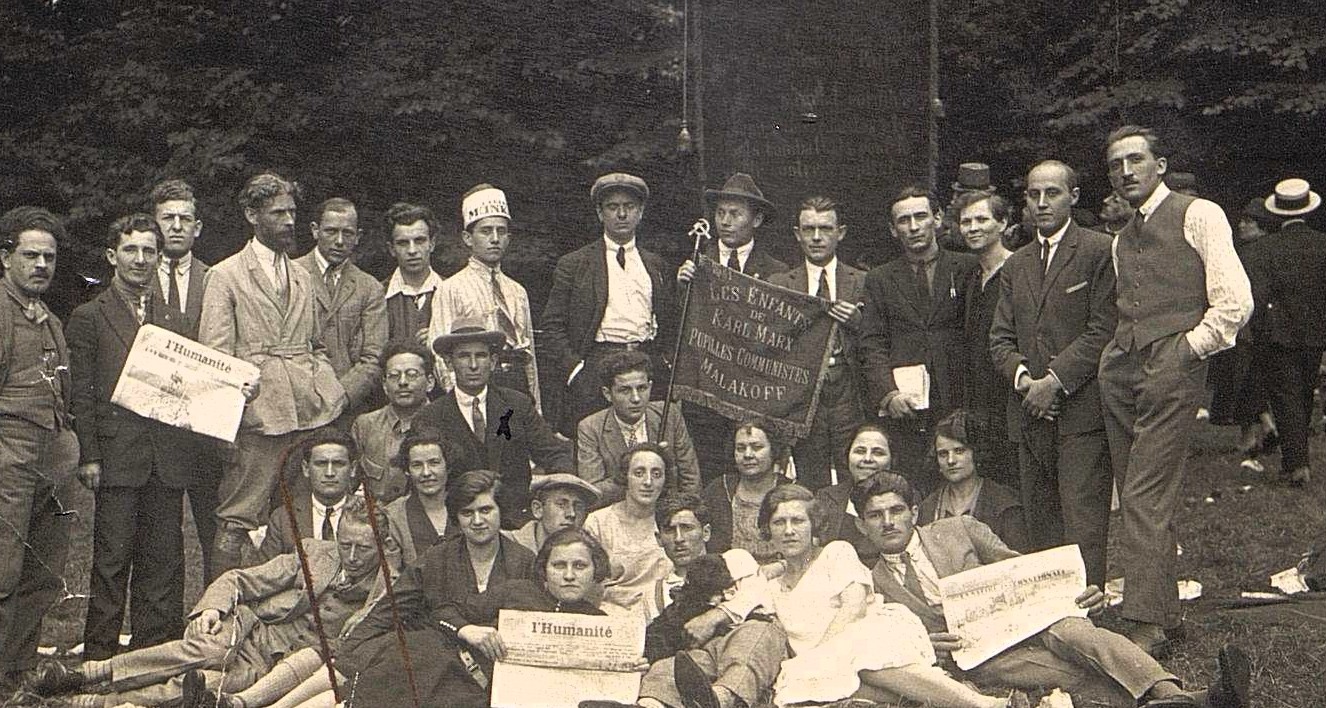
At the French Communist Party congress of January, 1923 the left-wing came to leadership and saw a turn from electoral work towards a rapprochement with Syndicalist currents and an orientation towards mass organizations, such as those of former soldiers. M. Mass looks back at the year as the Party met at Lyon for its Third National Congress during January, 1924.
‘A Year’s Work of the French Communist Party’ by M. Mass from the Daily Worker. Vol. 2 No. 24. April 14, 1924.
THE French Communist Party held its Third Congress in Lyon from January 20 to the 24th, and there some very important questions were discussed dealing with the future development of the French revolutionary movement. For the previous few months the entire party press had beer, opened for discussions, criticisms and suggestion by the rank and me. The letters published in the “Humanite” showed what great interest was manifested in the debates. Many ideas were advances to make the French party a real Communist Party of the masses.
Enormous progress has been recorded by the French party. The expulsion of the centrists headed by Frossard, Meric, and Paul Louis was balanced by the admission of such real revolutionists as Pierre Monatte, the well known former syndicalist leader, by Henri Barbusse, secretary of the “International Anciens Combattants,” by Andre Marty, the leader of the Black Sea revolt, by Lucien Midol and many others. They brought them revolutionary syndicalists and revolutionary ex-soldiers and sailors—and the party that for more than two years had been engaged in internal struggles turned its attention ranks in the struggle for the proletarian and energy towards organizing its interests.
The Occupation of the Ruhr.
The French section of the Communist International was given the task of propagating open revolt among the soldiers on the Ruhr. Due to the post-war position of France as a victorious nation, and to its great economic development, she became the most imperialistic country of Europe, the hope and the refuge of all counter-revolutionists. She was able to mobilize 700,000 men and send them into the Ruhr. Our answer to this was the international conference at Essen and the organization of hugs mars meetings all over France and even in the Ruhr district. As a result of this Communist activity there were instituted arrests of the best elements in the Communist Party and the “Confederation Generale du Travail Unitaire.” The old charge of plotting against the security of the state was the reason given.
Our party wag not discouraged by these arrests and in with the United Front policy, it organized mass meetings in collaboration with the C.G.T.U. and the “Association Republicaine Aneiens Combattants” throughout France, protesting against the invasion of the Ruhr and the arrest of our comrades. The pressure exerted by the French proletariat compelled the government to release these proletarian fighters, thus gaining the first victory of the year for the working class.
Great credit is due the French party for the organization of the Frankfort conference and while this conference was going on Comrades Hoellein and Peri were arrested for certain speeches in the House of the Syndicates. Again the French proletariat, led by the Communist Party, compelled the bourgeois state to free our comrades.
Revolutionary Political Action.
In its electoral campaigns the French section of, the Comintern never forgot its Communist mission. On all occasions the Party used the electoral tribune for propaganda purposes, and used workers who were class war prisoners as candidates for political office, such as; Marty, Badina, Midal, etc. These campaigns were truly carried on on the basis of the class struggle.
All the campaigns undertaken were successful from every point of view, especially in gaining the sympathies of the organized masses and bringing new elements into the party. Meetings were held for the defense of Matu and Nieolau, for Sacco and Vanzetti, and all class policy was utilized in campaigns in defense of the revolutionary outbreaks in Germany and in protest against the outrages of fascism.
Thus the watchwords of the Comintern were brought vividly before the great masses of the French proletariat.
The Syndicalist Movement.
By actively showing the workers in the syndicates the connection between the struggles on the economic war prisoners. The United Front and political fields our comrades succeeded in clearing away the old syndicalist ideas. By drawing examples from their daily struggles they showed the syndicalists the inherent bonds between the police, army, navy, and all the other apparata of the bourgeois state with the Comite des Forges, the bosses, financiers and other exploiters. Our comrades were successful in winning over to our side the great majority of the Confederation Generale du Travail Unitaire, which is a most important victory considering the wrong interpretations of the role of the syndicates prevailing among them for the past 25 years.
Our comrades in the Confederation Generale du Travail Unitaire are the vanguard of the communist-syndicalist forces that are forced to fight at every step the disrupters, the anarcho-syndicalist faction, which although a minority tries to cause a lot of mischief. They have succeeded in retaining the affiliation of the Confederation Generale du Travail Unitaire to the R.T.U.I. in spite of the tremendous efforts and the campaign of calumnies initiated by the agents of the so-called Syndicalist International. In the minds of the great masses our comrades are the only ones who thru their nuclei in the syndicalist movement are working with all energy towards bringing about unity between the Confederation General du Travail and the Confederation Generale du Travail Unitaire, thus restoring to the French proletariat its old fighting strength.
The Soldiers’ Organizations.
Thru the efforts of our nuclei in the Association Republicaine Anciens Combattants, of which Comrade Henri Barbusse is president, they have been able to develop this body into a real fighting organization of ex-soldiers. At every call of the Communist Party for a United Front this organization was always ready, thus bringing the ex-soldiers to the defense of the revolutionary movement. On armistice day the Association Republicaine Aneiens Combattants organized a parade headed by Comrade Vaillant Couturier, which marched thru the main boulevards of Paris and left the bourgeoisie in consternation.
The police were sent to stop this demonstration, but found that they had to deal this time with determined ex-soldiers ready to fight for their rights. Thus the working class learned that it could parade in spite of the police.
The Sports Organizations.
The French Communist Party realizing the importance of sports as a means of developing the youth physically and realizing the danger of leaving the working class youth at the mercy of professional bourgeois sport organizations, decided to instill into workers’ sports organizations the ideology of the revolutionary proletariat. After several months work in the Federation Sportive du Travail our comrades succeeded in getting this working class organization to affiliate itself with the Red Sports International. Today this organization publishes a bi-monthly paper called the “Workers’ Sports” and instead of losing its members as before, is gaining new members and soon hopes to become one of the greatest sports organizations of France.
The French Communist Party can do these things because it has its members wherever workers congregate. All workers’ organizations, such as the co-operatives, the locataires, etc., were penetrated and our comrades are the live forces in these bodies. They can be differentiated from the others by their enthusiasm and their devotion to the cause of the workers. In order to conduct all this work the Party developed a great press, which day by day is gaining the support of the majority of the workers.
The Communist Press.
The party press is centralized about its main organ, the “Humanite,” which is read by 200,000 workers daily.
In addition to the many organs of the Federations in the provinces, which themselves have many dailies and weeklies, the party publishes: “L’Ouvriere,” an organ for propaganda among women; “La Viox Paysanne,” organ of propaganda among the agriculture workers; “Bulletin Communiste,” the famous theoretical weekly edited by Comrade Boris Souvarin; “The Volktribune” of Metz is a German daily, and “The Humanite” in German is another daily published in Strasbourg. Another “Humanite” is printed in Italian every week, and in the Polish language there is a weekly, “Le Travailleur Polonais.” “The Workers’ Sports,” published by the Federation Sportive du Travail, and the “Vanguard” the organ of the Communist youth make up the list of the more important papers.
Besides the party press we have great influence over the “Clarte” thru its editor, Comrade Henri Barbusse. This is the outstanding organ of the Communist intellectuals.
With this press in hand and the efforts put forth by our comrades in the various organizations, the French party can look towards the future with confidence.
Last year they have demolished a great deal of influence exerted in former times by the social-democracy and by the Salutary decisions of the Lyon Congress the Party will forge the tools necessary for the destruction of the bourgeois state and the conquest of power.
The Daily Worker began in 1924 and was published in New York City by the Communist Party US and its predecessor organizations. Among the most long-lasting and important left publications in US history, it had a circulation of 35,000 at its peak. The Daily Worker came from The Ohio Socialist, published by the Left Wing-dominated Socialist Party of Ohio in Cleveland from 1917 to November 1919, when it became became The Toiler, paper of the Communist Labor Party. In December 1921 the above-ground Workers Party of America merged the Toiler with the paper Workers Council to found The Worker, which became The Daily Worker beginning January 13, 1924.
PDF of full issue: https://www.marxists.org/history/usa/pubs/dailyworker/1924/v02a-n024-apr-14-1924-DW-LOC.pdf
 Revolution's Newsstand