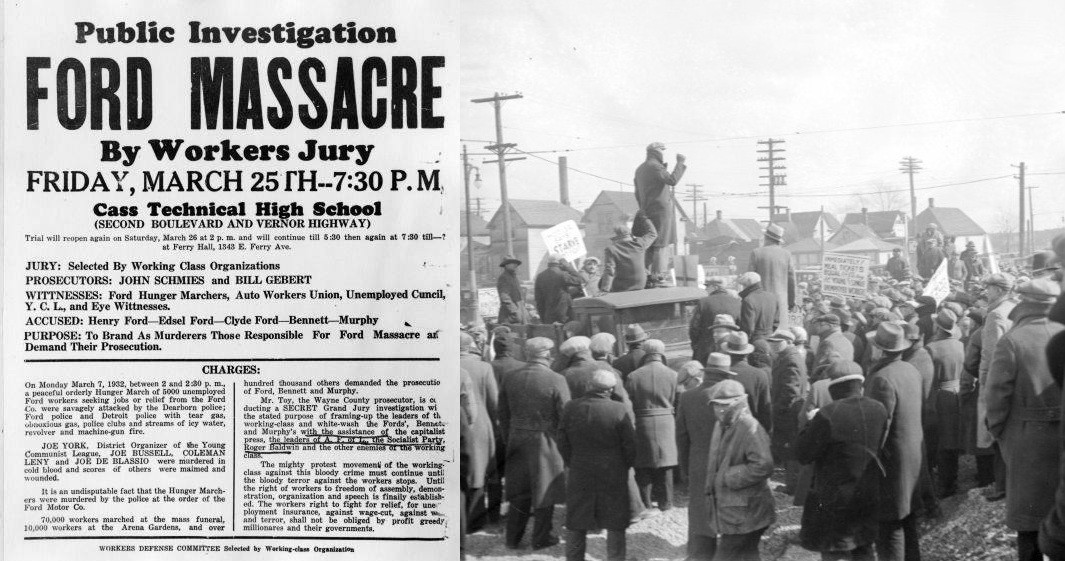
The work of organizing Ford’s massive Detroit-area plants in the aftermath of the March, 1932 Hunger March Massacre. The Party had 90 members at the Dearborn plant, with many hundreds more in the Detroit C.P. and Y.C.L.
‘The Work of the Communist Nucleus in the Ford Plant at Detroit’ by P.R. from International Press Correspondence. Vol. 12 No. 49. November 3, 1932.
Many of the social fascists “theoreticians” sing the praise of Ford as the inventor of a system of capitalist production which will lead to the elimination of capitalist crises through high wages and low prices for manufactured products. Ford himself in his books has boomed himself as one who is working for the welfare of mankind, who has set himself the aim of serving the public good instead of the aim of getting profits.
“Industry cannot exist for any specific class” wrote Ford, in the years of the “prosperity” of American industry in the book “To-day and To-morrow”.
In this book he wrote as follows on the principle of his system:
“To avoid a threatening depression, we must lower prices and raise wages. We think that it is a good business principle always to raise wages and never to lower them. There cannot be real prosperity in society as long as the workers who manufacture goods cannot consume them.”
But even in the period of prosperity, the Communists were well aware of the real situation in the Ford factories. Behind the relatively high wages was concealed the cruelest exploitation of the workers, converting them into physical wrecks after a few years of work.
That which the industrial process could not achieve was completed by a wide system of police espionage on the workers which literally embraced the whole of the existence of the worker, all his personal life. In the Ford plants, the slightest attempt at the class organisation of the workers was suppressed. Even members of the A.F. of L., this most reactionary organisation of all the social fascist unions, were not allowed to work.
But when the economic crisis came about, no trace was left of the legend of Ford’s heaven.
Before the crisis, 60,000 workers were employed in the Ford plant at Dearborn, near Detroit. Ford soon “forgot” his principles and threw tens of thousands of workers into the street. The unemployed from Ford’s plants do not receive any assistance and are literally starving. But Ford’s unemployed can sometimes avoid death from starvation by getting admitted into the Insane Asylum built by Ford. This Asylum is now crowded with unemployed whose only mental defect is hunger and homelessness. Such a situation has led to a rapid growth of indignation among unemployed and increased their readiness to fight. In March, a hunger march of the unemployed was organised under the leadership of the unemployed council. About 5,000 unemployed workers marched to Ford under the slogans: “Work for all dismissed Ford workers”, “The six-hour day without wage reduction”, “No bribery to get jobs”, “The right of the workers and the unemployed to organise”. Like all the hangmen of the working class, Ford replied to the demands of the unemployed with the machine guns of the police gangs in his pay. Four unemployed workers were killed and about 40 wounded.
A wave of indignation and hate swept through the broad masses of workers in Detroit as the result of this blood bath, carried out at Ford’s orders. Tens of thousands of workers participated in the protest meetings organised by the Communists. 70,000 went to the funeral of the murdered comrades. Under the influence of the powerful protests of the workers’ the town council was compelled to fire 150 police who took part in the shooting up of the hunger march. But Ford took them all on in his factory police and stated in the press that in future he would give a job to every policeman who was fired. In reply to the growth of revolutionary sentiments among the workers, Ford is again throwing hundreds of advanced workers out of the factory and is increasing espionage and all forms of terror.
At the present time about 25,000 workers are engaged at this plant in Dearborn, nearly all of them only for two or three days a week.
Having cut wages almost by 50%, Ford is preparing for new wage cuts, at the same time putting more and more young workers into the factory, paying them half the wages of an adult for the same work.
It would seem that exploitation and the intensification of labour at Ford’s plant had long since reached its maximum. However, Ford is taking advantage of the helpless situation of the workers and everyday is intensifying labour further.
In the plant, Ford gives the widest license to the foremen and managers with regard to the workers. Bribery for giving jobs, bribery for transfers to other work, etc., flourish in the factory. There are not even the most elementary. measures for the protection of labour, and along with the tremendous intensivity of the work, this leads to a rapid increase in the number of accidents which are very often fatal. A worker living in a town belonging to Ford is compelled to buy all he needs in institutions belonging to Ford, as a result of which his wages are cut still further–Ford’s prices on all articles of consumption are higher than in other places.
These are the conditions under which the Party organisation works in the Ford plant. It has about 90 members, most of whom are unemployed. The whole organisation is split into seven units directly connected with the Section committee of Dearborn. The units still work very badly. Their work at present consists of the distribution of the paper “The Ford Worker” which is published by the district party committee, holding meetings, distributing leaflets, etc. The Party organisation has to carry on a considerable part of its work illegally. The moulding shop unit attempted to organise open mass meetings. But as a result, the police and the spies at these meetings discovered the most advanced workers who were immediately fired. Then the unit made a correct decision to organise small illegal meetings which give a better result. At the Ford Plant there is a branch of the revolutionary union of automobile workers. However, owing to the poor leadership by the Party organisations, the union shows very little activity. Educational work is still badly carried on among the Party members.
The existing situation in Party work at the Ford Plant requires immediate and definite improvement. The Ford Plant is one of the biggest industrial undertakings and the development and the struggle of the workers in this plant is of tremendous importance for the whole labour movement of the U.S.A. This alone justifies us in considering the leadership of the Party organisations in the Ford plant by the district Party committee of Detroit to be very poor. In essence, the District Committee has not yet started concentration work in this plant, though the decision of the C.C. C.P.U.S.A. on this matter was made more than a year ago.
The poor contacts of the District Committee with the units at the Ford Plant, failure to organise the systematic leadership of the nuclei by the Dearborn section committee, insufficient attention to the utilisation of such an important factor as the paper “The Ford Worker” which has been published for several years, shows that the District Committee is not fulfilling its basic task of the reconstruction of Party work in the sense of the greatest possible strengthening of the work in the big factories, on the basis of personal instruction and the establishment of personal contacts with the Party organisations of the Ford Plant.
However, some measures of Party leaders have been successful in Dearborn. The District Party committee achieved great work by mobilising the masses for a protest against the shooting down of the hunger march of Ford workers. In spite of all the persecutions of the police and the raging white terror the District Committee properly utilised all the forces of the Party organisation and set an example of militant work. Tens of thousands of workers and unemployed who took part in the meetings and demonstrations under the leadership of the Party organisation, swept away the police terror, showing that wherever the movement extends to really broad masses, the bourgeoisie are unable to paralyze this movement by persecution and even by shooting. The district. committee at the time of this revolutionary upsurge correctly directed the masses towards the formation of their class organisation. Over a thousand workers applied to join the Automobile Workers Union, hundreds joined the Y.C.L. and the Party. This shows that the Ford plants contain a good field for Communist activity. The district committee was unable to consolidate the first successes of the Party organisation by continuous work. For example, there is no justification for the fact that for two months the district committee has not awakened the trade union, has not organised workers meetings of the workers who applied to join the red trade union. As the result of this delay and organisational laxness, most of the new members were lost.
In order to bring about a decisive change in Party mass work in the Ford plant there must be an immediate reorganisation of the work of the district party committee so that in practice there will really be concrete leadership of the Party work at the factory. The district committee must regularly discuss the situation at the Ford plant, even if only once a month, jointly with the Dearborn Party committee and in addition it must be constantly acquainted with all that is taking place in the working masses and must carefully check up the execution of decisions on work in the factory. At these meetings, there must be a detailed discussion of the contents of the current number of the “Ford Worker”, and the question of improving its distribution among the workers at the plant. An urgent question is the formation of a group of activists around the paper, a network of worker correspondents and the organisation of a broad editorial board consisting of representatives of the factory units and the most advanced non-Party workers, the more so because the district committee long since made a decision on this simple but necessary measure. Simultaneously the Dearborn Section committee must be reorganised so that in practice it will be a Party committee for the units in the Ford Plant. In particular it is impermissible that the Secretary of this Section committee, instead of spending all his time on the guidance of the work of the nuclei in the factory, travels around the district committee to carry on the election campaign. All the departments of the district committee and the fractions in mass organisations must seriously turn their faces towards the Ford plant, reorganising their work in such a manner that the contacts and the guidance of the work in the factory will be their main task. It is quite impermissible for the agitprop of the district committee not to have personal contacts with the members of the units in the Ford plant who are appointed to carry on political educational work.
In carrying out these organisational measures, the district committee together with the Party units in the factory and through the fraction in the Auto Workers Union, must call a series of meetings with non-Party workers to prepare a concrete programme of demands for the workers in the plant, including all the urgent and burning demands. of the workers. As one of the chief slogans of struggle for the Ford workers must be advanced the slogan of the right of Ford workers to organise as the first condition for a struggle against wage cuts, and other urgent demands of the workers.
The task of the District Committee and the unit in the factory is persistent energetic work to break down the fascist regime in the factory without regard to formal organisations as it deprives the workers of the possibility of having legal organisations.
In this matter, the primary task is the strengthening of the Auto Workers Union. The most extensive work must be continually carried on among the masses on the necessity of strengthening the union. The paper and special leaflets must be published on the struggle for the Auto Workers Union. The main task in this campaign is to make the union immediately increase its activity in the struggle for the everyday needs of the workers, in the struggle against bribery and the arbitrariness of the foremen, for the protection of labour against accidents, for social insurance for the unemployed at the expense of Ford, etc.
The units in the Ford Plant are not doing any work in the few organisations formed by Ford for the workers, such as Sport clubs, Schools to train workers for the factories, etc. The units in a way are hypnotised by the all powerfulness of the Ford spy system and do not try to get into them. Of course the conditions of work are unusually difficult, but there are no conditions which cannot be overcome by using proper Bolshevik methods of work among the masses. Lenin tirelessly taught the Bolsheviks to go everywhere, to penetrate everywhere where there are masses, and by following out these instructions, the Bolsheviks broke through the framework of the Tsarist regime and won influence among the masses. There is no other path for the work of the units under the conditions existing in Ford’s Plants.
While doing everything possible to carry on work in every organisation in the factory formed by Ford and his agents and where the masses are to be found, it is necessary to form all kinds of legal and semi-legal organisations in
Dearborn around the factory, and in Detroit where the workers live. This must be done with the same persistence and flexibility on our own initiative, through sympathizing workers and through the intelligentzia. The organisation of language groups is a specially available form of mass work. To some extent such organisations already exist among the workers, e.g., Ukrainian, Rumanian and Polish. But the Party organisation pays too small attention to them. Beside the language organisations there should be formed all kinds of cultural and educational circles, societies for recreation, etc. which will enable the Party to get nearer to the masses. All these organisations will help to break through the existing regime and will help the work among the masses to a tremendous extent.
It is urgently important to increase the work among the unemployed in Dearborn. The opinion which exists among some Party members that Ford restrains the unemployed with the illusion that he will soon give them a job, only hinders the activity of the revolutionary organisations. If the Party organisations only seize on the most burning question, possibly even the most petty needs of the unemployed at Ford’s, and begin to organise the masses on the basis of a struggle for these demands, success is assured.
International Press Correspondence, widely known as”Inprecorr” was published by the Executive Committee of the Communist International (ECCI) regularly in German and English, occasionally in many other languages, beginning in 1921 and lasting in English until 1938. Inprecorr’s role was to supply translated articles to the English-speaking press of the International from the Comintern’s different sections, as well as news and statements from the ECCI. Many ‘Daily Worker’ and ‘Communist’ articles originated in Inprecorr, and it also published articles by American comrades for use in other countries. It was published at least weekly, and often thrice weekly. Inprecorr is an invaluable English-language source on the history of the Communist International and its sections.
PDF of full issue: https://www.marxists.org/history/international/comintern/inprecor/1932/v12n49-nov-03-1932-Inprecor-op.pdf
 Revolution's Newsstand