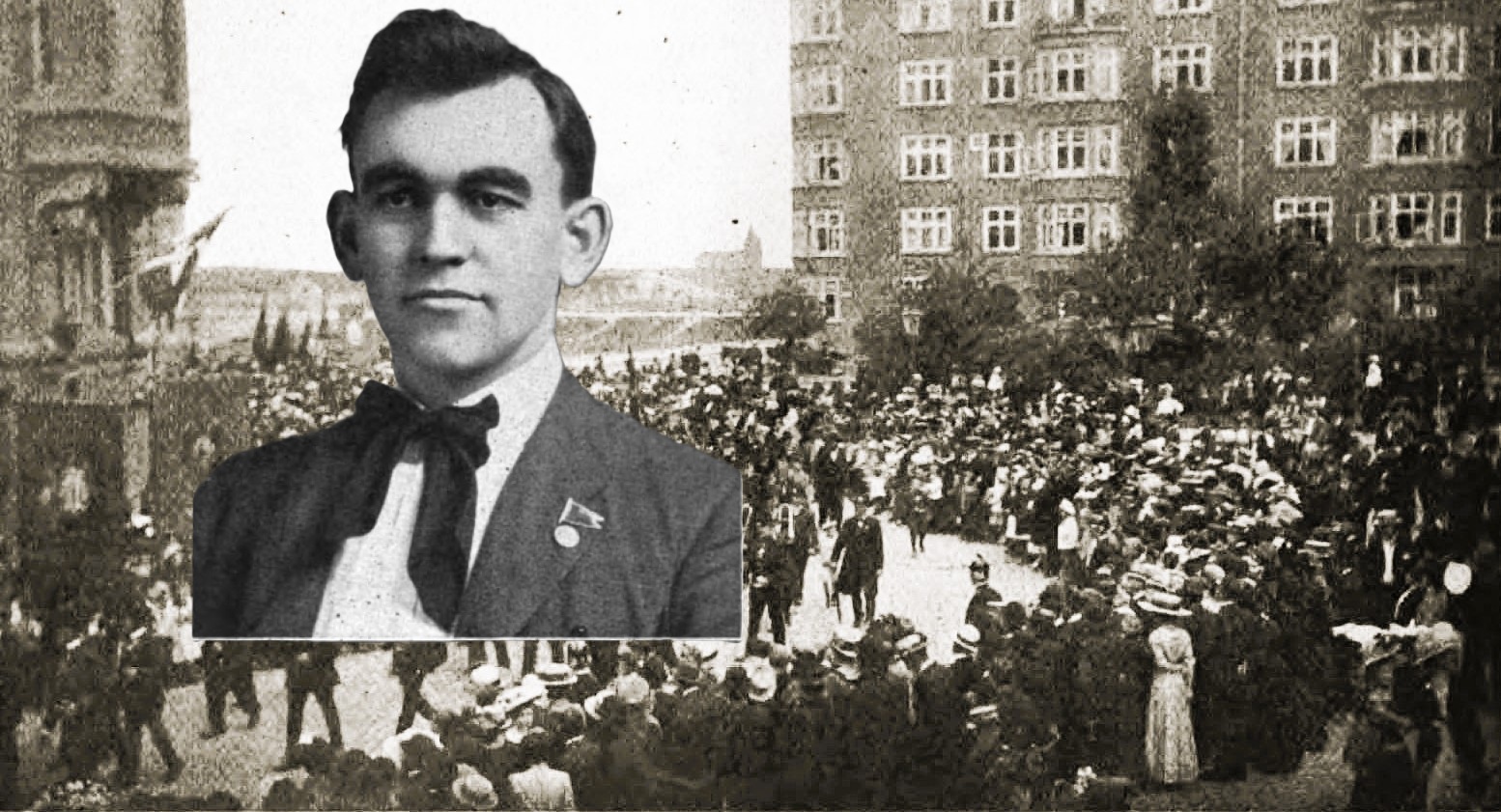
True to his word, Tom Mooney, the winner of Wilshire’s Magazine contest and a trip to the International Socialist Congress, reports home to comrades from Copenhagen.
‘The Eighth International Socialist Congress’ by Thomas J. Mooney from Wilshire’s Magazine. Vol. 14 No. 10. October, 1910.
Winner of Second Prize in the Wilshire “Round the World Contest.
On Sunday, August 28, the Eighth International Socialist Congress met in the beautiful city of Copenhagen at the great Concert Palace, the finest of its kind in the city, and only two blocks distant from the palace of the Danish king.
It seemed to me that though in some respects this Congress marked an epoch in the International Socialist movement, in others it was somewhat disappointing.
The manner in which the work of the Congress was conducted left nothing to be desired, the organization was almost perfect, the proceedings being carried out deliberately, systematically and thoroughly.
However, no new policies were inaugurated, nor was there any change of methods or tactics suggested for the emancipation of the proletariat. It seemed to be the general opinion that those now in use were sufficient, at least for the present.
The proceedings at the Concert Palace opened at 10 A.M. with almost nine hundred delegates, representing practically every civilized country on earth. An orchestra of sixty pieces—the best of its kind in Copenhagen—furnished the music for the occasion. Five hundred Danish workingmen sang in chorus the cantata composed by A.C. Myers, a member of the Social Demokraten staff—the greatest Socialist paper in the kingdom—finishing their part by the singing of the “Internationale,” the Marseillaise of the modern proletariat. The music and singing was tremendously inspiring, and was, judging by the applause it received, thoroughly appreciated by the delegates and visitors.
Two members of the Danish Riksdag, as the parliament of that country is called, welcomed the delegates and visitors to Copenhagen. These were Gustav Bang and Theo. Staunning, both well-known and prominent figures in the Danish movement. These comrades dealt mainly with the progress of Socialism in Denmark, pointing out that the class struggle there grows more bitter every day. In 1871 there was neither propaganda nor movement in Denmark, and no working class organization of any kind. Now they have twenty-eight Socialist members in the Riksdag out of a total of 114, and at the last election polled over 100,000 Socialist votes, while the total population of the country is only about two and a half millions. Their daily paper, Social Demokraten, had a circulation of 60,000, which was much larger than that of any other paper in the country, while the subscriptions to all Danish Socialist papers exceeded 120,000. Denmark also could show 100,000 organized trade unionists. The speakers in concluding their welcome, hoped that the proletariat of the world represented at this Congress would continue the methods and tactics that had brought such great results to the Socialist movement, and ever try to improve and strengthen them for the solidification of the confederated workers of all lands.
The opening address was then made by Emile Vandervelde of Belgium, one of the most eloquent European Socialists. The Congress adjourned for the day, and a monster procession which had been organized, and which contained not less than 60,000 people, started from the center of the city to an outlying park, where speeches were delivered by many of the most eloquent delegates from different countries, interspersed with music and song.
Next day the Congress devoted its time to the testing of the mandates and constitutions of the Commission, each section appointing delegates for the different commissions. On the day following, the commission met and selected reporters for presenting their reports. On Monday and Tuesday, August 29 and 30, there were inter-parliamentary meetings, and every morning at 9 A.M. the International Bureau met. On the day following the delegates were the guests of the Danish comrades on an excursion to Skodsberg, about two hours by steamer. The “Tivoli,” Copenhagen’s finest amusement garden, was thrown open free of charge to the delegates during the Congress sessions, and all public institutions were also open for their inspection. On the three following days the Congress received the reports and resolutions of the various commissions, many of them being rather lengthy. The report on the unemployed question received the greatest attention and criticism, while anti-militarism came a close second. A resolution presented by Keir Hardie, an English delegate, in favor of the general strike in time of war, was laid over to be taken up at the next Congress. There was a spirited passage between the German delegate Ledebour and Ramsay McDonald, a British delegate of the Independent Labor Party. Ledebour scored the Labor Party for their action in supporting the recent Budget which called for increased war expenditure and declared that all Socialists in the various Parliaments should universally vote against such appropriations.
The Congress closed on September 3 amid scenes of great enthusiasm. Delegate Adler of Austria made an appropriate expression of thanks when the Congress decided that its next meeting should be held in Vienna in 1913.
Molkenbuhr of Germany. Hillquit of the United States, Jaurés of France, and Vandervelde, the Belgian delegate, made the closing speeches, all paying grateful tribute to the efforts of the International Secretary, Huysmanns, and the hospitality of the Danish comrades to the visiting delegates,
That evening the City Hall, one of the finest modern buildings in Europe, was a scene of unparalleled festivity. A standing supper was served, beautiful music and singing from the best artists in Copenhagen and short addresses from most of the noted delegates. The evening closed with dancing and general merriment, and many were heard to declare that the occasion was the greatest of its kind that had ever been held.
Every one present was inspired with greater hope and energy to work harder for the cause of Industrial Freedom which all Socialists hold dear, and in this respect perhaps the Congress can be regarded as thoroughly successful.
Wilshire’s Magazine began as The Challenge, and was one of the most successful Socialist publications in U.S. history. Personally published by Gaylord Wilshire (of Wilshire Blvd. fame) in Los Angeles the magazine, like the Appeal to Reason, was aligned, but independent of the Socialist Party, and not on its ‘Marxist’ wing, its politics more closely resembled the Appeal’s Populism, although it was increasingly sympathetic to industrial unionism putting it at odds with the Party’s right.
PDF of full issue: https://www.marxists.org/history/usa/pubs/wilshires-mag/v14-17-1910-1915-Wilshires-Mag.pdf
 Revolution's Newsstand