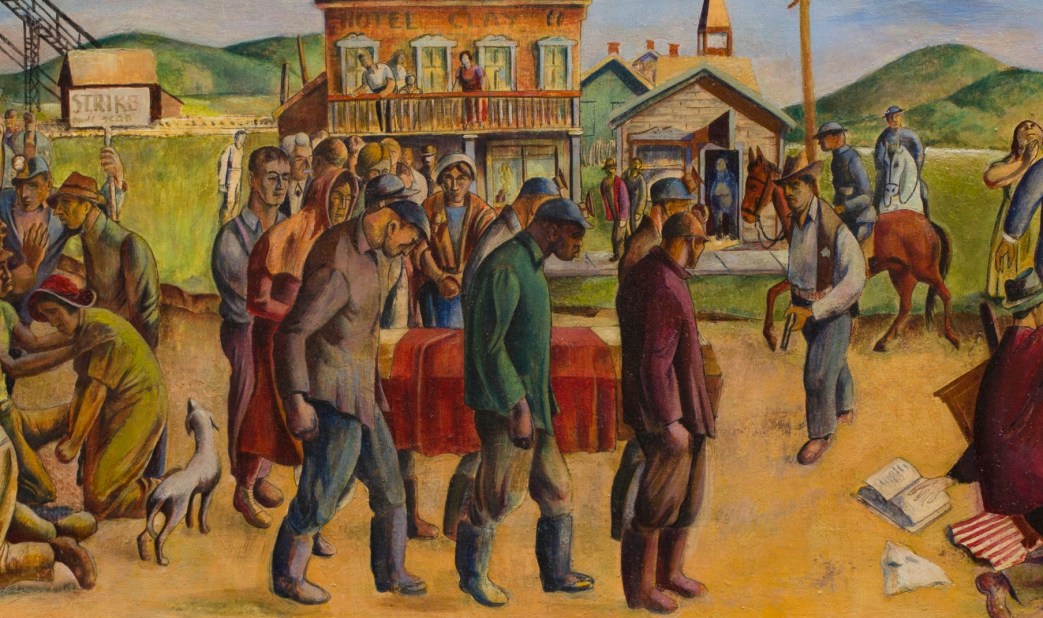
Clarence Weinstock on Walter Quirt’s early work.
‘The Paintings of Walter Quirt’ by Clarence Weinstock from Art Front. Vol. 2 No. 5. April, 1936.
EASEL painting worries the revolutionary artist. Given the present gallery system, it has fewer communicative chances, if only from a material point of view, than any other form of art, mural, graphic, or even sculpture. Appealing generally to more limited and “experienced” audiences, the painter must exert his imagination in a way calculated to satisfy them. That way is. somewhat different from the method employed by his fellow artists. He may use devices developed in the course of modern scientific discovery, or he may try a technique which resembles literary experiments of the day. The bourgeois critics will of course comment on his sophistication. Is this art for the working class? They will be pleased to announce that Quirt’s technique has more in common with surrealism than with revolution. They are wrong as usual. It never occurs to the bourgeois that a revolutionary does not confine himself to the lowest common denominator of Cultural development, that he is interested in everything that goes on in the world today, in physics, anthropology and psythology as well as in the class struggle. He is a merciless marauder, taking anything of value that he can lay his hands On. And so if he has an audience that requires the riches of science and poetry, he will be able to supply them.
Quirt has begun to do this. In his recent show at the Julien Levy gallery he has broken away from his former rather uninteresting stylization of strike conflicts, war scenes and the like. Half way between realism and an old fashioned symbolism, those works might move one only in the degree that they were reminiscent of actual struggles, as the name, Lenin, spoken oratorically, might arouse feeling. They created nothing new, but only stiffened and denatured the events they dealt with.
In his present painting Quirt abandons this cautious and obvious technique. He starts from the symbol of the Waste Land which has touched all of modern poetry and at least half of contemporary painting. This devastated landscape is peopled with victims and modern monsters. Masked figures, vast skulls on foetuses, headless gentlemen with top hats, floating through the air, a body with hundreds of wounds and sores firing a cannon, squash-like heads and classical statues that send Negroes to the electric chair, these move like instruments of torture over a starved and tormented population. In one picture use is made of the old proverb idea which intrigued Breugel.
Sayings of the people are given new or reversed interpretations having political or social point. Quirt takes the hackneyed American virtues to how they are caricatured in practice, the starved saving money, the half dead worker kissing the boss’s feet, virtue reduced to a chemise.
However, the landscape of Quirt differs greatly from that of the modern bourgeois poets. Torment is not merely “in the air,” a spiritual bane which dries up the rivers. No one expects release by the mysterious touch of a fisher king. Here the enemies are known, the bankers, the generals, the officials of firms. The parched earth gives way to ploughed under crops. Tiresias is evicted from his farm. Five flying Jehovahs won’t give the people bread, And the fisher king, the prince, has been replaced by an angry farmer and an armed worker.
Quirt owes really little beyond suggestions to the surrealists. As a craftsman, he has looked at the Florentines and Siennese, some at Mantegna. (The composition gets too crowded at times, giving or reinforcing an impression of banality of idea). If he dreams it is not after an induced reduction of the intelligence, but over manifestos and resolutions. He is interested in socialist poetry.
Art Front was published by the Artists Union in New York between November 1934 and December 1937. Its roots were with the Artists Committee of Action formed to defend Diego Rivera’s Man at the Crossroads mural soon to be destroyed by Nelson Rockefeller. Herman Baron, director of the American Contemporary Art gallery, was managing editor in collaboration with the Artists Union in a project largely politically aligned with the Communist Party USA.. An editorial committee of sixteen with eight from each group serving. Those from the Artists Committee of Action were Hugo Gellert, Stuart Davis, Zoltan Hecht, Lionel S. Reiss, Hilda Abel, Harold Baumbach, Abraham Harriton, Rosa Pringle and Jennings Tofel, while those from the Artists Union were Boris Gorelick, Katherine Gridley, Ethel Olenikov, Robert Jonas, Kruckman, Michael Loew, C. Mactarian and Max Spivak.
PDF of full issue: https://www.marxists.org/history/usa/parties/cpusa/art-front/v2n05-apr-1936-Art-Front.pdf
 Revolution's Newsstand