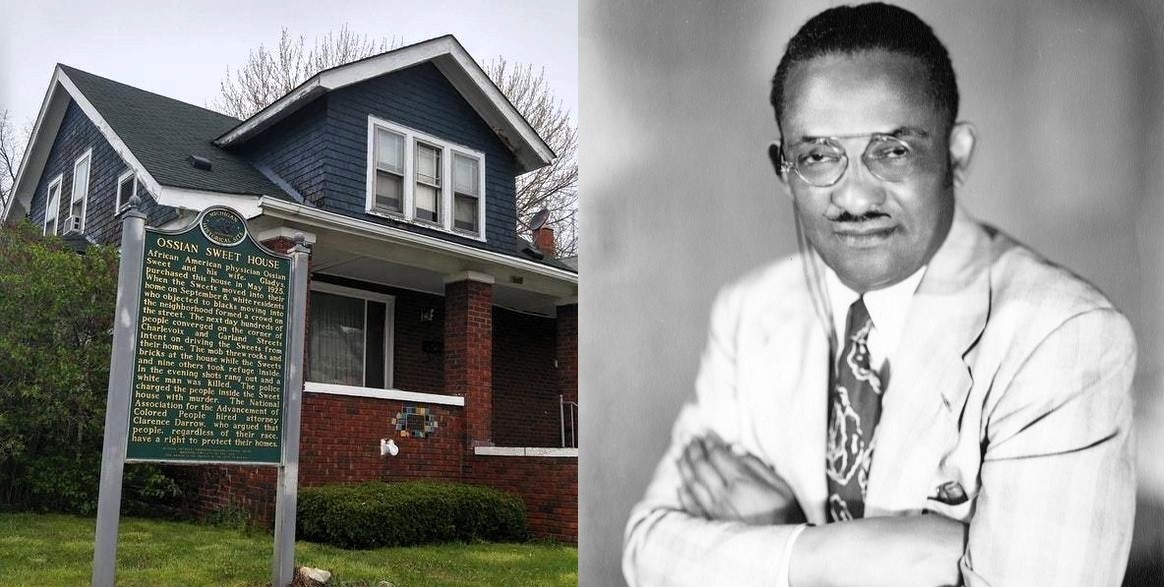
Detroit ‘Sweet Case,’ which saw a Black doctor and his relatives successfully defend their home against a white mob in 1925, became one of the seminal civil rights cases in the North. Defended by Clarence Darrow, eventually all of those charged would be acquitted or have charges dismissed. Also important for the history of our movement, Sweet would later be the doctor who delivered League of Revolutionary Black Workers founder General Baker when born.
‘Dr. Sweet Related Efforts of K.K.K. to Terrorize His Race’ by C. O’Brien Robinson from The Daily Worker. Vol. 3 No. 4. January 16, 1926.
Dr. Ossian H. Sweet of Detroit, Mich., this week told a Chicago audience of his experiences during the time of his case with ten co-defendants indicted for murder in the first degree following a race clash In Detroit in which one white man was killed and one wounded.
In Detroit about five years before the world war there were not over 6,000 Negroes. At that time there was no racial friction and the slogan of the Negroes was–, “Detroit, the place where life is worth living.” With the post-bellum exodus of Negroes from the south, approximately 60,000 were added to Detroit’s population and spread thruout the residential sections of the city. The Negroes, however, were not the only ones to invade Detroit. With them came thousands of southern “crackers” with their doctrines of prejudice, racial separatism, and mob psychology. Now there are in Detroit 800,000 southern whites of various classes, but all under the influence of southern ruling class race hatred, which was soon reflected in the growing strength of the ku klux klan.
Kluxers Hold Political Power.
The ku klux klan soon began to assert political power and the entire police department (approximately 90%) became “klan.” Many of the public office holders were kluxers and the spirit of “100% Americanism—white supremacy” became the spirit of Detroit.
Mob Ran Out Dr. Turner.
The first real issue to grow out of the development of residential segregation effected by the “block agreement” or the agreement of a group of whites living in a certain neighborhood to neither “sell nor rent property to Negroes” or permit them to occupy premises within that given territory for “a period of 21 years.”
A Negro physician, Dr. Turner, purchased a home in one of the “forbidden” blocks and moved in. Then the K.K.K. and their agents threatened him, and finally formed a mob and stormed his house. They destroyed everything they could lay their hands on; threw coal into the windows; and, with a threat of death, forced Dr. Turner to sign a statement to the effect that he would leave the premises immediately. Unfortunately Dr. Turner became frightened and complied with their request. This set up a precedent which made the kluxers feel that they had the right method for “bluffin’ ’em out.” They tried it again. This time the victim was a woman with a newborn baby. However, the “protection of womanhood” again scored with their terror.
“Once too Often.”
At this time Dr. Sweet had already bought his home and was ready to move in. In spite of the unpleasant experiences of the Negroes who had attempted this before him, Sweet believed that It was Ibis home and he would live in it. Immediately after he moved in, the white neighbors began to protest. Women and men went thru the streets attempting to stir up the mob spirit. The wife of the man killed during the clash was seen running up and down the street shouting, “You are not men if the permit this ‘n***r’ to live here.” A meeting was held that night and the plan for attack was completed for the following night.
Dr. Sweet and a few of his relatives and friends determined to stand their ground. The mob gathered and stormed his home. Shots were exchanged. One white man was killed and one wounded. It was not known whether the dead man was a victim of a shot from within the house or from without. However, when he fell, the mob changed their minds about “bluffin’ ’em” and ran to cover. Soon the kluxer police, having to their credit the record of having killed 80 Negroes “wantonly and willfully” during the period between January and December, 1925, arrived on the scene, and lined up the eleven Negroes. They were taken before Judge Faust and indicted for murder in the first degree.
After the case was presented the defense compelled the state to present a bill of particulars, which they utterly failed to prove! The witness for prosecution made a miserable attempt even to prove that there was no mob gathered at all. Attorney Clarence Darrow “wound them up” and made their testimony ridiculous. One amusing point in the trial was indicated by Darrow when seventy witnesses swore that only about ten or twelve were in front of the house.
The testimony of Dr. Sweet covering a period of three days was the most interesting point of the trial. Dr. Sweet painted the picture of the racial persecution of the Negroes from their early slavery to the present day.
K.K.K.’s Cause Jury to Disagree.
As Dr. Sweet, in a personal interview with me stated, the presence of four klansmen on the jury accounted for the disagreement of the jury resulting in a “mistrial.” The case will come up sometime in the future, and the defendants are released on bail.
Dr. Sweet said: “I do not know how the new trial will come out, but I am confident of victory. I know that we are right.”
The Daily Worker began in 1924 and was published in New York City by the Communist Party US and its predecessor organizations. Among the most long-lasting and important left publications in US history, it had a circulation of 35,000 at its peak. The Daily Worker came from The Ohio Socialist, published by the Left Wing-dominated Socialist Party of Ohio in Cleveland from 1917 to November 1919, when it became became The Toiler, paper of the Communist Labor Party. In December 1921 the above-ground Workers Party of America merged the Toiler with the paper Workers Council to found The Worker, which became The Daily Worker beginning January 13, 1924.
PDF of full issue: https://www.marxists.org/history/usa/pubs/dailyworker/1926/1926-ny/v03-n004-NY-jan-16-1926-DW-LOC.pdf
 Revolution's Newsstand