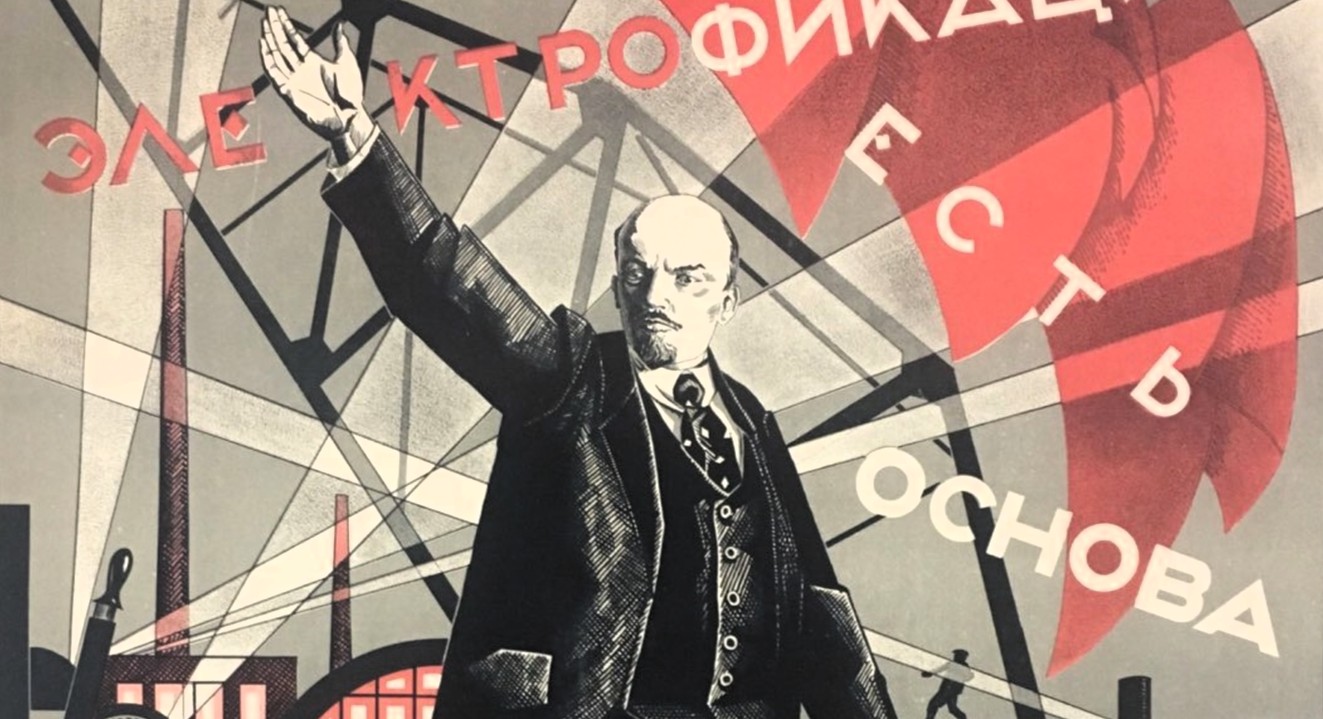
Lenin offers thoughts the goals of communist labor, and the difference between those goals and the first steps towards them taken in the transition period opened up by the Russian Revolution.
‘From the Destruction of the Ancient Social System to the Creation of the New’ (1920) by V.I. Lenin from Selected Works, Vol. 10. International Publishers, New York. 1937.
Our newspaper is devoted to the problem of Communist labour.
This is a very important problem of the construction of Socialism. First of all we must be very clear on the point that this problem could only be raised in a practical manner after the proletariat had captured political power, only after the landlords and capitalists had been expropriated, only after the proletariat, which had captured political power, had achieved decisive victories over the exploiters who had organised desperate resistance, counterrevolutionary rebellions and civil war.
In the beginning of 1918 it seemed that that time had arrived, and it did indeed arrive after the February (1918) military campaign of German imperialism against Russia. But that period was so short-lived, the new and more powerful wave of counter-revolutionary rebellions swept over us so quickly, that the Soviet government had no opportunity to devote itself at all closely and persistently to problems of peaceful construction.
Now we have passed through two years of unprecedented and incredible difficulties of famine, privation, and suffering, simultaneously with unprecedented victories of the Red Army over the hordes of the international capitalist reaction.
Now there are serious grounds for hoping (if the French capitalists do not incite Poland to war against us) that we shall get a more durable and longer peace.
During the two years we obtained some experience in construction on the basis of Socialism. That is why we can, and should come right down to the problem of Communist labour, or rather, it would be more correct to say, not Communist, but Socialist labour; for we are not dealing with the higher, but with the lower the primary stage of development of the new social system that is growing out of capitalism.
Communist labour in the narrower and stricter sense of the word is labour performed gratis for the benefit of society, labour performed, not as a definite duty, not for the purpose of obtaining a right to certain products, not according to previously established and legally fixed rates, but voluntary labour, irrespective of rates, labour performed without expectation of reward, without the condition of reward, labour performed out of a habit of working for the common good, and out of a conscious realisation (become a habit) of the necessity of working for the common good—labour as the requirement of a healthy body.
It must be clear to everybody that we, i.e., our society, our social system, are still a very long way from the broad, genuinely mass application of this form of labour.
But the very fact that this problem has been raised by the whole of the advanced proletariat (the Communist Party and the trade unions), and by the state, is a step in this direction.
In order to reach the big thing we must start from the little one.
And on the other hand, after the “big thing,” after the revolution which overthrew capitalist private ownership and placed the proletariat in power, the construction of economic life on the new basis can only start from the little thing.
Subbotniks, labour armies, labour service—such are the various forms of Socialist and Communist labour.
There are still numerous defects in this. Only those who are totally unable to think, not to speak of the champions of capitalism, can make shift with jeers (or abuse) at them.
Defects, mistakes, blunders in such a new, difficult and great task are inevitable. He who is afraid of the difficulties of building Socialism, he who allows himself to be scared by them, he who drops into despair or cowardly consternation, is no Socialist.
The work of creating a new labour discipline, of creating new forms of social ties between men, of creating new forms and methods of getting people to work, must take many years and decades.
It is work of the noblest and most grateful kind.
It is our good fortune that, after overthrowing the bourgeoisie and suppressing its resistance, we were able to win for ourselves the ground on which this work has become possible.
And we will set to work with all our might. Perseverance, persistence, preparedness, determination and ability to test a thing a hundred times, to alter a thing a hundred times and to achieve the goal, come what may—these are the qualities that the proletariat has acquired in the course of the ten, fifteen, twenty years that preceded the October Revolution, that it acquired in the course of the two years that have followed this revolution, while suffering unprecedented privation, hunger, ruin and destitution. These qualities are the guarantee that the proletariat will conquer.
April 8, 1920
PDF of full issue: https://archive.org/download/selected-works-vol.-9/Selected%20Works%20-%20Vol.%209.pdf
 Revolution's Newsstand