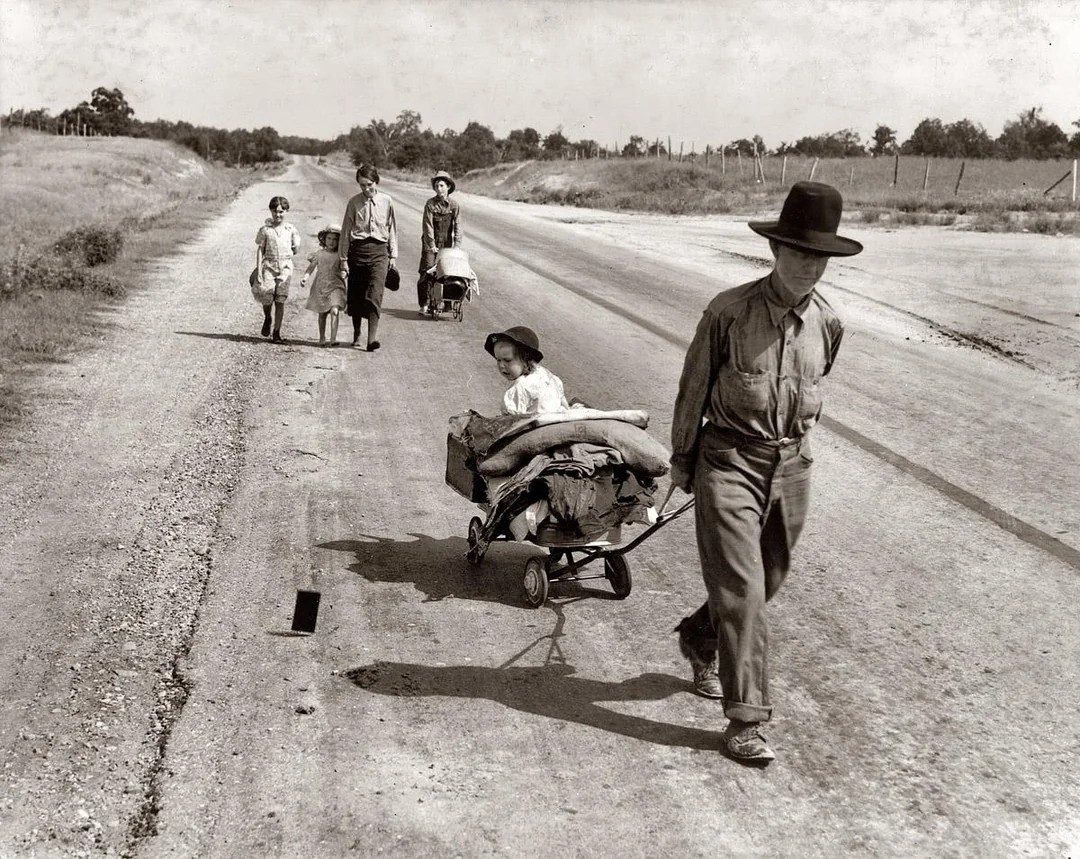
The Great Depression forced nearly a quarter of Oklahoma’s population to migrate in search of work. Mufson on the early moves out of the Dust Bowl.
‘The Depression Hits the Southwest’ by Israel Mufson from Labor Age. Vol. 20 No. 6. June, 1931.
WITH the exception of the flop-houses and the breadlines in the larger cities, extensive poverty resulting from the present depression is still pretty well kept from public view. Whether workers without jobs stay away from the more central and popular thoroughfares, or whether the clothes from “prosperity” days are still sufficiently wearable to present the customary “pressed” front, there is still very little surface evidence of the result of America’s greatest deflation. Main Street still surges with silk-stockinged damsels and knife-edge trousered gentlemen to continue the illusion of wealth widely distributed and the good life within reach of all who are worthy.
It is true that the older and denser cities of the East show more of the strain of the workers’ shortening earning-power than do those West of the Mississippi. It is more difficult to keep the larger number of unemployed in the industrial East, from overflowing in the squares of the affluent. There, shoddy clothes rub elbows with silk. Such evidences of poverty, however, are too few to cause undue alarm. The world is still very definitely a safe world for investment—on the surface.
Beneath the surface, things are neither so peaceful nor so beautiful. A question indifferently asked invariably supplies the answer.
“This is a dead town,” was the opinion of the handsome, soft-spoken youth, who brought me my eggs one morning in Tulsa, Okla. “There is nothing for anyone to do here. I’m stuck because I can’t keep a job long enough to get a stake with which to get out of here.”
One must know Tulsa to appreciate the youth’s estimation of its present virility. Tulsa is a boom town, prospering with the opening of the Oklahoma oil fields. Long before one reaches the city the beacon lights of its skyscrapers, modest enough, when compared with the sky ticklers of New York City, but symbols of achievement in their own rights, point their revolving fingers into the darkness of the surrounding prairie. Coming north from the black loam of Arkansas, the gleaming brilliance of Tulsa’s towers kindle a glow in the heart of the duskweary traveller. At last a color other than black! At last a smell other than of the earth! And the day does not dissipate any of Tulsa’s charms. Probably one of the finest architectural creations in the States is represented by the modernistic Episcopal church. Another church raises its spire to heaven in serious competition with the Rockefeller Riverside church in New York. Fourteen to twenty story hotels assure the stranger of ample accommodations. And all this in a city of around 50,000 population!
Loudly the Tulsa Chamber of Commerce demands that Tulsa be made a seaport. But how make a seaport out of a town which squats in the center of a dust-parched prairie is a problem that seems to hold no serious obstacle to Tulsa’s boosters. Of course the Great Lakes could be pulled down from the North or the Gulf of Mexico could be pulled up from the South. Small matter, the Chamber of Commerce will undoubtedly find a way to bring deep water to Tulsa, but how will it bring employment?
Denver, Colorado, is much less ambitious. It has no dreams of ships from the earth’s corners anchoring in its inland harbors some day. It is satisfied to have the Rockies for its biggest industry. Removed from Nature’s tremendous upheaval, Denver would probably suffer the fate of Goldsmith’s Deserted Village. Even so, Denver has its own unemployment problem and its own remedy. All unemployed workers are admonished to go forth onto the lawns of the community and free the beautiful collective greensward from the pesky dandelion. The Denver remedy for unemployment is not without its merits. Picking dandelions is not only a job, but dandelions offer eat and drink in and of themselves to those who know the proper recipes.
Land Toilers
Once out of the city the economic solvency of America’s producers is far more difficult to ascertain. Of course, the land toiler of Arkansas and even of Oklahoma neither can nor cares to bide his poverty. The Russian humblest peasant hut can stand favorable comparison with the unpainted, tumble-down seamy shacks called home by the majority of the landed gentry of these benighted states. The soil fills every crease and pore of the native populace until it seems that man, woman, horse, house and child are but different patterns sprung direct from Mother Earth’s womb. The men appear darker than nature colored them in their eight-day beards. The women are slutty and brown-stained from excessive indulgence in snuff. Another season awaits them without additional hope. The market for their staple produce, cotton, promises to be flooded with greater world productivity, prices naturally falling to lowest levels yet reached.
Further North in the more prosperous sections of our agricultural domain, the relative well-being of those who live by the soil is more difficult to estimate. Ploughed and furrowed fields look just as neat and hopeful whether wheat sells for $1.50 or 40 cents a bushel. The general appearance of the farm holdings along the highways is far more tempting and “substantial.” Farmers’ homesteads are more solid, less earthy than among the farmers of Arkansas and Oklahoma. But whether these visual evidences are due to higher standards or to the rigidity of Kansas and Colorado winters is difficult to surmise without more thorough investigation. If the natives of Kansas and Colorado attempted to live like those in Arkansas and Oklahoma they’d freeze to death. Probably in all states most tillers of the soil live too close to the subsistence level for comfort. However, farmers are always optimistic and this year the cotton as well as the wheat crop will be bigger than ever before.
Roving Workers
Hard times, unemployment, savings wiped out and most physical roots uprooted—what do they all mean toward the social attitude? Is there a social attitude? If there is it is too weak, puny and inarticulate to matter. There is discontent and unrest. Thousands of workers are foot-loose and roving. Freight trains are once more filled with Knights of the Road following the trail of Lady Luck across the continent and back. Respectable workers are taking to transcontinental meanderings, either in flivvers of their own possession, hitch hiking or riding de luxe on bus cushions. Another factor has entered civilization to complicate an already insoluble problem. By its cheap rates the bus is adding to the fluidity of labor. It is making it easy for workers to cut loose from old surroundings and look upon a trek of a thousand miles with no greater trepidation than they formerly looked upon ten miles.
“And where are you going, Buddy?” I asked of my temporary travelling companion, as we were raising the dust on Oklahoma’s unsurfaced roads.
“Oh, me, I’m headed for Detroit,” was his enthusiastic answer. I almost gasped with astonishment. Of course, it wasn’t the distance that floored me but the physical proof that anyone would want to leave any place for the ugliest depression center in the whole country.
“Well,” I continued, my curiosity forcing my persistency, “do you know what you will find in Detroit when you get there?”
“Oh, yes, I know there are plenty of unemployed. But I have special skill,” was his assured answer.
And so they travel. Workers are still seeking their salvation individually and look for the pot of gold at the other end of the rainbow. That they’ll find a garbage can there—they know not yet, not having seen Jerger’s cartoon in the April Labor Age.
Labor Age was a left-labor monthly magazine with origins in Socialist Review, journal of the Intercollegiate Socialist Society. Published by the Labor Publication Society from 1921-1933 aligned with the League for Industrial Democracy of left-wing trade unionists across industries. During 1929-33 the magazine was affiliated with the Conference for Progressive Labor Action (CPLA) led by A. J. Muste. James Maurer, Harry W. Laidler, and Louis Budenz were also writers. The orientation of the magazine was industrial unionism, planning, nationalization, and was illustrated with photos and cartoons. With its stress on worker education, social unionism and rank and file activism, it is one of the essential journals of the radical US labor socialist movement of its time.
PDF of full issue: https://www.marxists.org/history/usa/pubs/laborage/v20n06-Jun-1931-Labor%20Age.pdf
 Revolution's Newsstand