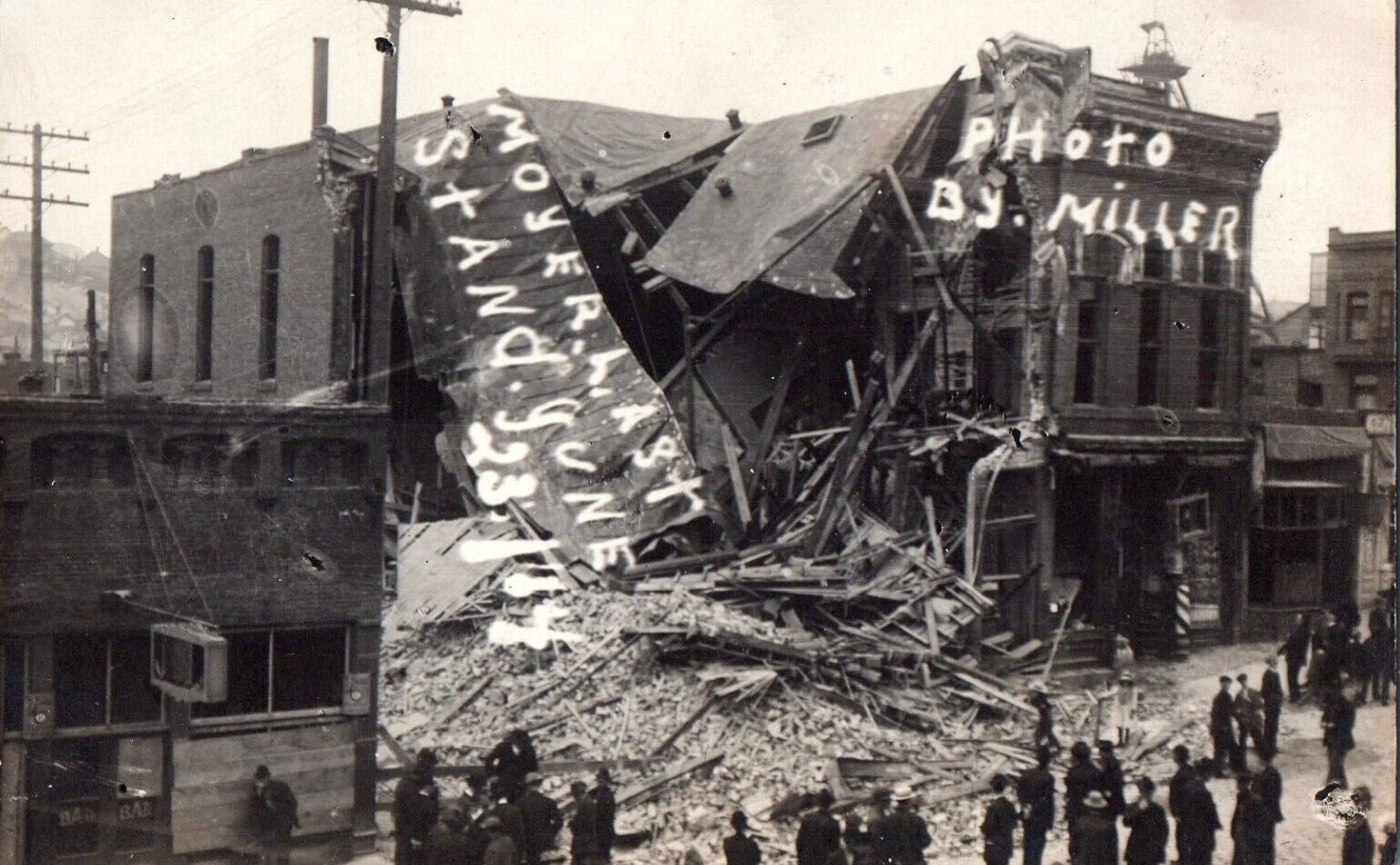
‘A Miner’ gives the story behind the beginning of the rebellion against the Western Federation of Miners by militants in Butte, Montana. A little over a week later and the hall would be dynamited.
‘Revolt of Rebel Miners in Butte’ by A Miner from Solidarity. Vol. 5 No. 233. June 27, 1914.
Standard Oil Domination of the Big Miners’ Union Disputed By A Minority of Determined Militants
Butte, Mont., June 13. This is “Miners’ Union Day,” the anniversary of the formation of Butte Miners’ Union. They are parading now, with a few miners in line, other unions making up the bulk of the marchers.
As I was writing the foregoing, things began to happen in Butte. As the parade crept along on its weary way, the rebels let the crafts pass, but when the miners came along, the bunch of militants closed in and broke the line. Streets were packed with people. The delegate was pulled off a horse and manhandled some, but the president it seems got away. One stool got direct action to convince him that the thing he uses and at the same time denounces, gets the goods for the workers as well as for the parasites.
The rebels went up to the hall they call the Union Hall, and proceeded to take possession, smashing windows and dumping everything into the street. The gang of stools have been in the habit of packing the hall at all meetings, and anyone making a motion in the interest of the men who go down into the hole was promptly smothered by the gink in the chair declaring the motion lost. If a protest were made the gang would proceed to throw the party downstairs.
This is the line of action followed by the stools, and the miners have determined to break the machine of the grafters. Up to the present they have succeeded admirably. After raiding the hall, the rebels got a truck and took the big safe out on the flat and blew it open. Have not learned the particulars yet. They held a mass meeting and decided to take a vote of the men in the camp for the purpose of deciding whether or not they should show cards of the W.F.M. at the mines. They will have one square election anyway; first in a long time. When the rebels arrived at the hall today they found two or three kegs of beer, a case or two of champagne, and some red-eye. Fine doings for the grafters.
This is without exception the finest piece of action ever pulled off by the workers to protect themselves from the grafting labor fakirs, and should be carried out on a general plan. Those who might be inclined to think the miners did a foolish thing in wrecking something that belonged to them, should save their sympathy for some other occasion, as the gang that had control of the place. could not be jarred loose any other way, as all other ways have been tried.
Just a few words on what led up to this episode of “Miners’ Union Day.” There has been discontent among the miners here for some time with the policy of the W.F.M. It appears that the union is run by a gang of stools whose only object is to graft off. the slaves, who eke out a miserable existence in those infernal hot boxes. Last Friday the discontent reached a climax, the men being notified that all who went underground would have to show their cards and all in arrears pay up or not go down. Consequently there was a counter notice posted by the men advising not to show cards, which notice was complied with first at the Speculator, then at the Black Rock mine. The boys marched down town and arranged to hold a mass meeting in the Auditorium for the a purpose of reorganizing. About 2,000 men refused to show cards, and is said that nearly all in the camp have signified their determination to take similar action.
It has been spread all over the world that Butte is a union camp. I am not going to say whether it is or not, but let the reader judge from the facts of the situation. The “rustling card” system of the Amalgamated Copper Co. consists in the miner going to the company’s office and filling out an application which is the greatest blacklisting scheme it has ever been my misfortune to see. There is not one company that sends into the so-called union for men. Those who get employment must chase from one mine to another and hunt a master as individuals. They could do no worse if there were no such thing as the W.F.M. here.
A MINER.
The most widely read of I.W.W. newspapers, Solidarity was published by the Industrial Workers of the World from 1909 until 1917. First produced in New Castle, Pennsylvania, and born during the McKees Rocks strike, Solidarity later moved to Cleveland, Ohio until 1917 then spent its last months in Chicago. With a circulation of around 12,000 and a readership many times that, Solidarity was instrumental in defining the Wobbly world-view at the height of their influence in the working class. It was edited over its life by A.M. Stirton, H.A. Goff, Ben H. Williams, Ralph Chaplin who also provided much of the paper’s color, and others. Like nearly all the left press it fell victim to federal repression in 1917.
PDF of full issue: https://www.marxists.org/history/usa/pubs/solidarity-iww/1914/v05-w233-jun-27-1914-solidarity.pdf
 Revolution's Newsstand