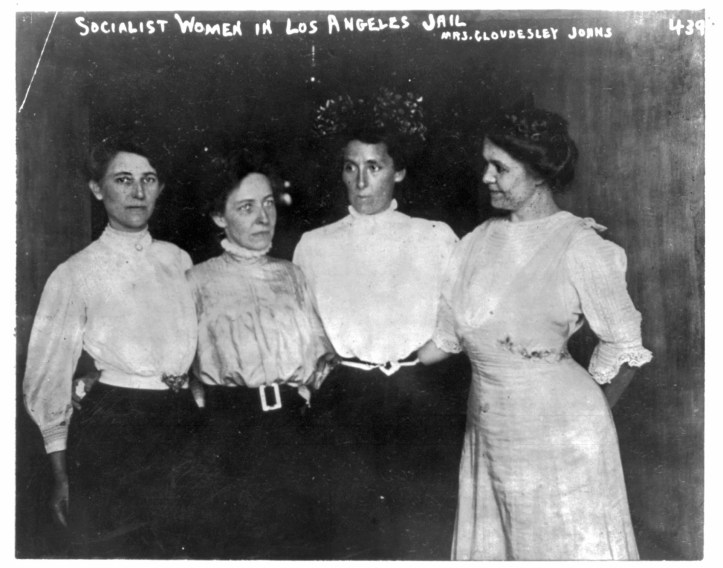
In a Socialist Party local with notoriously right-wing leadership, the Women’s Socialist Union stood out on the left, with many embracing free speech struggles, favoring ‘No Compromise, No Fusion’, and supporting industrial unionism. A number of activists who graduated from the union, such as Georgia Kotsch, would develop national profiles.
‘The Women’s Socialist Union of Los Angeles’ by Agnes H. Downing from The Chicago Daily Socialist. Vol. 2 No. 285. September 30, 1908.
Los Angeles branch consists largely, overwhelmingly, of men: the contingent of women is small. In this respect, perhaps, it is like most locals the country over.
This preponderance of men in the work here was one of the causes which led a few active Socialist women to start an educational society that would teach Socialism to women; hence the Women’s Socialist union.
The union has been in existence some years. Its members are almost all of them women busy with the cares and duties of the housewife, some busy with the further duty of providing in whole or in part for the house; yet they have managed to keep alive the fires of inspiration in their own hearts and to extend it to others. They have studied, a little at least, the philosophy of Socialism, and so they steadily grow stronger, better prepared to do. The members also have found themselves women who when they joined were not able to speak a word in public, who were voiceless in fact, can now express themselves clearly and forcefully.
Though scattered about to the uttermost limits of a scattered city, they have maintained an organization that sometimes ran low, but always persisted. In the struggle of busy lives, with little material means, scattered domiciles, and lacking a literature that appealed to women, the union has found serious obstacles to a rapid growth.
This year, however, with a national convention that has thought it worthwhile to reach out in a special effort for women, and with the national woman’s committee which it gave urging and planning for them; with the Chicago Daily steadily compelling the interest of women, and The Socialist Woman devoted entirely to woman’s education and work, the members of the union are putting new heart into their efforts.
The membership, which for the last two years has hovered around thirty, has almost doubled in the past two months. The help and response so much needed seems to be at hand, and the watchword now is action–double the membership, and then double it again.
To move along the lines of least resistance, their first work is directed toward families where some members are already Socialists. Lists of the dues-paying members of the branch have been prepared and the homes of each will be visited by committees or with literature or both where it is possible. Leaflets will also be distributed to women workers in shops, stores, factories, etc., by committees of the union, who will stand near the exits.
“How does your work strike the local?” or “Do you not get in the way of the branch?” has been asked. An answer to this is many of the most active members of the union are also active members of the branch, so to that extent it is the same spirit in both. The union does not regard itself as final, even as a working force. As one of its workers put it: “We strive to interest woman in Socialism to teach them Socialism and, finally to graduate them in the Socialist party.” The Socialist party is the real field for action for women and men alike: all who love its progress should welcome the literature and the society, which alms to bring men and women together there that they may work together for its great triumph.
Taking last year as a type–in August a committee on program prepared an outline of the work for the year. An afternoon meeting was planned for the fourth Tuesday of each month, to be held at headquarters of the branch. A neat little folder was printed in advance, headed with the Socialist mottoes and a declaration of principles. And giving the subjects for each month with the name of a member who was to prepare a paper or lead in the discussion.
The program included among other subjects such topics as “The Basis and Aims of Socialism,” “Political Equality for Women,” “Women in the Industrial World,” “Condition of the Working Women in Los Angeles,” and a debate. “Resolved, That Poverty Is a Greater Cause of Intemperance Than Intemperance Is of Poverty.”
The program made provision for drawing out all the members. Such topics as “What Socialism Means to Me,” where each member spoke and a “question box” where live questions–objections to Socialism, etc., were put in, and the members called on to reply. Then the business of the society is in itself a drill in parliamentary practice, and in readiness to speak concisely without preparation.
Two of the regular lessons—”The Basis and Aims of Socialism” by Mary E. Garbutt, and “Woman in the Industrial World” by Georgia Kotsch, were regarded as especially good. The former has already been printed and is circulated for propaganda.
Then an evening meeting once each month has been held for propaganda and for a social hour. When one remembers that so much of a housekeeper’s work is done in isolation we see a reason for the hunger among women for some form of social recreation. Those who wish to attract women must make an effort to supply that want. So the evening meeting of the W.S.U. consists of a short address followed with light refreshments and a brief period of social enjoyment. At the last meeting Mrs. Ruth Lindgrin, formerly state secretary of the Socialist party of Illinois, gave a very instructive address. At the next meeting Mrs. F.N. Nobel of the Union Label league will speak.
Recently a Socialist lyceum for the instruction of children has been started. Perhaps no work undertaken by the union has met with more cordial response, which shows the need of this work. Miss Ethel Whitehead, our state president, Mrs. Leah Levine, and Mrs. Newerf, have had charge of the lyceum work, and already even in the warm season, there are fifty children enrolled. It is planned to have the children march at the Debs meeting in September and with songs and flowers greet our presidential candidate. Parents, especially mothers, come out with the children Sunday afternoons, and it is powerful means of interesting them in the work. Though only in its beginning the lyceum has already become a strong link in our solidarity.
The W.S.U. of Los Angeles has no leaders, and it needs none. It has developed something far better, and that is a band of workers who find in each other equals and comrades, who see and seeing, are ready to do, each according to her strength.
The Chicago Socialist, sometimes daily sometimes weekly, was published from 1902 until 1912 as the paper of the Chicago Socialist Party. The roots of the paper lie with Workers Call, published from 1899 as a Socialist Labor Party publication, becoming a voice of the Springfield Social Democratic Party after splitting with De Leon in July, 1901. It became the Chicago Socialist Party paper with the SDP’s adherence and changed its name to the Chicago Socialist in March, 1902. In 1906 it became a daily and published until 1912 by Local Cook County of the Socialist Party and was edited by A.M. Simons if the International Socialist Review. A cornucopia of historical information on the Chicago workers movements lies within its pages.
PDF of full issue: https://www.marxists.org/history/usa/pubs/chicago-daily-socialist/1908/080930-chicagodailysocialist-v02n285.pdf
 Revolution's Newsstand