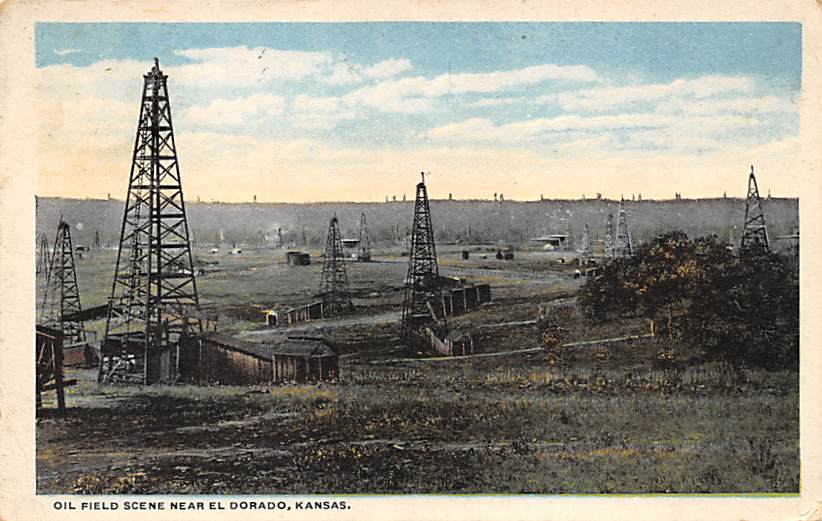
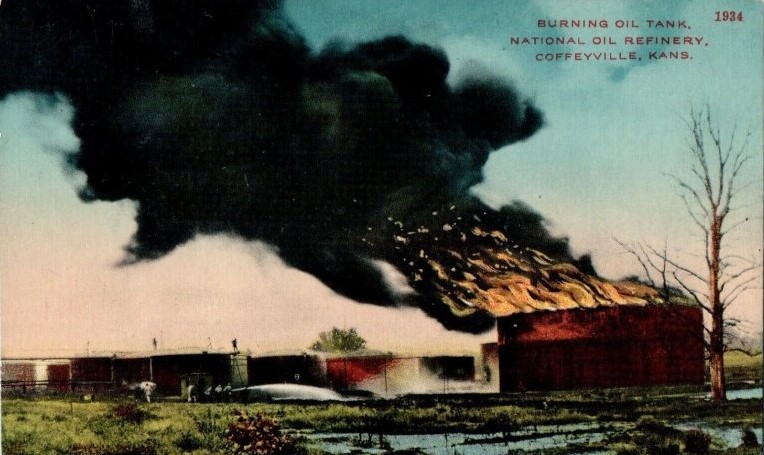
The fossil fuel industry has never not been a blight and a violation. A look at the natural gas fields of Kansas early in the last century.
‘The Kansas Gas Belt’ by J.B.C. from The Weekly People. Vol. 14 No. 43. January 21, 1905.
Life in Its Zinc Smelters and Brickyards–Bad for Labor–A Pen Picture.
Cherryvale, Kansas, Jan. 5. Cherryvale is a typical non-union town. There isn’t a labor union in it. Yet it is an industrial town and has the largest individual zinc smelting plant in the world. It has sixteen furnaces fed entirely by natural gas. The atmosphere around the smelter is so poisonous that it kills all plant life within a radius of one to two miles, according as the season is dry, or wet. In this smelter four hundred men are employed. The highest wage paid is $3.10 for twelve hours’ work, and the man in charge of the fires gets this. There is a class of work here, however, which calls for extraordinary bodily exertion. The men doing it are allowed to go home when they have charged the furnace. These men start to work at four a.m. and generally get through about 11.30 a.m. to 12 noon. The wages range from $1.00 to $2.15 and only one man to each furnace receives this wage. The kiln men and the roasters work twelve hours for $2.15; while the laborers in the yard receive $1.50 for a ten-hour day. Now a charge consists of zinc, ore, silica, coal dust, coke dust and a blue powder containing arsenic in large quantities. Only the strongest and most robust men can stand it, and they become saturated with zinc and arsenical poisoning after a few years.
There are also six brick yards here. The highest wages paid in them is $2.50 for the head setter. The rest get $1.50 per day. There are but two men who receive more than $1.50 per day. They receive $2.00 per day.
With the discovery of gas in paying quantities came the discovery, that the small hills around here were composed of shale, a kind of decomposed rock; this combination, natural gas and shale, caused brick yards to be established here. They employ over one thousand men. A great many of the brick yard men live in tents patched up with refuse boards, and dry goods boxes, and anyone who remembers how upper Fifth avenue looked with its goats and shanties among the rocks can easily picture the settlements of these brick yard employes. These men are employed only about one-half the time. Whenever it rains “no work”; when it freezes up, or machinery breaks, “no work.” If they had to pay house rent it would be impossible for them to live.
In the town, the middle-class reign supreme; the restaurants are all small and while the men folks wait on the table the women folks do the cooking. A great many people who, in the keen competition of the larger places, and railroad men, whom the age limit has eliminated from railway service, are starting small places in this and surrounding towns; in fact, the Kansas gas belt is the last gasp of the expiring middle class. These people are renting from the farmers in the surrounding country and they expected that, attracted by the abundance of gas, factories would spring up, the renting value of their houses and stores would increase and a home market created, so that they could raise garden truck, poultry, dairy products, etc., and sell direct to the consumer without paying enormous freight rates to the railroads, and trusting to the tender conscience of the commission merchants in Kansas City. So when an agent of one of the subsidiary companies of the Standard Oil Company offered them 850.00 to $75.00 per year royalty on a gas well, and $100.00 to $150.00 for an oil well the owners of the farms jumped at it. They figured that these people would start factories and a great land boom would result.
The ore that is smelted here comes from the Joplin district of Missouri, a distance of seventy-five miles. The coal used has to be brought fifty miles from the Pittsburg coal district. The blue arsenical powder bas to be brought from St. Louis, and through the Joplin district to Cherryvale. Freight rates are high. The trust has piped the gas as far as Galena. The next move will be the erection of an up-to-date smelter, run by gas and electricity, as that will generate enough horse-power to run the machinery, while the gas coming through a pipe at a pressure of 450 to 500 pounds will require no pumping and furnish the heat for the furnaces. If the gas plays out in the gas belt, coal and coke would have to be shipped into Cherryvale, but if the gas gives out in Galena they are in the midst of the coal belt and also the zinc belt. The middle class is desperate. They see in the leasing of these gas and oil lands their chance of becoming rich vanishing. They tried to stop the building of the pipeline. An injunction was soon issued by a friendly corporation judge, and then they appealed to the legislature to pass a law preventing the piping of natural gas out of the State. Still the laying of the pipes continued. Then a party of men disguised, blew up the pipeline with dynamite. A reaction set in and troops. were about to be ordered out to protect the property of the pipeline company, when the pressure was turned on and there the matter rests.
Any law that prevents the pipeline company from sending gas out of the State would promptly be declared unconstitutional. The handwriting is on. the wall. Cherryvale and the towns in the Kansas gas belt will become sleepy agricultural towns once more. More of the middle class will be in the ranks of the working class, and the southeastern part of Kansas, together with southwestern Missouri will be the greatest proletarian point between the Mississippi River and the Rockies.
Now there are signs of an approaching split on the trade union question in the Socialist party. The workingmen of southwestern Missouri cannot be organized in a pure and simple union. They will listen to Socialism. They will support a Socialist speaker liberally, but they wont turn out to hear a pure and simple speech. These men must be reached by scientific literature as they will form the bulwarks of a genuine Socialist movement in the near future. Speed the day.
New York Labor News Publishing belonged to the Socialist Labor Party and produced books, pamphlets and The People. The People was the official paper of the Socialist Labor Party of America (SLP), established in New York City in 1891 as a weekly. The New York SLP, and The People, were dominated Daniel DeLeon and his supporters, the dominant ideological leader of the SLP from the 1890s until the time of his death. The People became a daily in 1900. It’s first editor was the French socialist Lucien Sanial who was quickly replaced by DeLeon who held the position until his death in 1914. After De Leon’s death the editor of The People became Edmund Seidel, who favored unity with the Socialist Party. He was replaced in 1918 by Olive M. Johnson, who held the post until 1938.
PDF of full issue: https://www.marxists.org/history/usa/pubs/the-people-slp/050121-weeklypeople-v14n43.pdf
 Revolution's Newsstand