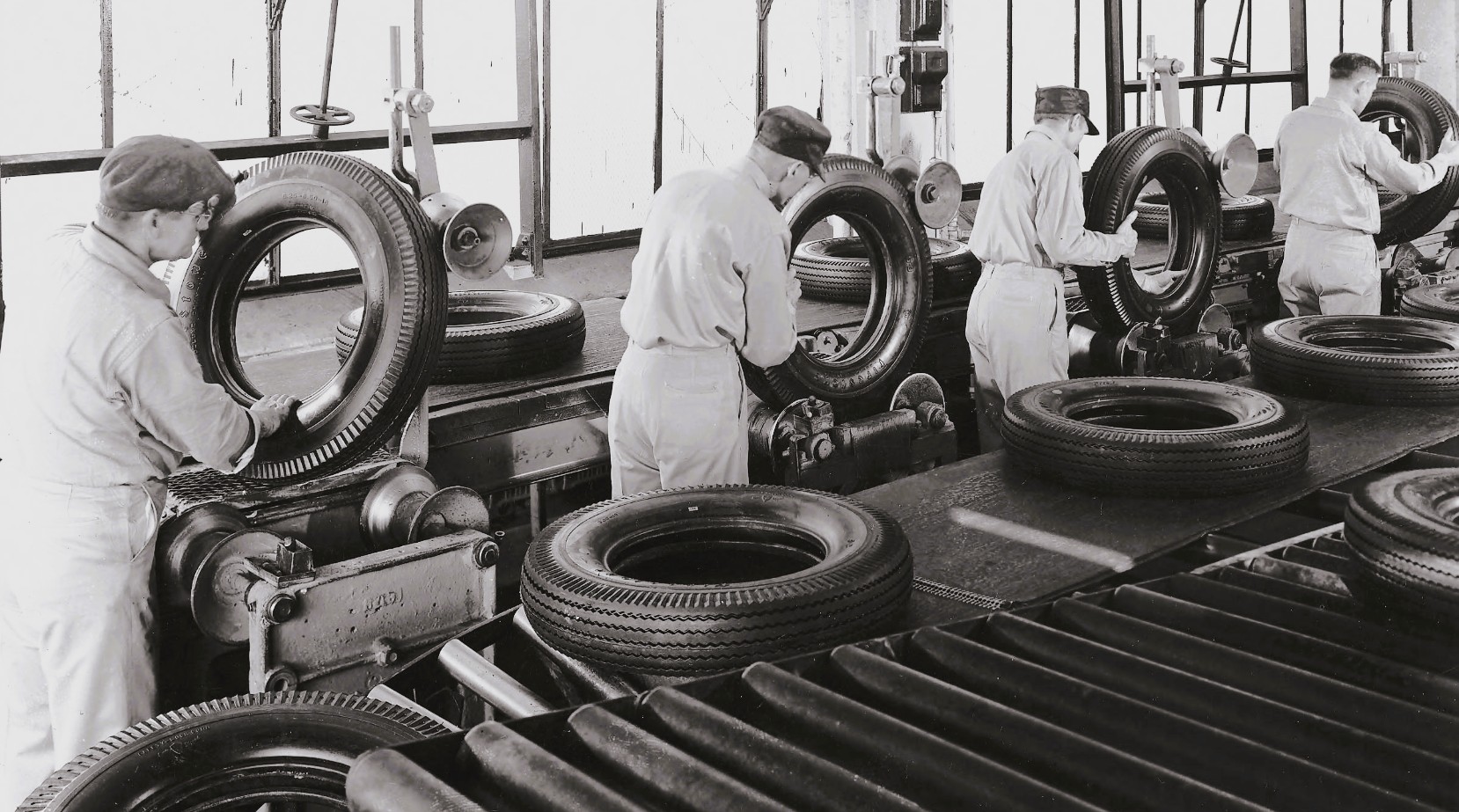
What capitalism creates, it also destroys. It was the rubber industry that made Akron, Ohio a boom town; it was the rubber industry’s demise that made Akron an emptied out, rust-belt shell. Scott Nearing with an aerial view of the city in 1928.
‘Rubber Town–Home of 62,000 Slaves’ by Scott Nearing from The Daily Worker. Vol. 5 No. 109. May 9, 1928.
More automobile tires are produced in Akron, Ohio, than in any other city in the world. In fact the rubber factories of Akron use 65 per cent of the world’s total output of rubber—463,666,466 pounds in 1927. Most of this rubber goes to the three big plants; Goodyear, Goodrich and Firestone which produce the great majority of the 44,000,000 tire’s that Akron ships out each year.
The automobile industry was a stroke of unbelievable luck of Akron. Only 16,512 people lived in the city in 1880; 27,601 in 1890, and 42,728 in 1900. The population jumped to 69,067 in 1910 and to 208,435 in 1920. The war years were the period of Akron’s greatest prosperity.” Population increased 200 per cent in a decade; land values soared; buildings shot up in every direction. The Ohio town of 1880 had become a roaring center of American prosperity by 1920. For 1927 the Akron Chamber of Commerce made this boast:
Population 220,000
Factory workers…62,018
Value of manuf. Prod….$603,519,000
Total factory payroll…$105,866,000
School enrollment…39,930
No. of permits to build…5,748
Value of bldgs, erected…$20,967,461
2nd industrial city in Ohio.
10th industrial city in the U.S.
The rubber center of the world.
Home of Rubber Trust.
The tire industry proved to be a “millionaire maker” during the early years. Demand rose fast. The product was sold before the raw material reached the tire factories. The “big three” rubber companies grew up together. The Firestone business was started in 1900 and reincorporated in 1910. By 1922 it was selling goods valued at $64 million a year and paying dividends of $1,293,182. Four years later, in 1926, sales were million and dividends $4,039,474. Goodyear has an even better record. Organized in 1898; reorganized in 1927, the company made sales of $127 million in 1923 and paid dividends of $2,729,000. For 1926, sales were $230 million and dividends $8,642,000. Meanwhile the assets of the company had grown from $156 million in 1923 to $208 million in 1926.
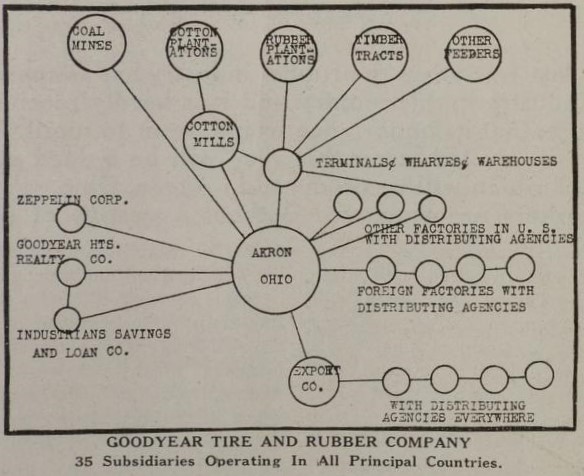
The ramifications of the rubber trust extend far beyond Akron. Only part of its business is located there. Firestone holds a 99-year lease on a million acres of former jungle land in Liberia, Africa; 200,000 acres of this land were planted to rubber trees in 1910. The remainder is being cleared and planted. Firestone has plants at Akron; Hudson, Massachusetts, and at Hamilton, Canada. He has preparation mills at Fall River Mass., and at Singapore. Goodyear has extensive rubber plantation holdings in Sumatra; controls various companies producing cotton and cotton fabrics, including the Devon Mills at New Bedford, Massachusetts; the Goodyear Cotton Mills at Goodyear Con.; the Goodyear Clearwater Mills at Cedartown, Georgia; the Goodyear Cotton Company of Canada, and the Goodyear Textile Mills Co. of Los Angeles, California, all engaged in manufacturing tire fabric, and the Southwest Cotton Company located at Phoenix, Arizona, which owns 35,767, acres of land and is engaged in the growing of cotton. Goodyear products are distributed through a distributing organization with branches in the principal cities of the world.
Goodyear owns 1,300 acres of land in Akron and vicinity; has 66 buildings, three-fifths of them built since 1915, The Akron plant employs about 16,000 people.
Rubber Slaves.
Tire building began as a “skilled” trade. It soon became a machine process with the worker tending the machine. Skilled labor was replaced by semi-skilled and unskilled labor. Foreigners and Negroes shouldered out native white workers who insisted on a higher standard of living. The make-up of Akron’s population at the time of the last census (1920) is a striking picture of the forces at work there. White persons born in the United States of native parents made up 60% of the population; white persons born of foreign parents 18%; foreign-born persons 20%; Negroes 2%. There were 121,167 males and 87,266 females in the Akron population—141 men for each 100 women. Akron rubber workers have been exploited more and more intensively as the years passed. Tire building is one of the industries that has shown an immense increase in productivity per man in recent years. Since the war employment in the industry had increased 7 per cent while the total output has increased 28 per cent, or four times as much as the increase in the number of workers employed.
The 62,018 workers who were exploited in Akron factories during 1921 did not lead an easy life. Much of the work of tire building demands great physical exertion; in some of the processes the workers are wet; in other the odors and fumes are bad. Then the factories usually work either two or three shifts per day—the workers going on their shifts by turn. Sometimes, therefore, the worker goes to his work at 4:30 a.m.; sometimes in mid-afternoon; sometimes in the evening.
During the boom years of the Akron rubber industry repeated efforts were made to organize the worker into labor unions. Thus far the efforts have been largely unsuccessful. Among the 62,000 Akron factory-workers the total number of card-holding trade unionists is probably under 3,000 and the total number of active trade union workers is probably less than 50.
A.F.L. Not Interested.
American Federation of Labor officials have been slow to help in the organization of the rubber workers. Most of the A.F. of L. members are craft workers and there are no crafts in the rubber industry. The only type trade union organization that has a chance to succeed in the rubber factories is an industrial union. A.F. of L. officials are not industrial unionists and are taking no steps to organize this type of union. Independent efforts at unionization have! lacked financial backing and have failed for want of trained leadership.
Akron bosses have handled the union situation without gloves:
1. They have put together in the same departments workers speaking different languages and who therefore have difficulty in understanding one another.
2. They have organized a very extensive spy system in their plants.
3. They have dismissed workers ruthlessly whenever they were engaging in organizing activity.
During the most recent effort at organization of the rubber workers, in 1927, after a union membership was built up, it was discovered that the man who had been elected secretary of the union was a government agent. He had worked regularly at the tire building trade for years, at the same time keeping his sleuth connection. On a previous occasion, ten employes of detective agencies were discovered holding various key positions in Akron trade unions.
Rubber town is a typical United States get-rich-quick town. Forty years ago it was a village. Today it is one of the most important industrial centers of the United States. The rubber industry has paid immense profits. The rubber trust, from its center at Akron, has reached around the world for raw materials; semi-finished fabrics; markets. The workers meanly housed, intensely exploited, denied even the opportunity to build trade unions, go stolidly through their round of daily toil, dimly conscious that something is wrong and wondering when their turn will come and what it will be.
The Daily Worker began in 1924 and was published in New York City by the Communist Party US and its predecessor organizations. Among the most long-lasting and important left publications in US history, it had a circulation of 35,000 at its peak. The Daily Worker came from The Ohio Socialist, published by the Left Wing-dominated Socialist Party of Ohio in Cleveland from 1917 to November 1919, when it became became The Toiler, paper of the Communist Labor Party. In December 1921 the above-ground Workers Party of America merged the Toiler with the paper Workers Council to found The Worker, which became The Daily Worker beginning January 13, 1924. National and City (New York and environs) editions exist.
PDF of full issue: https://www.marxists.org/history/usa/pubs/dailyworker/1928/1928-ny/v05-n109-NY-may-09-1928-DW-LOC.pdf
 Revolution's Newsstand