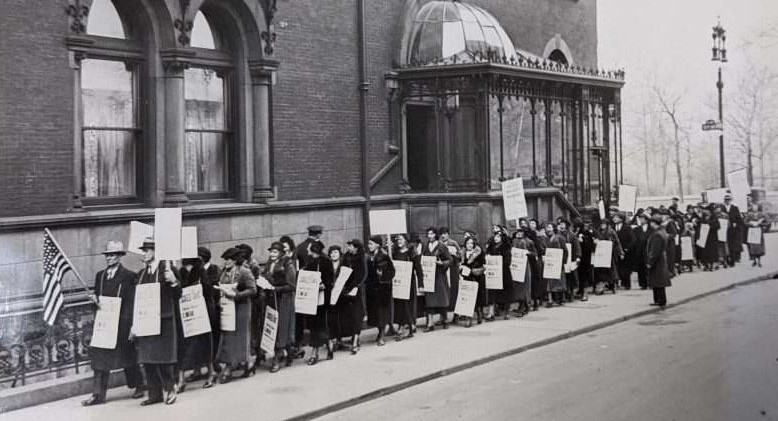
The story of sympathy strikes spreading throughout the company and a growing consumer boycott threatens to turn the struggle against today’s Nabisco company into a major showdown between capital and labor in 1935.
‘Biscuits and Blackjacks’ by Edward Newhouse from New Masses. Vol. 14 No. 8. February 19, 1935.
EATING or selling products of the National Biscuit Company today means eating or selling stale warehouse stock, some of it baked as far back as last August, and it means eating or selling products of scab labor.
The strike of six thousand started in the giant company’s Philadelphia plant, one of the five organized under the Inside Bakery Workers Federal Union. It was found that N.B.C. was shipping goods to the New York City and Philadelphia plants from non-union branches in Cambridge, Mass. and Buffalo. In the union shops this resulted in what production experts refer to as personnel reduction. This was the company’s first major step in the campaign to break the union. The second came with a point blank refusal to equalize the pay of several hundred employes in Philadelphia. The plant struck and in support New York, Atlanta, York, Pa. and Newark, N.J. walked out as bodies. Local 807 of the International Brotherhood of Teamsters went out with the bakers. The trucks stopped running.
National Biscuit had been apparently preparing for the showdown. Four days after Jan. 8 when the strike was called, they declared a lockout. The warehouses were stacked to capacity. Several weeks before any of the workers had dreamed of strike, iron gratings were installed on the windows of the New York plant.
In New York City the strike has been 100-percent effective for over a month. In the first flush of the walkout, the three thousand workers treated it as a sympathy gesture with Philadelphia. Then they remembered their own situation. Nellie Cassidy had worked in the icing department for twenty-five years before the company decided that if she worked a little longer they would have to pay a pension. They could scarcely have dropped her out of consideration for her age. There are many women over sixty working in the departments. One elderly woman whom I surely supposed to be a striker’s mother said she had been trucking bundles for thirty-seven years.
A mechanic, seventeen years with the company, assured me he wouldn’t scab if the strike lasted for another seventeen. At the time of the strike call, the mechanics were working two on a floor where five had been previously required to attend the then simpler machinery. This mechanic was handling twelve packing machines, twelve conveyors, twelve closing machines and twenty-four carton folds. He and some of the girl strikers standing around had a difference of opinion as to what was worse, rushing from one conveyor to another or standing before one of the relentless belts. A group of girls employed on one operation told how the transference to the conveyor of pans hot from the oven made their fingers bleed. Theresa Daniels of the packing department said that on her operation you had to dip so low and so often that in the daytime your back nearly broke and after hours you didn’t know whether you were coming or going, you were dizzy.
Has the N.R.A. helped any? Hell no, the mechanic said. What happened was this. Their hours were decreased from forty-four to forty but with a corresponding wage cut. They had to stage a brief strike before they won the forty-hour week.
Most of these strikers had little or no previous experience in labor struggles. The behavior of press and police shocked them beyond measure and enraged them. They saw policemen who had been nearly human during their first hour on duty, called into the company office and come out tougher than the Industrial Squad. They see the radio cars constantly circling the plant and the dozens of mounted cops patrolling the neighborhood. In New York there have already been thirty-five arrests of strikers who picketed stores handling N.B.C. goods. Police with drawn guns have dispersed these pickets, firing shots a number of times. There are girls nursing injuries from horses’ hoofs and a girl staying home with the purple welt of the nightstick across her arm and breasts. In Philadelphia, the International Labor Defense is handling the cases of those arrested.
To some extent this is the fault of the union leadership. No publicity committee has been set up and only William Galvin, president, is allowed to give out information. Not only did he consistently dodge an interview by THE NEW MASSES but there were several attempts to prevent the writer from gathering details from the strikers themselves. Lack of a publicity committee is entirely in line with Galvin’s general policy of running the union singlehanded. Here is a large strike without a strike committee which functions as such. There is no discussion from the floor at meetings. All important decisions are made by Galvin alone.
The capitalist papers, of course, would have clamped down on news of the strike, publicity committee or no. National Biscuit is a huge advertiser. The newspapers consistently played down the story. Eight dailies failed to run a single line about the strike parade which stretched for twenty blocks. After N.B.C. tried to start shipping with a few scab trucks and some of them were found to have been turned over on the wrong side, dozens of pictures were taken, good pictures by competent staff photographers, but they didn’t find their way into the papers. When one of these photographers tried to snap an overturned truck near 74th Street, the workers asked why none of these pictures were ever printed. And the photographer had to show his Newspaper Guild card and had to explain it wasn’t his fault before they let him go unharmed.
Finally a shot of one of these trucks sneaked into The Daily Mirror where Stanley “I-print-the-news” Walker who doesn’t like unions, is managing editor. But the cation took care to leave out the name of the company which owned the truck and implicitly called attention to the strikers’ vandalism. It was the first time The Mirror had taken cognizance of the strike. Up to date The Daily News has also carried only a single notice, glorifying the heroic cops who dispersed the picketers by firing shots.
For those of the strikers who have wondered why Mr. Walker’s alma mater, The New York Herald-Tribune, has not displayed any unusual enterprise in obtaining news of their battle: Mr. Ogden Reid, publisher of The Herald-Tribune, is not only a relative and namesake of Mr. Ogden L. Mills, but vice-president and director of Mills Estate, Inc. Mr. Ogden L. Mills, who is an ardent Republican and a likely presidential candidate in 1936, is burdened with a directorship of the N.B.C.
Still more cards have been stacked against the strikers. A month after the strike began the company sent this letter to individual workers: “The Metropolitan Life Insurance Co. has suggested that you be notified that your privilege of converting your Group Life Insurance Certificate into an insurance policy without a medical examination expires thirty-one days after leaving your employment. Your Group Insurance participation ceased when you terminated your employment on Jan. 8.”
One of the strikers showed me a clipping of this letter’s photostat which ran in The Daily Worker. He said, “It seems they’re the only ones who give a damn.”
After a month’s delay, the New York Central Trades and Labor Council finally went on record for a general consumers’ boycott of the company’s products. This had already been effective in most independent stores. Atlantic and Pacific, Reeves, Butler and the rest of the chains, all notoriously anti-labor, still handle National Biscuits and most of the arrests have resulted from picket activities against them. But there are still many more independent grocers than chain stores. N.B.C. salesmen are being used for little else than propaganda among these. For one, they say, it’s a lot of new workers who came into the plant to make trouble and they’re mostly straggling back to work. Both assertions are bare-faced lies. Of the 3,000 strikers in New York, 925 have worked for the company eleven to fifteen years and 175 for twenty-six years or more. Not a single striker has returned to work and not a single machine is running.
Labor unions and many other organizations have joined the boycott. Waste no sympathy on Mr. Ogden L. Mills and his fellow stockholders. For the first five years of the well-known depression, National Biscuit Company, Inc. reports a net profit of $109,992,170. As to what they actually make, get your Congressman to find out from Mr. Mills at the next Republican Convention.
The New Masses was the continuation of Workers Monthly which began publishing in 1924 as a merger of the ‘Liberator’, the Trade Union Educational League magazine ‘Labor Herald’, and Friends of Soviet Russia’s monthly ‘Soviet Russia Pictorial’ as an explicitly Communist Party publication, but drawing in a wide range of contributors and sympathizers. In 1927 Workers Monthly ceased and The New Masses began. A major left cultural magazine of the late 1920s and early 1940s, the early editors of The New Masses included Hugo Gellert, John F. Sloan, Max Eastman, Mike Gold, and Joseph Freeman. Writers included William Carlos Williams, Theodore Dreiser, John Dos Passos, Upton Sinclair, Richard Wright, Ralph Ellison, Dorothy Parker, Dorothy Day, John Breecher, Langston Hughes, Eugene O’Neill, Rex Stout and Ernest Hemingway. Artists included Hugo Gellert, Stuart Davis, Boardman Robinson, Wanda Gag, William Gropper and Otto Soglow. Over time, the New Masses became narrower politically and the articles more commentary than comment. However, particularly in it first years, New Masses was the epitome of the era’s finest revolutionary cultural and artistic traditions.
PDF of full issue: https://www.marxists.org/history/usa/pubs/new-masses/1935/v14n08-feb-19-1935-NM.pdf
 Revolution's Newsstand