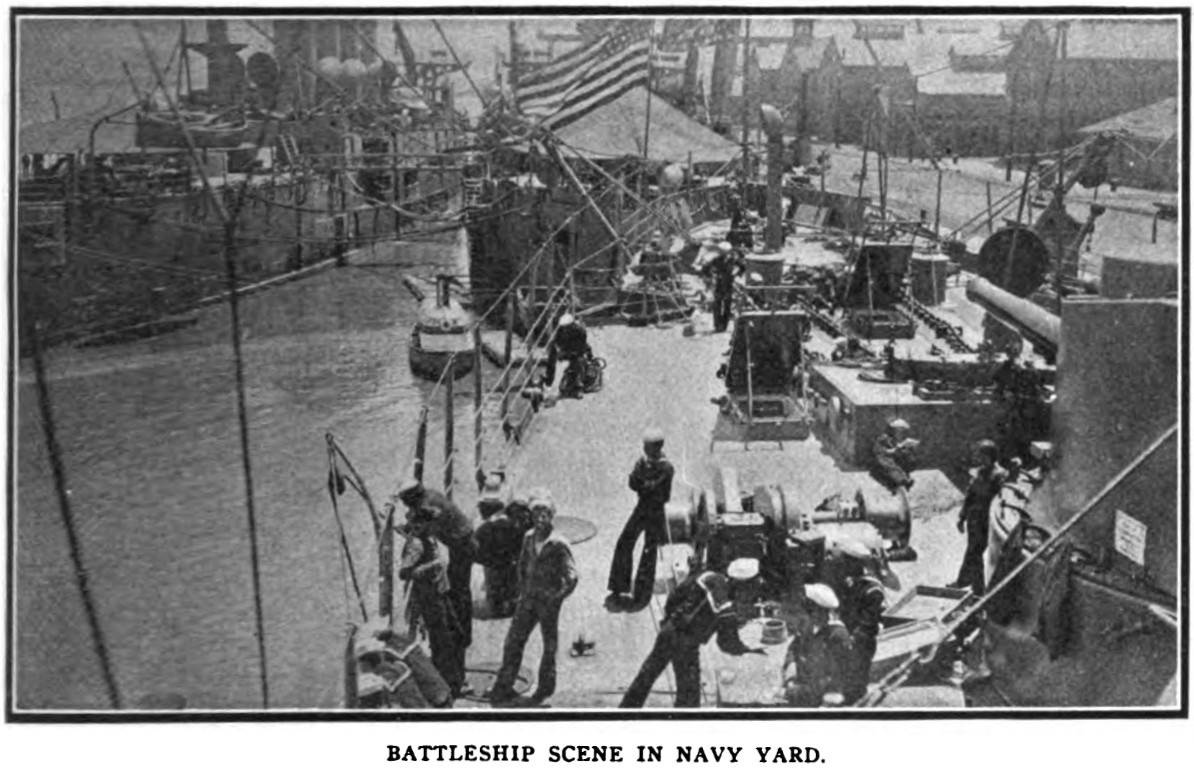
As U.S. imperialism emerged on the world stage, it required a huge navy, and the sailors to operate it. Long promoted as the ‘safe’ service to join, complete with posters of ‘exotic’ locales to entice the punters, Marion Wright speaks of the reality on board a United States Ship and warns those who might be fooled not to be suckers for capital.
‘Fresh Bait—‘Ware Suckers’ by Marion Wright from The International Socialist Review. Vol. 13 No. 3. September, 1912.
THE SENATE recently passed an appropriation measure for $133,000,000 to meet the expenses of the United States navy for the next fiscal year. Most of this enormous sum will pour into the coffers of the steel, gun and powder trusts at extortionate prices for material, for many of the officials authorized to place contracts for ships, armor and guns are in partnership with the steel and powder companies and the rest will be frittered away in the easiest way to get rid of it until time rolls around for the next appropriation.
About $200,000 will be required for the up-keep of the trained man-catchers employed by the navy department to keep the enlisted personnel of the navy up to its standard quota of approximately 48,000 men. Recently it has been necessary to put a number of new flying recruiting squadrons in the field as the old facilities for landing men have proven entirely inadequate. These traveling parties are to search the country with a fine-toothed comb for suitable food for powder and scalding steam.
And the anglers are using fresh bait! Trusting, gullible farmer boys and young tradesmen from the inland states were formerly drawn like flies to a molasses jug by the pretty picture posters of Navy life on the town “Opry” house. “Serve your Country,” said the flaming posters with their spotless decks and shining guns. But the recruiting offices are no longer filled with eager youths. The young men of America are getting wise to the game, their older brothers, cousins and friends who have been “Joinin’” the Navy since the Spanish-American (Sugar-Trust) war have been coming home again. And Jack has had a story to tell. Although the capitalist press shuns these stories like a breath of plague, they have a way of getting around and the recruiting officer with his glib tongue is continually running foul of young men who have had friends or relatives who have “been there,” and so the recruiting problem is becoming acute. Dozens of ships are laid up in the yards rusting for want of men to man them. At the grand fleet mobilization last fall for the political benefit of President Taft about half the ships were manned with skeleton crews.
The navy department is cutting away from its circus-poster stunt and getting down to brass tacks. In other words, they place economic facts before the prospective victim now instead of appealing toy his cupidity and patriotism. The green young men of the farm and country towns holding aloof, the recruiting officer goes down to the haunts of men who have been ground betwixt capitalist mill-stones until they are ready for anything, and opens his arsenal of facts.
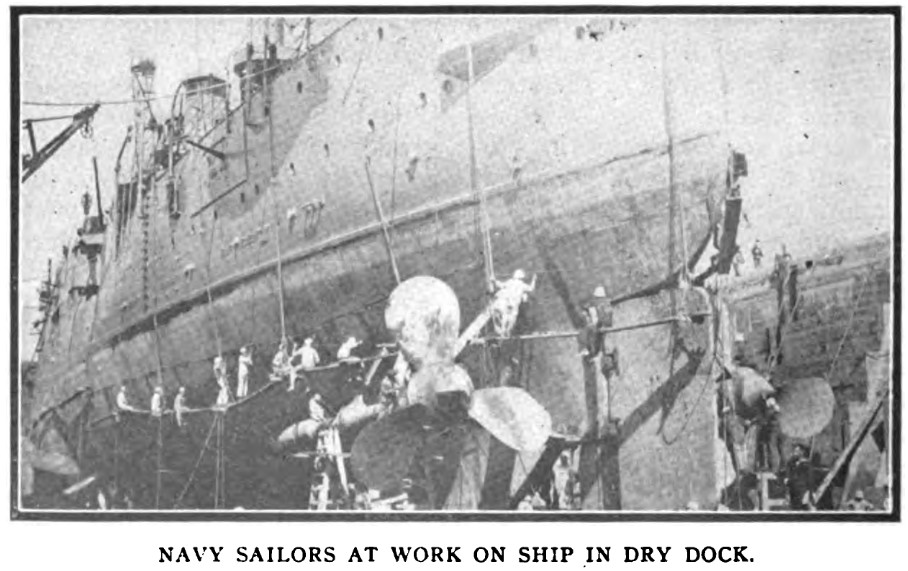
“Young man, how much money do you earn?” is his opening broadside, and he follows this with a rapid-fire line of what every workingman already knows—that it is impossible for him to earn a decent living—let alone saving anything, and that he is never sure of even a dog’s job. In short, it is made perfectly clear to the intended prey by the recruiting officer, who is carefully selected for this line of work, that he must choose between two things; that of continuing to be a capitalistic wage-slave, or becoming (if the victim only knew) an officer’s dog. The man-catcher frankly acknowledges the present terrible industrial situation. In fact, he dwells on it—drives it home, makes it plain that under the present system the workingman has “no chance.” And the fine irony of it all is that he is coaxing the poor, blind fool to swear to support to the death the very leech that has already sucked his life blood.
Skillfully it is explained that pay in the navy is fairly good; that there are no strikes; that board, bed and medical attention is free; that chances for promotion are good, etc., etc., etc. And so the sucker bites! What then?
Once hooked, the angler changes his manner toward the catch completely. This American youth must be “broke” immediately. “These United States ideas of independence” are the very first things that are taken out of him—sometimes even before he is sent to the barber to have his hair clipped. If the Medieval ways of handling this Twentieth century man fail to work on the start they will get in their good work before he leaves the training station. He is either “broke” or forced to desert before he goes to sea; and then what?
He is indeed “food for powder” and scalding steam for the rest of his enlistment. During the past nine years 149 men in the United States Navy have been horribly cooked and shot to death, and 102 maimed for life in accidents of bursting guns and exploding boilers. Eight men were scalded to death last year in the boiler room of the battleship Delaware, and there is continually news of some naval casualty due to graft in ship construction and reckless management. The sailor is not allowed to question or discuss these things. To any who “opens his face” the severest penalty is meted out.
In the early part of July of this year a sailor on a Navy vessel serving in the Pacific, whose enlistment was to expire in a few days, was suddenly arrested and thrown into the ship’s brig. He had written some letters under a nom-deplume calling attention to rotten conditions in the fleet. The officers put secret service men and handwriting experts on the case and located the man. Now, although his four-year enlistment has expired, he will undoubtedly be sent to prison for a long term for writing these letters while in the Naval service.
The prospective recruit is shown, in his own language, “only one side of the paper” to which he puts his name. Only the pay, promotion and retirement tables are prominent there. He does not learn that he can be ordered to act as a scab or strike-breaker (navy sailors were recently ordered to take the place of strikers on the Panama line) and be sent to prison for a long term if he so much as hesitates to obey.
He takes an oath to obey “all lawful orders,” but another part of the Navy regulations which he is not allowed to see provides that as far as his opinion is concerned, any order given him by a superior is “lawful.”
The constitutional right of trial by his peers is unheard of. Officers only sit on court-martials, and an officer’s word is taken over any number of enlisted men’s. All officers are educated in the one snob-factory at Annapolis, and they are bound together in self-interest bands of brass. If a man is accused by an officer his punishment is certain. There is no “comin’ clear” in a court-martial; it is merely a question of the extremity of the sentence.
Privacy, even of the person, though one of the most ancient and sacred rights of man, is a jest in the navy. Every man on board ship may be called on deck and forced to stand in line while his personal effects are being ransacked by the officers, ostensibly in a search for liquor or drugs, and many a man has stood under guard while an officer read his private letters in an effort to discover a clue to the whereabouts of a deserter who was known to have been his friend. At inspection a man must stand rigidly at attention and silent as a statue while the officers may finger his chin to see if he shaved closely enough; pull open his shirt front and inspect his underwear; comment on the length of his hair while pulling his fore-lock, and otherwise treat him as if he were a prize mule on exhibition. There are also times when the crew is lined up and every man, irrespective of his character and habits, is forced to submit his person for examination by the surgeon for evidences of vermin or venereal disease.
Any protest against these outrages is dealt with in the severest manner. Many men have lain in irons for weeks on a diet of bread and water for “silent contempt.” Punished because they were unable to repress the blaze of fury in their eyes while being so publicly and thoroughly humiliated.
No longer is the navy job a Sinecure. Sailors are now required to perform much of the work at the yards formerly done by civilian workmen, who are becoming more and more “exacting” (which means that they resented the infamous Taylor system of “speeding-up”).
The man who goes into the navy expecting something soft gets badly fooled. He swears his soul away for four years and becomes, potentially, a catspaw to snatch chestnuts out of the fire for Capitalism.
The International Socialist Review (ISR) was published monthly in Chicago from 1900 until 1918 by Charles H. Kerr and critically loyal to the Socialist Party of America. It is one of the essential publications in U.S. left history. During the editorship of A.M. Simons it was largely theoretical and moderate. In 1908, Charles H. Kerr took over as editor with strong influence from Mary E Marcy. The magazine became the foremost proponent of the SP’s left wing growing to tens of thousands of subscribers. It remained revolutionary in outlook and anti-militarist during World War One. It liberally used photographs and images, with news, theory, arts and organizing in its pages. It articles, reports and essays are an invaluable record of the U.S. class struggle and the development of Marxism in the decades before the Soviet experience. It was closed down in government repression in 1918.
PDF of full issue: https://www.marxists.org/history/usa/pubs/isr/v13n03-sep-1912-ISR-gog-ocr.pdf
 Revolution's Newsstand