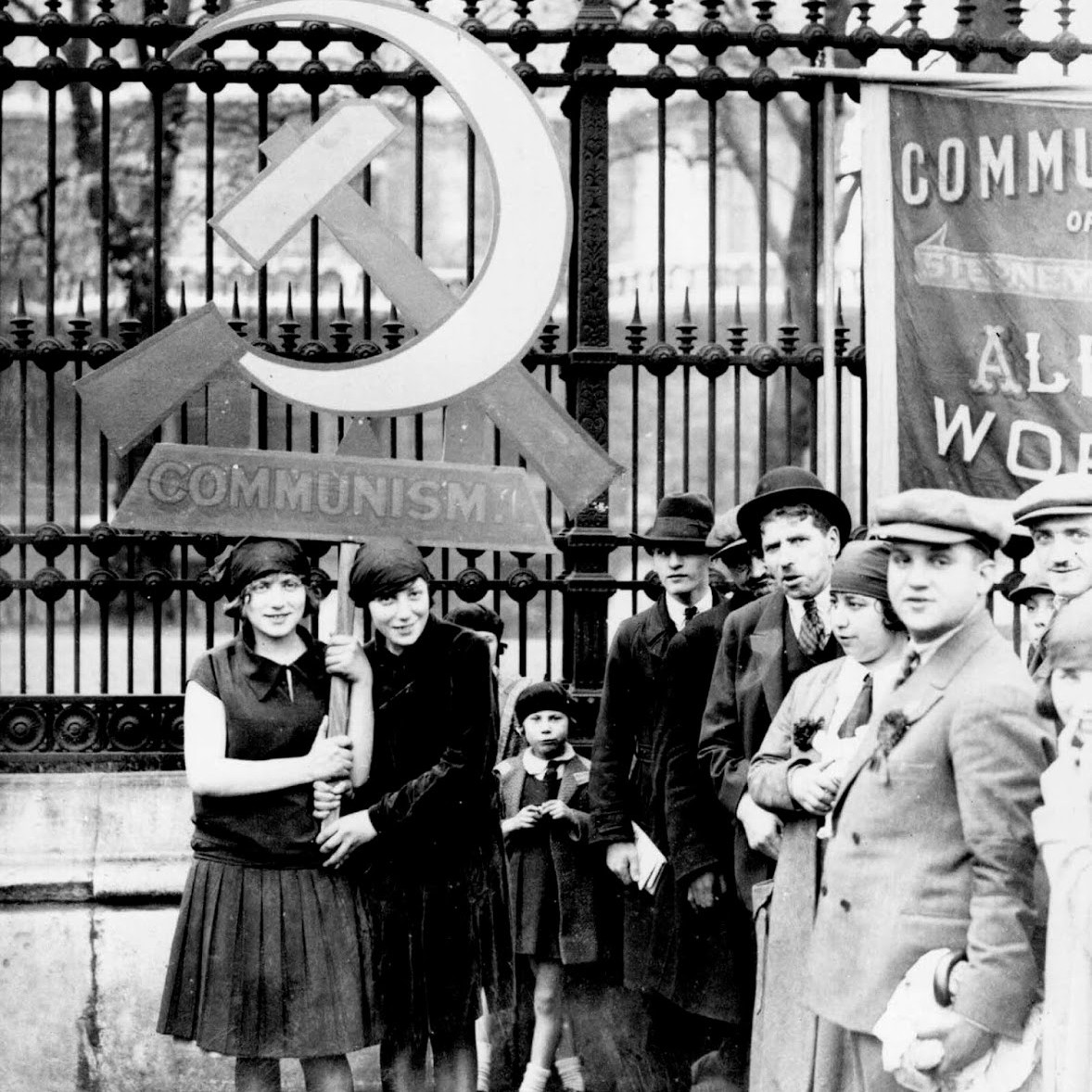
A report on several year’s work, most importantly through the miners’ and General Strike of 1926, from the Young Communist League in Great Britain to the Fifth Congress of the Y.C.I.
‘Young Communist League of Britain’ from The Young Communist International Between the Fourth and Fifth Congresses, 1924-1928.
The activities of the British Y.C.L. from the period of the Fourth World Congress, its participation in the great struggles of the British proletariat have raised the importance of the Y.C.L and its role as a fighter in the strongest imperialist country in the world. In 1924, during the period of the MacDonald Government, the Y.C.L. revealed to the young workers the imperialist policy of the Labour Government (bombing of natives in Iraq, preparations or war against China and the S.U.). For the first time work amongst the army and the navy on a large scale was began. In the General Election the League played an active part; 15,000 leaflets were distributed, three special numbers of the “Young worker” published, each with a sale of 10,000 copies, and a special programme of youth demands was put forward in the election campaign conducted by the Party. In Battersea, where the only Communist Member of Parliament was elected, the League played an active part in the Party campaign. In the economic field, the League successfully conducted a campaign amongst young workers employed in the metal and shipbuilding trades. In 1924, when the Government answered the murder of the Governor-General in Egypt with an ultimatum and repressions, the League was active in the “Hands off Egypt ” campaign, and demanded the evacuation of British troops from Egypt. In December, 1924, the enlarged Executive dealt with the question of Trotskyism and unanimously supported the C.P.S.U. and the Comintern in the struggle against the opposition.
The successes achieved in 1924 made possible the fortnightly publication of the “Young Worker,” which hitherto had been published once a month. The terrible conditions of the miners led the League to conduct a campaign amongst the young miners. The League answered the attack on the railway workers by a special campaign amongst young railway workers. Special demands and a programme was put forward for the young workers in these industries which met with great popularity, especially among the young miners. These campaigns were connected with the campaign or organisation of young workers into the unions. The League commenced paying more attention to the Pioneer movement, and in a number of districts children’s organisations began to spring up. The League showed itself to be active in the campaign for International Trade Union Unity, and for unity with the Soviet Union as a weapon against the war preparations. Successes were also established in educational work, and a new League Syllabus was issued and many weekly courses and groups conducted in all districts.
On the 11th and 12th July, 1925, the Congress of the League took place in Manchester. This Congress may be characterised as a congress of Bolshevisation. Important resolutions were those on increased trade union activity, on the formation of factory groups, on training work and on the United Front. In the summer of 1925 the League conducted active propaganda against the war of France in Morocco. A representative of the British Y.C.L. was sent to the Berlin Conference of European Leagues. One of the most important results of this Conference was the wide campaign conducted in the League and Party on the question of the attitude of Communists in the event of a new imperialist war. When 200,000 textile workers were faced with a lock-out in connection with the reduction of their wages by five per cent., the League conducted a campaign among the young textile workers, and although its forces among the young textile workers were not very great, much activity was shown, and new recruits were made by the League. The League also conducted a campaign with special demands for young unemployed. Meanwhile the position of the miners was becoming more and more critical, and the Y.C.L. therefore strengthened its campaign among the young miners. The C.C. sent a number of organisers to the coalfields and issued a special pamphlet for young miners. Thanks to systematic work in the coal districts, the influence of the League among the young miners increased considerably.
Two resolutions demanding the affiliation of the Y.C.L. to the Labour Party were on the agenda of the L.P. Congress. The Y.C.L., together with the C.P., conducted a broad campaign for affiliation.
The campaign for a united front with the I.L.P. Guild of Youth and the youth sections of the Labour Party was everywhere conducted with great energy. Mistakes and waverings made in connection with the affiliation of the united front tactic were rectified by the Central Committee by means of a special campaign within the of ranks of the League. In the Autumn of 1925, the General Secretary League, together with the leaders of the Party, stood before capitalist justice and was sentenced to twelve months imprisonment. The campaign conducted by the League, together with the Party, the Minority Movement and the I.C.W.P.A. for the liberation of our comrades, deserves special mention. Sunday young workers under the leadership of the Y.C.L. Every marched to the gates of the prison, and there demonstrated their Sympathy with the imprisoned Communists. In London and several other places we were able to draw the I.L.P. Guilds of Youth into this campaign. At the Conference of the I.L.P. Guild of Youth, held Easter, 1926, the C.C. of the League made an offer of a united front, but this was defeated by 37 votes 25. At this period the I.L.P. Guild of Youth had, according to their figures, a membership of 9,000. Despite the refusal of the united front, the Y.C.L. strengthened its work in this direction, and numerous United Front Committees were set up on the basis of demands for the trade union organisation of young workers, the release of the twelve Communists, and for the sending of a Young Workers’ Delegation to the Soviet Union. Thousands of copies of the pamphlet on the United Front were distributed.
The Conservative Government, having finished its preparations for an attack on the miners, provoked the General Strike of May, 1926. The General Strike, which the young as well as the adult workers conducted with enormous enthusiasm, was unexpected by the General Council itself. Every member of the League understood that the time of trial had arrived, and answered the call by unflagging activity. In all Strike Commit tees and Committees of Action the Y.C.L. had its delegates. The C.C. sent practically all its members into the important industrial areas, leaving at the Centre but a small bureau. Despite strict police surveillance and almost hourly raids, 2,000 copies of the “Young Striker” were distributed daily in London, and in several other large towns. During the days of the General Strike the League distributed 60,000 leaflets. The I.L.P. Guild of Youth and the Youth Sections of the Labour Party practically disappeared from view as organisations, and only where United Front Committees or Left Wing organisation existed, did they work under the guidance of the Y.C.L. A considerable number of active League members were arrested during this period. In the coal districts the League was active in organising Defence Corps against the attacks of the police. The League untiringly agitated for the participation of young workers and apprentices in the strike, for the defence of apprentices in the event of breach of agreements and for youth representation on all Committees of Action. The immediately visible results of the work of the League was that 200 new members entered its ranks. After the betrayal of the General Strike, the Y.C.L. concentrated all its energies on supporting the miners’ lock-out. A great campaign was conducted, and for nine months young Communists were to be found in the front ranks of the struggle. Ruthless criticism of the tactics of the General Council and the E.C.s of the trade considerably strengthened the influence of the League amongst unions, which sabotaged the struggle and tried to break it up, the young workers. The Pioneer organisation played a great part in the coal districts in the struggle for support of the children of strikers, and for free food and clothing. The heroic fight of the miners was the testing period of the Y.C.L., and was brilliantly carried out.
The campaign for the sending of the first British Youth delegation to the S.U. was made use of by the League for the support of the miners’ struggle, or the strengthening of International Trade Union Unity, and for the struggle against the war preparations on the S.U. The success of the campaign was undoubted, especially when taking into consideration that all the attention of the workers and their financial resources were being directed to aid the miners in their struggle. In September, 1926, the Youth Delegation left England and remained in the S.U. for over six weeks. On its return it conducted wide propaganda among the young workers.
In the middle of December, 1926, the Fourth Congress of the League was held in Sheffield. The successes of the League during the miners’ lock-out were recorded, and plans for the strengthening of the organisation and the formation of factory groups worked out. The League showed great activity in the campaign for support of the Chinese Revolution. Leaflets were distributed among soldiers and sailors, and propagandists were sent to the most important ports. The League sent its delegate to the Congress of the League against Imperialism, which was held in Brussels.
The League participated in the working out of the political line of the Party in the agitation for a general strike as a means of struggle against war preparations. When the Baldwin Government broke off diplomatic relations with the S.U. in May, 1927, the League conducted wide propaganda against the break and against war preparations on the S.U. In the economic field a campaign among unemployed young workers against the reactionary Blanesburgh Bill was carried out. League was mobilised for struggle against the “seditious teachings bill.” In the middle of June the Second Congress of the Young Comrades’ League was held, at which it was decided to send a Children’s Delegation to S.U. This Delegation left for the S.U., despite the refusal of the Government to issue the required passports and despite the vicious campaign of the bourgeois press. After a three months’ stay in the S.U., the delegation returned and conducted a wide campaign. The Congress of the I.L.P. Guild of Youth, which took place at Easter, 1927, disclosed the large growth of opposition within its ranks and the influence of the League. Counter-resolutions were put forward against each resolution. The resolution on a United Front with the Y.C.L. was defeated by a narrow majority of 29 against 24 votes. The fight for a united front was intensified and a Left Wing Committee organised. The League showed great activity in the campaign against the Anti-Trade Union Bill, and agitated for a General Strike. It conducted wide propaganda for support of the Vienna Uprising in July, and together with the Party organised mass demonstrations throughout the country for the freeing of Sacco and Vanzetti.
As a result of the activities of the League a football team from the London Group of the British Workers’ Sports Federation was sent to the S.U., in reply to the invitation of the Russian trade unions. On their return a report was issued in pamphlet form. Two delegates of the Y.C.L. took part in the celebrations of the Twentieth Anniversary of the First Congress of the Socialist Youth International in Stuttgart. The League was active in the struggle of the miners, particularly in the Durham area. It replied to the threatened attack against the textile workers by an energetic campaign, issuing leaflets, and putting forward special youth demands. At the Ninth Party Congress a practical resolution on the support of the League by the Party was adopted.
When the leader of the Boy Scout Movement, Baden-Powell, commenced his campaign for the collection of £50,000 for struggle against the Y.C.L., the League replied by a counter-campaign, which extended to the ranks of the Boy Scout Movement.
The League energetically supports the struggle of the Party for new leadership in the trade unions. Successes have been achieved in the Fifeshire and Lanarkshire areas, where the Party have obtained leading positions in the miners’ union, and other important mining districts.
A Second Youth Delegation was sent to the S.U. on the occasion of the Tenth Anniversary of the October Revolution. The decay of the I.L.P. Guild of Youth had increased, and the opposition was particularly strengthened, thanks to the campaign of the Delegation and the publication of the resolutions of the Congress of Young Friends of the S.U. The Manifesto of the Delegation, which called for unity on the basis of a revolutionary programme, was signed by a number of leading members of the I.L.P. Guild of Youth. In connection with the Canton uprising the League conducted propaganda for the support of the Chinese Revolution. In November, 1927, the first National Y.C.L School was organised.
In 1928 the complete break-up of the I.L.P. Guild of Youth At the Y.C.L. Congress, taking place simultaneously with that of the Scottish Divisional Council of the I.L. P. Guild of Youth, representatives of this organisation from Scotland and other districts, spoke as fraternal delegates in favour of the Guild members joining the Y.C.L. In April a Unity Conference was held in Scotland, at which the Scottish Guilds of Youth joined the Y.C.L.
The League displayed great activity in the struggle against Industrial Peace propaganda and parleys on the part of the trade unions. The Fifth Congress of the League, which was held at the end of March, displayed clearly the great political development of the League, the strengthening of its influence in a number of industries, and the strengthening of the organisation.
Access to full book: https://hdl.handle.net/2027/uc1.$b812215
 Revolution's Newsstand