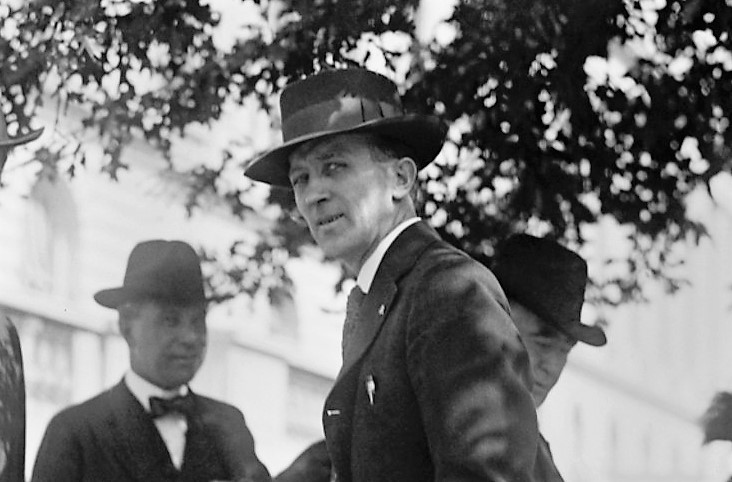
William Z. Foster leaves on his months-long fact-finding trip investigating the European labor movement. The trip would make Foster an ardent syndicalist, using his experiences and letters home in an attempt to intervene in the I.W.W. to steer them in a syndicalist direction. Failing that, after the 1911 convention, Foster would start the Syndicalist League of North America. Here, he offers his first report as he crosses the country and boards a steamer to sail the Atlantic.
‘Our Foreign Correspondent’ by William Z. Foster from The Industrial Worker. Vol. 2 No. 24. September 3, 1910.
On Board Steamer Prinz Friedrich Wilhelm, Bound for Cherbourg, France, August 10, 1910.
Fellow Workers:
I left New York so suddenly that I had no opportunity to write you a letter, so I will briefly cover the topics in this letter that I would have more fully discussed had I not been so hurried. My trip east was a somewhat uneventful one; in fact, the most exciting and exasperating time I had was trying to adjust myself to the price of food, which, in the eastern country, has gone soaring to dizzy heights. Despite the wretchedly low wage scale prevailing throughout the east compared to the west the cost of living is greater in the east, unbelievable as it may seem. I got a much better 25c meal in Spokane or Butte than I did in Baltimore or Philadelphia. All the way across the country as the wage scale drops the price of food rises until you reach the eastern coast, where it is almost prohibitive. How the slaves even keep alive on their miserable wages is a mystery to me.
I stopped at Gary, Indiana, for a few hours and was deeply interested in this modern product of capitalism. A town built almost overnight because of its strategic position in the steel industry. Having read of the so-called “fortifications” around the great steel mills I took trouble to investigate and found the statements in the circular of the Nat. Ind. U.M. & Workers to be correct. The site of the mills has undoubtedly been chosen and developed with the idea of making the plant easily defensible against attack from strikers. It fronts on Lake Michigan on the north and a deep creek flows along the south and east. The bank of the creek on the nil side has been raised about a dozen feet. ostensibly to raise the level of the yard, but evidently to serve as a hindrance to a mob of strikers. The embankment extends along the short distance not protected by water. While the embankment looks innocent in itself, when one has the key to the situation he is startled by the resemblance of the plant to a great fort.
The entrance to the “works-fort” is by way of a bridge, and as I stood on this bridge and watched the thousands of slaves swarming into the works it made me smile o think of how vain all these fortifications will be against an army of educated workers who thus have the privilege extended to them of capturing the works daily by way of the main gate.
I arrived in New York on July 29th. Gave the few I.W.W. in town a talk on the Spokane fight. New York is the same New York as before. Its most remarkable characteristic is its growth. Great sky “scratchers “and hotels are going up on every side; no sooner is one finished than a swarm of “cockroaches” descend upon it and in a jiffy it is fully tenanted. The I.W.W. has the insect powder that will eventually drive these vermin from their cracks and crannies. What a scurrying there will be when the working class finally gets in action. Alas!, poor old Broadway, what will you do without your gilded parasites!
On the east side, in the notorious slum district, the conditions under which the slaves live are horrible. Accustomed as I am to the slaves of New York, I could not but feel disgusted after a ramble through the “Ghetto.” In this modern inferno the people swarm like maggots in the carcass of a dead dog. Not much more foul and ill-smelling is the dead dog than the homes of these victims of profit. In Streets covered with stinking filth and litter, a densely packed mass of squalling, brawling. fighting, crying, playing, hawking, bargaining human beings live their allotted span in this “best of worlds.” The pitiable part of it all is that these poverty stricken wretches take their miserable fate almost as a matter of course. Ignorance rules supreme among the denizens of the “Ghetto.”
In the midst of this proud monument to American civilization there is a little square, and in the center of this square, within easy reach of any itching revolutionary fingers, flies the American flag. How proud the brothel keepers, the preachers and other patriots must feel when, after wandering through the miles of monster rookeries of tenements, to suddenly meet “Old Glory” thus boastfully flying over such a scene. I was filled with disgust and took an “L” train to the Bronx to get a breath of fresh air. Here at the famous Bronx Zoological Gardens I saw “5,000 animals kept in captivity,” according to the official brag–in a space that would suffice to “keep in captivity” at least 200,000 human beings in lower. New York.
The police graft on prostitution in-New York is so high as to be almost prohibitive, and many unfortunate women, who are unable to pay, are forced to adopt many expedients in order to make a living. One of the favorite methods is to hire a room in a tenement and post a man at the street entrance to act as a solicitor. Anyone passing through the tenement districts soon gets accustomed to the multitudinous hails of these rustlers. This is still further specialization or division of labor, I suppose. The women who either can pay the graft or have a political “pull” brazenly strut about the streets by the hundreds.
In the western country usually a man needs quite a little capital in order to go into business; but not so on the east side of New York. In this crowded district hundreds of peddlers infect the streets and many of them have for a stock in trade a second-hand pair of pants or coat. When one of these “merchants” makes a sale he “sells out,” and with the proceeds he buys a new stock and possibly a cup of coffee.
A Sunday visit to Coney Island, the playground of New York’s vast army of slaves, is something to be remembered. With its customary niggardliness towards its slaves, capitalism has set aside as a playground a place so small that on a hot Sunday it is simply jammed with people. The crowds are everywhere. On the beach there is standing room only for the majority of the bathers. In order to sit down one must wait until a place in vacated by some earlier arriver. There isn’t room in the shallow water for one-tenth of the bathers: Under conditions such as these the benevolent bathing masters rent 75c suits to the slaves for 50c a pair. Taken altogether the bathers are a thoroughly miserable looking lot as they stand broiling in the hot sun. According to the rules of Coney Island, however, they are enjoying themselves, so they let it go at that.
After struggling for a couple of hours in the dense crowds filling the streets, lined with thousands of catch-penny devices of every sort. I hit the trail back to New York.
After knocking about New York for a few days I took this steamer to Cherbourg, from whence I expect to go to Paris by rail. The trip has been uneventful so far, except that we are experiencing the crowded conditions usually obtaining on these trans-Atlantic hog pens.
There are about 1,800 slaves in the steerage, most of them being “stake men” from the coal and iron districts of Pennsylvania. Several of them belong to the U.M.W. of A. and it is surprising how much they understand about industrial unionism. One of them, who had never heard of the I.W.W., told me in broken English how the hard coal miners scab on the soft coal miners and vice versa, and how each scab on themselves by making district contracts. They have the “one big union” idea strong and it is a moral certainty that some-thing will be doing in the Pennsylvania country soon whether the I.W.W. is the organization or not by which it is done.
Though these slaves have the fundamental working ideas very strong, they are also greatly tainted with religion. We are being fed rotten grub on this trip, and many times I have been amused to see a devout Russian believer in the Christian myth, after duly thanking God for his beneficence in giving him his daily allowance of slop, taste the foul mess and after spitting in disgust, throw it overboard. Then he would open up a broadside of guttural curses against the cooks and the ship officers. He don’t seem to see any inconsistency in thanking God for giving him the food and then blaming the cook because it is unit to eat. How long will it take these disciples of an outworn religion to finally get wise and eliminate God from his universe and more closely investigate where his grub comes from.
The revolutionary sentiment is strong among these slaves. One young Polander is going home. He will have to serve in the Russian army, but he informs me in case of active service the only one he will ever shoot will be Russian officers.
But I must bring this letter to a close. We are expecting to sight the coast every moment now and I must hurry and get a shave and pack my cigar box preparatory to going ashore.
Yours for serious trouble with the boss.
W.Z. FOSTER.
The Industrial Union Bulletin, and the Industrial Worker were newspapers published by the Industrial Workers of the World (IWW) from 1907 until 1913. First printed in Joliet, Illinois, IUB incorporated The Voice of Labor, the newspaper of the American Labor Union which had joined the IWW, and another IWW affiliate, International Metal Worker.The Trautmann-DeLeon faction issued its weekly from March 1907. Soon after, De Leon would be expelled and Trautmann would continue IUB until March 1909. It was edited by A. S. Edwards. 1909, production moved to Spokane, Washington and became The Industrial Worker, “the voice of revolutionary industrial unionism.”
PDF of full issue: https://www.marxists.org/history/usa/pubs/industrialworker/iw/v2n24-w76-sep-03-1910-IW.pdf
 Revolution's Newsstand