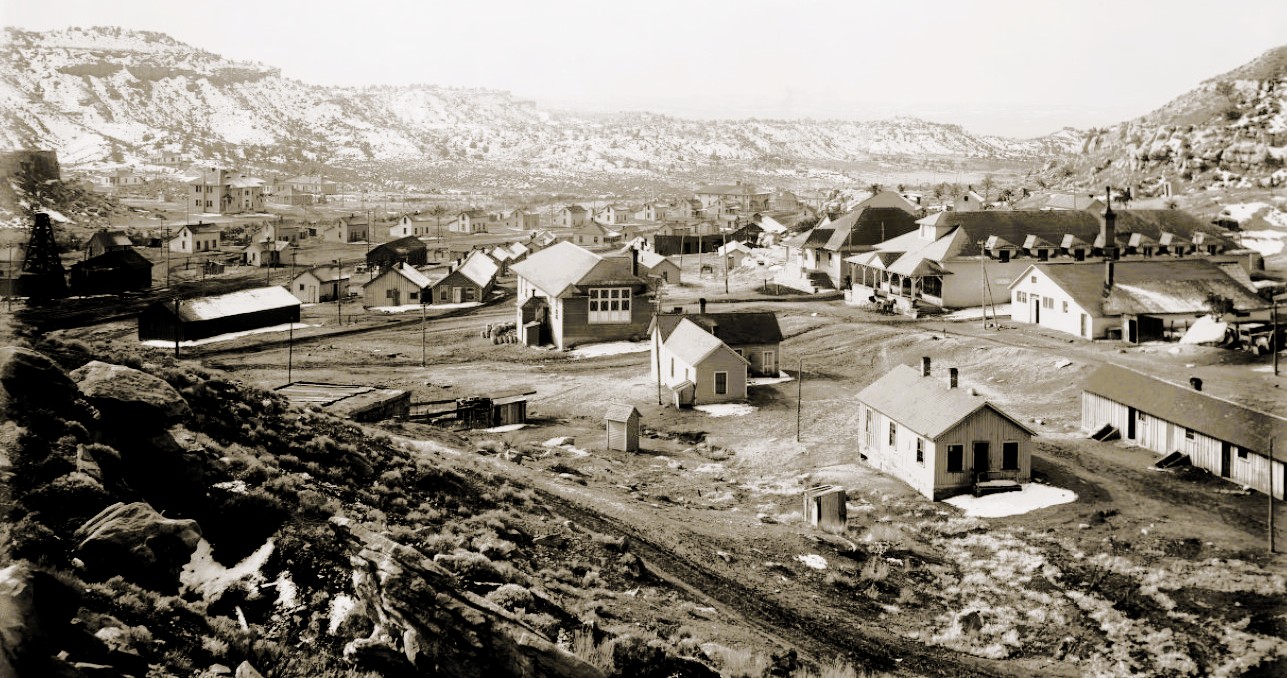
Involving mainly indigenous and Mexican workers, the National Miners’ Union strike in Gallup, New Mexico gets underway with mass picketing.
‘1,000 Picket New Mexico Mines and Break Through Armed Thugs’ from Western Worker. Vol. 2 No. 37. September 11, 1933.
Women Join Men in Battling Deputies; Five Mines Tied Up in N.M.U. Strike
GALLUP, N.M., Aug. 30. A picket line of 1000 men and women broke through the lines of the deputy sheriffs and armed thugs at the Gomerco mine late last night. The mine has been on strike since August 26.
All day long mass picket lines were not molested. About 9 p.m., however, when the night shift of pickets went to relieve the men, they were met by drunken deputies who refused to let them relieve the pickets.
The pickets came at once to a meeting of the unemployed local of the National Miners Union, then in session, and after hearing their report the unemployed voted to go out to all the camps and mobilize pickets to smash through the deputies’ lines.
At 10:30 p.m. there were 950 miners and their wives and daughters assembled in the union hall, ready to leave for Gomerco. A short meeting was held and in the meantime trucks were mobilized to carry the pickets. By 11:30, the State highway was lined with cars and trucks, led by a truckload of women from the Women’s Auxiliary of the N.M.U.
At the entrance to the company property, the pickets formed in lines four abreast, with the women leading the line of march, singing strike songs.
At the tipple, three deputies’ cars were drawn across the road and armed thugs halted the march. The women improvised verses to the tune of labor songs, calling the deputies “brave men” for facing unarmed workers with guns. “We’ll go to the 5 and 10,” they shouted, “and buy us water pistols if you don’t watch out.”
The lines pushed forward and finally the deputies drew back and the march surged on. Cheering and shouting to the pickets still on duty, they ran across the tracks to the cages where the pickets were stationed. “This is your picket, relief,” they shouted. “We are parked for the night.” All night long the throng of men and women stayed at Gomerco.
Not one scab has entered any of the five struck mines since the strike was declared. Gomerco is the largest mine in Gallup. The power house at Gomerco supplies the cities with electricity, and the local press declares that, “with all the mines shut down, it is only a matter of days until Gallup will be without lights or water.”
COAL MINING OUT
Though the mine operators have stated that they have sufficient coal for three weeks, it is obvious that they are desperate. National Guardsmen and uniformed thugs are scheduled to arrive in Gallup at 2 p.m. today, but the miners are determined to stay out until the end.
This morning an old-timer told of the 1917 strike, when miners were picked up on the streets and loaded into box cars, which carried them to other cities. “Last night was not like that,” he said. “This time we won. This is different.” “Yes,” shouted another, “and this is a different union, too.”
State Labor Commissioner Davey, in a conversation with Martha Roberts, organizer of the Women’s Auxiliary of the N.M.U., asked if she would get Robert Roberts, N.M.U. organizer, to call off the strike. “This is not the United Mine Workers of America,” he was informed. “No bureaucrats can call our strike, neither can they call them off. This is entirely the miners’ affair and their decision is the only final and official decision.”
Picketing is going on at all the five mines. An appeal is being solicited for relief funds. Rush all funds to N.M.U. Relief Committee, Box 218, Gallup, New Mexico.
Western Worker was the publication of the Communist Party in the western United States, focused on the Pacific Coast, from 1933 until 1937. Originally published twice monthly in San Francisco, it grew to a weekly, then a twice-weekly and then merged with the Party’s Daily Worker on the West Coast to form the People’s Daily World which published until 1957. Its issues contain a wealth of information on Communist activity and cultural events in the west of those years.
PDF of full issue:https://www.marxists.org/history/usa/pubs/westernworker/1933/v2n37-sep-11-1933.pdf
 Revolution's Newsstand