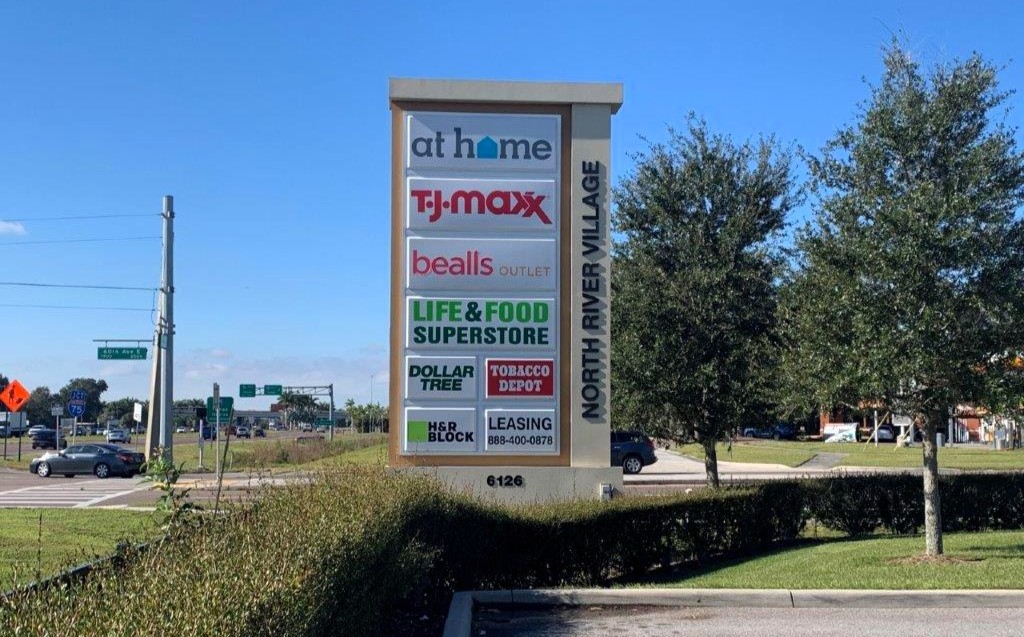
And so it begins. Capitalism creates a profoundly unnatural, grotesque, and utterly indistinct landscape where you don’t know if you are in Colorado or Florida.
‘Big Growth of Chain Stores’ by Justus Ebert from Solidarity. Vol. 6 No. 282. June 5, 1915.
In no sphere of capital is concentration going on’ on such a scale as in retail distribution. In older times, this was attempted by way of the department stores. In them, every phase of retail selling was carried on under one roof. But that method is now giving way to another method, namely, that of the chain of stores, handling, or specializing in, one or a few lines only.
Few people have any idea of the extent of this development. Conducted most largely on a local basis, it appears to be only of a local nature. Its highest development has, however, been obtained on an interstate and national basis, in the United Cigar Stores Co. and the Great Atlantic and Pacific Tea Co. Both of these companies are backed by tens of millions of capital and have over a thousand stores each in the leading cities, with new additions being opened every week.
The United Cigar Stores Co. group of capitalists also owns the Riker-Hegeman chain of drug stores in the principal cities of the East, and has recently absorbed the United Chemists’ Co.) operating combination drug and cigar stores in cities of smaller size. It is reaching out in other directions and may be said to be the largest and most powerful operator of chain stores in this country.
Other chain stores of a more than local character are those owned and operated by the various shoe companies, like the Douglas, Regal, etc. Some of these, companies operate from a score to three scores of stores in the larger sized cities. They, too, are constantly extending their operations by increasing the number of their branches.
England has also some colossal chain stores. This is more remarkable in view of the fact that England is believed to be the home of competition and “no trusts.” The Lipton Tea Co., with, a capitalization of $13,000,000 and 469 stores; Homes and Colonial Stores, $7,500,000 and 688 stores; Maypole Dairy Co., $7,000,000 and 835 stores, and the Pearks Co., $1,750,000 and 200 stores; are the leaders of this system in “the tight Little Island” across the herring pond.
Every big city has a local corporation with many stores. These abound especially in the grocery line. This field, it was one time claimed, was of such a petty character as to make big and profitable organization impossible. The Profit Sharing Corporation has been organized under the laws of Delaware with a capital stock of $2,000,000. The company plans to open a large number of grocery stores and meat markets in Greater New York, and later to conduct a wholesale and importing business. The first store, at 96th street and Amsterdam avenue, New York, is now open, and other stores, it is stated, are already under lease.
In the leading cities of New Jersey, it is the National Grocery Co. that is much in evidence. Its stores are to be seen in many localities, especially those inhabited by workingmen. In New York city, it is the James Butler Co., a $3,000,000 corporation, with a large central warehouse, and some 400 stores; the Roulston Co., and lesser concerns. In Philadelphia, the Acme Tea Co., with 253 stores there and 136 more across the river in Camden, N.J.; the Bell Co., with 151 stores, the Robinson Co. with 138, and the Dunlap Co., with 50, are the leaders in this line of selling groceries at retail on a large and profitable scale.
The retail candy trade is also becoming a profitable, field for the chain store system. New York has three in operation–Huyler’s, Loft’s and the Mirror stores. The Huyler chain now braces 27 stores within greater New York and 29 in other large cities of the United States and Canada. They do a combined business of about $4.000.000 a year, it is said. The Huyler factories and stores employ on an average of 3,000 persons. Loft’s has eleven stores in the greater city, and one in Newark, N.J. Its factory and store employes average 1.100. The Mirror is a $500,000 corporation; its average number of employees is unknown. It has a large factory and 13 stores, all in lower Manhattan.
None of the employees of the chain stores are organized. Like the leading corporations in wholesale production, the leading corporations in retail distribution, are non-union and antagonistic to labor organization. So they depend mainly on the trade of the workers, they could be brought to time by organizing the purchasing power of the latter.
“No union; no working class trade,” should be the slogan.
J. E.
The most widely read of I.W.W. newspapers, Solidarity was published by the Industrial Workers of the World from 1909 until 1917. First produced in New Castle, Pennsylvania, and born during the McKees Rocks strike, Solidarity later moved to Cleveland, Ohio until 1917 then spent its last months in Chicago. With a circulation of around 12,000 and a readership many times that, Solidarity was instrumental in defining the Wobbly world-view at the height of their influence in the working class. It was edited over its life by A.M. Stirton, H.A. Goff, Ben H. Williams, Ralph Chaplin who also provided much of the paper’s color, and others. Like nearly all the left press it fell victim to federal repression in 1917.
PDF of full issue: https://www.marxists.org/history/usa/pubs/solidarity-iww/1915/v06-w282-jun-05-1915-solidarity.pdf
 Revolution's Newsstand