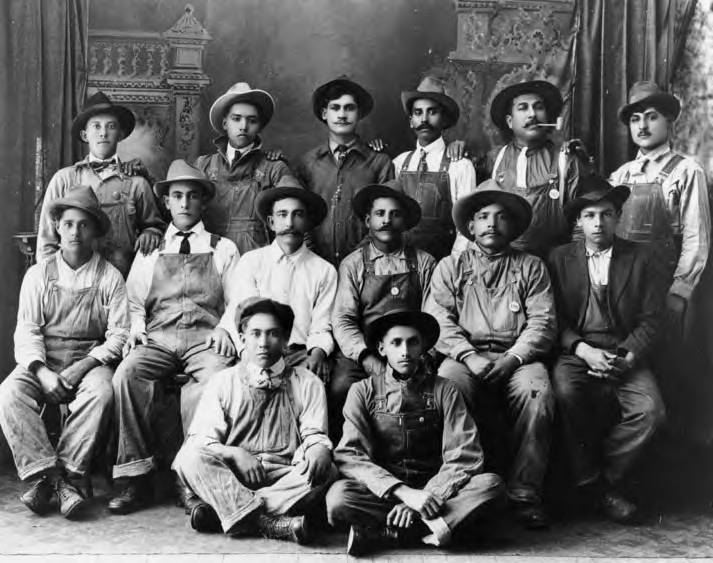
Hugo Oehler, here writing as Communist Party Organizer for District 10 (Kansas, Nebraska, Colorado, Utah, and Wyoming), urges the Party to attend to Mexican workers in the U.S. with and speaks to the dangers of white chauvinism, and the growing division between Black and Mexican workers.
‘Special Problems of the Mexican Worker in the U.S.’ by Hugo Oehler from The Daily Worker. Vol. 4 No. 221. September 29, 1927.
Victims of Low Wages and Social Oppression—Must Be Brought Into American Labor Movement—Found Mostly in Basic Industry
SINCE the immigration restrictions against the European worker have been effective the influx of Mexican workers into the United States, especially the Central Western division, has increased. The number of workers that have entered the country exceeds the allotment granted and this is due to the increasing demand for cheap labor, due to the immigration laws and the internal condition of Mexican economy.
IN the southwestern part of the United States, in those states stolen from Mexico in 1848, the Spanish speaking population was always great and large sections have been and are dominated by the customs, language and even laws of these people. But in the last few years they have increased and a movement northward of migratory workers, who shift from place to place looking for a livelihood can be recorded.
They are mainly employed on the railroads, as the poorest paid workers in section gangs, in the packing industry, the metal mines, the cement industry, etc., and are being used in greater numbers in large plantations of the west slope of the Rockies and are in some places of the south taking the places of Negro workers.
THE condition of the majority of these workers, the wage standard and discrimination puts them in the section of the most exploited workers in America. In some places their wages have been reduced lower than the Negro worker and these isolated instances, that seem to be increasing, have caused a psychological reaction on a section of the backward Negroes who have come in contact with them, creating in these Negro workers the! feeling of superiority, a reflection of the treatment they receive from the white workers. An influx has brought with it an increase of discrimination on the part; of the backward white workers, especially in the northern division where the line was not drawn so tight before.
FOR example in Kansas City a young Mexican 21 years old stepped into; a drinking parlor on Southwest Blvd., and asked for a drink of soda! water. After he was told to leave, cussed and insulted because he happened to be a Spanish speaking worker, the owner threw a ball bat at him that dangerously injured the young worker. Friends, both Spanish and English-speaking workers took the case up, however, in the northside court. The assailant was dismissed with a $5.00 fine. Friends were not satisfied with this and a $10,000 suit has been filed against this man.
The problem of the Mexican workers; their relation to the Negro workers and white workers, their relation to the exploiters of America, their relation to the trade unions and to the revolutionary party of the workers in American is a problem that can not be pushed aside.
THE systematic education of the workers, the Negro workers and the English and Spanish speaking, in spite of the language difficulties to this special phase of activity, is essential in order that progress by the militant section of these workers can be effective in penetrating the backward workers.
The connection of the struggle of the Spanish-speaking workers of America with the struggle of the American workers against the capitalist as well as a closer alliance with the Mexican workers’ fight against American Imperialism is necessary.
AN ideological campaign, first among the Mexican workers of America in order to rid their advanced section here of leftism and show them the need of working within the A.F. of L., is needed. Great numbers of the Mexican workers in the southern border section are members of the Mexican Unions and correctly consider the leaders of the A.F. of L. as tools of imperialism. However, they do not seem to understand the role of Morones nor the great pressure they could exert within the A.F. of L. Secondly, a campaign in order to insure their admittance in the A.F. of L. and the organization of these workers in their respective industries should be begun.
THE Mexican workers conditions and past as well as his present connections with Mexico make for ripe revolutionary action in the linking up of their struggle with the American workers and the Spanish-speaking workers of Mexico. The strengthening of the ties of the American workers with the Spanish-speaking workers residing in the United States will be a reflection of the unity of the workers against imperialism, a lever for further fighting against imperialism, and the strengthening of the opposition to future invasions of Mexico.
The Daily Worker began in 1924 and was published in New York City by the Communist Party US and its predecessor organizations. Among the most long-lasting and important left publications in US history, it had a circulation of 35,000 at its peak. The Daily Worker came from The Ohio Socialist, published by the Left Wing-dominated Socialist Party of Ohio in Cleveland from 1917 to November 1919, when it became became The Toiler, paper of the Communist Labor Party. In December 1921 the above-ground Workers Party of America merged the Toiler with the paper Workers Council to found The Worker, which became The Daily Worker beginning January 13, 1924.
PDF of full issue: https://www.marxists.org/history/usa/pubs/dailyworker/1927/1927-ny/v04-n221-NY-sep-29-1927-DW-LOC.pdf
 Revolution's Newsstand