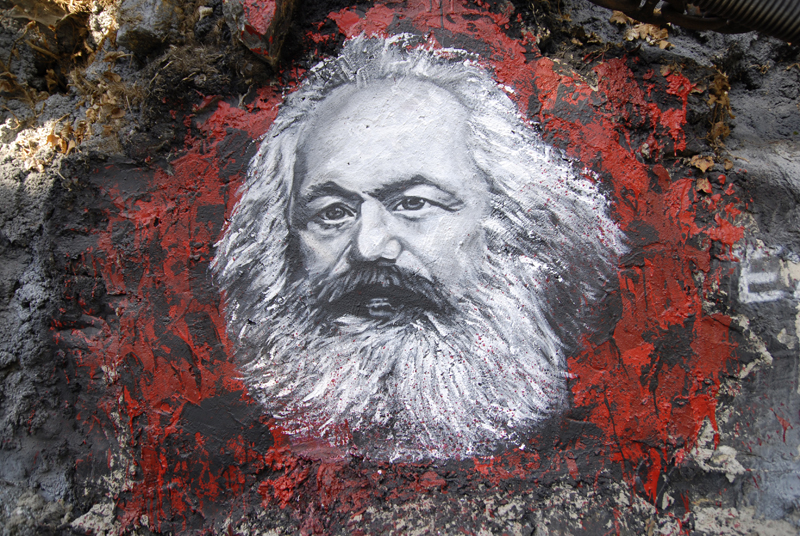
Written in 1908 and here translated by Ernest Untermann, the Foreword, Introduction and first chapter of Kautsky’s popular presentation of Marx’s ideas. Other chapters to follow.
‘The Historical Achievement of Karl Marx: The Unification of Natural and Mental Science’ by Karl Kautsky from The Socialist (Seattle). Vol. 8 Nos. 373 & 374. April 25 & May 3, 1908.
Foreword
At the request of the Educational Committee of our party at Bremen I gave a lecture on Karl Marx in that city on December 17th of the preceding year. Some of the Bremen Comrades who had heard this lecture urged me to issue it in pamphlet form, since it was calculated, in their opinion, to correct widespread errors concerning the meaning of Marxism and the achievement of Marx. Herewith I comply with this invitation, without, however, limiting myself to a mere reproduction of that lecture. I have enlarged it at different points for publication, particularly in its first part.
It is not a eulogy on Karl Marx, which I bring here. Such a thing would not suit the proud mind of the man whose motto was: “Follow your course and let the people talk.”
Moreover, it would be out of place at a time when his personal significance is recognized by all the world.
I am rather interested in facilitating the understanding of the gift of Marx to the world. This is by no means so generally known as would be necessary at a time, when bitter controversies are carried on for and against Marx. Many a one may find on reading the following lines, that thoughts, which have become matters of fact today, had to be discovered by Marx and Engels through hard work. They will also find that ideas, which are offered to us today as surprising and new discoveries, by which the “obsolete” Marxism is supposed to be overcome or further developed, are at bottom nothing but the revival of conceptions and modes of thought which were in vogue before Marx and were wearing away, and which were overcome precisely by Marx, although they always reappear to the new generations, who are strangers to the history of our movement.
For this reason this work is not written merely as a contribution to the history of our party, but also as a contribution to the settlement of pending questions.
Friedenau, February 1908, K. KAUTSKY.
Introduction
On March 14th, 1908, it will be 25 years since Marx died, and in the beginning of the same year it was six decades since the “Communist Manifesto” appeared, in which his new teaching found its first comprehensive expression. These are long periods for times as fast as ours, which change their scientific and artistic conceptions as quickly as their style of dressing. But nevertheless Karl Marx still lives among us in his full strength, and he dominates the thought of our times more than ever, in spite of all crises of Marxism, in spite of all refutations and defeats by the chairs of capitalist science.
This amazing and ever increasing influence would be wholly inexplicable, if Marx had not succeeded in laying bare the last roots of capitalist society. If he has done that, then it is a fact that, so long as this form of society endures, no new social discoveries of any fundamental nature can be made beyond those of Marx. And in that case the way shown by him will remain theoretically and practically far more effective than any other. The powerful influence of Marx upon modern thought would, however, be unintelligible, if he had not been able to grow mentally beyond the confines of the capitalist mode of production, to recognize the tendencies, which lead on beyond it towards a higher order of society, and in this way to hold up to our view remote aims, which shall become more distinct and tangible through the further progress of historical development. To the same extent will the magnitude of the man be revealed, who was the first to understand them clearly.
It is the rare combination of scientific depth with revolutionary daring, which causes Karl Marx to live far more powerfully among us now, a quarter of a century after his death, two generations after the beginning of his public career, than he did when he was actually alive.
Let us try to gain a clear conception of the nature of the historical achievement of this wonderful man. We shall then realize that it may most appropriately be regarded as a work of unification, a unification of different, and often seemingly antagonistic fields in a higher unity. Above all we mean the unification of natural science and mental science, of English, French and German thought, of the labor movement and socialism, of theory and practice. That he succeeded in all this, that he was not only familiar with all these fields by his unequalled universality, but also grasped them to the point of mastery, made It possible for Karl Marx to accomplish his stupendous historical mission, which places its mark upon the last decades of the nineteenth and the first of the twentieth centuries.
The Unification of Natural and Mental Science
The foundation of all of Marx’s activity is his theoretical achievement. It is the first to be considered before all others. But it is precisely this which offers the greatest obstacles to popular presentation. We hope to be able to overcome these difficulties, although we shall have to limit ourselves to a few suggestions. At any rate, the points of which we propose to treat after this will be easily understood. The reader, therefore, should not be deterred, if the following pages should offer a little difficulty, from pushing onward through the others.
The sciences are divided into two great territories: The Natural Sciences, which seek to explore the laws of the movement of living and inanimate bodies, and the Mental Sciences, which bear this name unjustly, since the mind, so far as it manifests itself as the expression of some individual body, is analyzed by the natural sciences. Paychology, the science of the soul, is wholly carried on by methods of natural science, and the mental sciences have never attempted to heal diseases of the mind. The claim of natural science to this territory remains unchallenged.
The thing called Mental Science is actually Social Science, and deals with the relations of man to his fellow men. Only those mental activities and expressions of man, which come under this head, are analyzed by the mental sciences.
Within the Mental Sciences we may distinguish two groups: One kind studies human society as such by means of mass observations. Of this kind is Political Economy the science of the laws of social economy under the rule of commodity production; Ethnology, the science of the different social conditions of different nations; finally Primitive History, which explores the social conditions of periods which did not bequeath any written records to us. The other group of mental sciences comprises studies which have so far had mainly the individual for their starting point, and treated of the position and activity of the individual in society; History, Law, Ethics or Morality.
This second group of mental sciences is extremely old and has from time immemorial exerted the greatest influence upon the human mind. The former group, however, was new at the time when Marx was in process of formation, and had just acquainted itself with scientific methods. It remained confined to specialists and had as yet no influence upon public thought, which was controlled by the natural and mental sciences of the second group. But there was a deep chasm between the two last named kinds of sciences, and it revealed itself in antagonistic world conceptions.
Natural science had discovered so many necessary and law-controlled interrelations in nature, that is, it had found by frequent tests that the same causes always produced the same effects, that it was thoroughly imbued with the assumption of a general lawfulness of nature and completely rejected the Idea of mysterious powers, which were supposed to interfere with the natural events in an arbitrary manner. Modern man no longer endeavors to incline such powers in his favor by prayers and sacrifices. His aim is rather to understand the laws of natural Interrelation, in order to produce, by his own interference, such effects as are helps to his existence or well being.
It was different in the so-called mental sciences. These were still dominated by the assumption of a free will of man, which should not be subject to any lawful necessities. The jurists and moralists felt constrained to cling to this assumption, because the bottom would otherwise have slipped from under their feet. If man is a product of conditions, if his will and actions are the necessary effects of cause, which are not dependent upon his good will, then what would become of sin and atonement, of good and bad, of legal and moral condemnation?
True, this objection was urged only by a certain motive, a consideration of “practical reason.” It was not a proof. But the proof was supplied principally by historical science, which rested essentially upon a mere collection of written documents of former days, in which the deeds of single individuals, particularly of rulers, were registered either by themselves or by others. It seemed impossible to discover any controlling law in those individual deeds. In vain did thinkers in natural science try to discover any such natural necessity. Of course, they were unwilling to believe that the universal laws of nature should not apply to the actions of men. Experience supplied them with enough material to show, that the human mind was not an exception in nature, that it rather replied to definite causes by definite effects. However, while this could undeniably be proved in the case of simpler mind activities, which man shares with animals, the natural scientists were unable to find any casual connection for the social Ideas and ideals, so that they were unable to fill this gap. They might indeed assert that the human mind was a part of nature and subject to its natural laws, but they could not prove it convincingly upon all fields. Their materialist monism remained incomplete and could not make an end to idealism and dualism.
Now Marx came and saw that the history and the ideas and ideals of men in history, with their successes and failures, were the result of class struggles. But he saw still more. Class antagonisms and class struggles had been observed even before him in history, but they had generally been regarded as the work of ignorance and spite on the one hand, of highmindedness and enlightenment on the other. Marx, on the contrary, revealed their necessary interdependence with economic conditions, whose laws may be understood, as Marx proved better than anyone else. These economic conditions in their turn rest in the last analysis upon the manner and measure of man’s control over nature, due to his understanding of natural laws.
Only under definite social conditions are class struggles the agents of history; whereas the struggle against nature is, in the last resort, always the prime motive power. No matter how peculiar society may appear when compared to the rest of nature, here as there we find the same manner of movement and development by a struggle of opposites, which always proceed fundamentally from nature, the dialectic development.
By this means the social development was placed within the frame of natural development, the human mind, even in its most complicated and supreme expressions, the social, was revealed as a part of nature, and the natural lawfulness of its activity upon all fields demonstrated, so that philosophical idealism and dualism were deprived of their last foothold.
In this way Marx has not only completely revolutionized the science of history, but also bridged the chasm between the natural sciences and mental sciences, laid the foundation for the unification of the entire human science, and thus made philosophy superfluous, to the extent that it sought to bring about the unification of thought concerning the world process in the role of a wisdom standing outside of the sciences and above them, because formerly this unification could not be gained from the sciences.
It signifies a stupendous rise of science, this achievement of Marx by his conception of history. The entire human thought and understanding had to be powerfully fertilized by it. But strange to say, capitalist science declined it, and only in opposition to capitalist science, as a special proletarian science, could the new scientific, conception assert itself.
The assertion of an antagonism between bourgeois and proletarian science has been ridiculed, as though such a thing as a bourgeois or proletarian chemistry or mathematics could exist. But the scoffers merely prove that they do not know the real point.
The discovery of the Marxian materialist conception of history was based upon two prerequisites. In the first place, it required a certain rise of science, and in the second place a revolutionary point of view.
The laws of historical development could not be recognized, until the new mental sciences mentioned above, political economy, and in it particularly economic history, furthermore ethnology and primitive history, had reached a certain eminence. Only these sciences, from whose material the individual was excluded from the outset, which were based at the start upon mass observations, could reveal the fundamental laws of social development and thus pave the way for the study of those currents, by which the individuals floating on the surface, whom the traditional writings on history considered and registered alone, are driven about.
These new mental sciences developed only with the capitalist mode of production and its world traffic, they could not accomplish remarkable results until capital had come to rule, which implied, indeed, that the capitalist class had ceased to be a revolutionary class.
But only a revolutionary class could accept the theory of the class struggle. A class that wants to conquer the power in society must also want the struggle for this power, it will easily grasp the necessity of such a struggle. On the other hand, a class that is in possession of the power will regard every struggle for it as an unwelcome disturbance and reject every teaching which reveals its necessity. It will object to such teaching all the more, if the theory of the class struggle is a theory of social development, which demonstrates the inevitable outcome of the present class struggle to be the abolition of the present rulers of society.
But also the teaching that human beings are products of social conditions to the extent that the members of a certain form of society differ from those of another form of society is not acceptable to a conservative class, because in that case a change of society itself appears as the only means of changing human beings. So long as the bourgeoisie were revolutionary, they likewise held that human beings are the products of society. But unfortunately the sciences, by which the motive forces of social development could have been understood, were not sufficiently developed in those days. The French materialists of the 18th century did not know the class struggle and did not consider technical development. They knew, indeed, that in order to change men it would be necessary to change society, but they did not know, whither the forces were to come that should change society. They saw these forces in the omnipotence of a few extraordinary men, especially in that of school masters. Beyond this point bourgeois materialism did not progress.
As soon as the capitalist class became conservative, the thought seemed unbearable to them that it should be social conditions, which were to blame for the particular evils of our times and which would have to be changed. To the extent that the bourgeoisie think scientifically, they now attempt to demonstrate, that men are by nature and must be what they are, and that to change society would mean to overthrow the order of nature. However, a man must be very exclusively educated as a naturalist and have remained wholly untouched by the social conditions of our time, in order to contend that these will endure forever by natural necessity. The majority of the capitalist class no longer find the courage to do this, they seek consolation in a repudiation of materialism and an endorsement of freedom of the will. They claim that it. is not society which makes human beings, but human beings that make society, according to their will. Society is imperfect because human beings are. We should improve society, not by social transformations, but by uplifting the individuals and inspiring them with a higher morality. Better men will then of themselves create a better society. Thus ethics and the championing of freedom of the will become the favorite doctrines of the present day bourgeoisie. By this means they pretend to show their good will to remedy social evils, and yet this is not. supposed to pledge them to any social changes, but on the contrary to ward of such changes.
Whoever is standing upon the soil of capitalist society, cannot have any access, from this standpoint, to any of the knowledge gained upon the basis of the unification of all sciences achieved by Marx. Only he who looks critically upon existing society can come to an understanding of this knowledge, that is, only he who stands upon proletarian soil. To this extent proletarian science may be distinguished from bourgeois science.
Naturally the antagonism between these two expresses itself most strongly in the mental sciences, whereas the antagonism between feudal, or catholic, and capitalist science shows itself most clearly in the natural sciences. But human thought always strives after unity, the various fields of science always influence each other, and for this reason our social conceptions impress themselves. upon our entire world conception. Consequently the antagonism between bourgeois and proletarian science asserts itself also in natural science.
This may be observed even in ancient Grecian philosophy, and it is shown, for example, by the following illustration from modern natural science, which is closely related to our subject. In another place I have already indicated that the bourgeoisie, so long as they were revolutionary, also assumed that natural evolution proceeds by catastrophes. But since they have become conservative, they refuse to have anything to do with catastrophes, even in nature. According to them, evolution now proceeds in very slow steps and exclusively by means of imperceptible changes. Catastrophes appear as something abnormal, unnatural, something that is rather calculated to disturb natural development. And in spite of the Darwinian struggle for existence bourgeois science makes every effort to identify the conception of development with that of an entirely peaceful process.
For Marx, on the other hand, the class struggles were but a special form of the universal law of natural development, which is by no means of a peaceful character. Evolution for him, as we have already indicated, is “dialectic,” that is, a product of a struggle between opposites, which appear of necessity. But every struggle of irreconcilable antagonisms must ultimately lead to a defeat of one of the combatants, in other words, to a catastrophe. The catastrophe may be long in preparation, the strength of one of the opponents may increase imperceptibly, that of the other decrease absolutely or relatively, in the end the collapse of one of them will become inevitable, that is, inevitable as a result of the struggle and the increasing strength of the other, not inevitable in the sense of something that accomplishes itself. Day by day, step by step, we meet with little catastrophes, in nature as well as in society. Every death is a catastrophe. Every existing form must at some time succumb to the overwhelming power of antagonisms. This applies not only to plants and animals, but also to entire societies, entire empires, entire celestial bodies. For all of them the process of development prepares from time to time catastrophes by the gradual accumulation of antagonisms. No movement, no development, without occasional catastrophes. They are a necessary stage of development, evolution is impossible without occasional revolutions.
In this conception we have overcome both bourgeois conceptions of evolution, the revolutionary one, which assumed that evolutions proceed exclusively by catastrophes, as well as the conservative one which does not regard a catastrophe as a necessary point of transition of a frequently very slow and imperceptible process of transformation, but rather as a disturbance and obstacle of such a process.
Another antagonism between bourgeois and proletarian, or, if you please, between conservative and revolutionary science, is found in the field of epistemology (Theory of understanding). A revolutionary class that feels in itself the strength to conquer society, is also inclined to acknowledge no barrier to its scientific conquests and think itself capable of solving all problems of its time. A conservative class, on the other hand, instinctively dreads every progress, not merely upon the field of politics and sociology, but also upon that of science, because it feels that any deeper knowledge can no longer help it much, but may do it much harm. It is inclined to belittle confidence in science.
Even the most daring revolutionist of today can no longer share the naive confidence which animated the revolutionary thinkers of the 18th century, who fancied that they carried the solution of all world problems in their pockets and that they were the mouth pieces of absolute reason. No one will want to deny nowadays, what a few thinkers knew also in the 18th century, and some even in antiquity, namely that all our cognition is relative, that it represents an interrelation between man, or his I, and the rest of the world, that it shows to us only this interrelation, not the world itself. All cognition is relative, conditional and limited, and there are no absolute or eternal truths. But this signifies nothing else but that there is no end to our cognition, that the process of cognition is an infinite and unlimited one, that it is indeed vain to represent any cognition as the last conclusion of wisdom, but no less vain to formulate any statement as the ultimate limit of wisdom, which we are supposed never to exceed. We rather know that humanity has always succeeded in passing beyond every limit of cognition, of which it ever became conscious, of course only to find other limits beyond, of which it formerly knew nothing. We have not the least reason to shrink from any definite problem, which we can recognize; we need not lose courage, fold our hands resignedly and mumble: We shall never know about that. But it is precisely such discouragement which is typical of modern bourgeois thought. Instead of exerting all their powers to extend and deepen our knowledge, bourgeois thinkers today devote themselves chiefly to finding definite limits by which our cognition is supposed to be bounded forever. and thus to discrediting the accuracy of scientific understanding.
So long as the bourgeoisie were revolutionary, they pass ed by such problems. Marx likewise paid no attention to them, much to the indignation of the present bourgeois philosophy.
There have been a number of journals in our history named ‘The Socialist’. This Socialist was a printed and edited in Seattle, Washington (with sojourns in Caldwell, Idaho and Toledo, Ohio) by the radical medical doctor, former Baptist minister and socialist, Hermon Titus. The weekly paper began to support Eugene Debs 1900 Presidential run and continued until 1910. The paper became a fairly widely read organ of the national Socialist Party and while it was active, was a leading voice of the Party’s Left Wing. The paper was the source of many fights between the right and left of the Seattle Socialist Party. in 1909, the paper’s associates split with the SP to briefly form the Wage Workers Party in which future Communist Party leader William Z Foster was a central actor. That organization soon perished with many of its activists joining the vibrant Northwest IWW of the time.
PDF of full issue: https://www.marxists.org/history/usa/pubs/thesocialist-seattle/080425-seattlesocialist-v08n373.pdf
PDF of issue 2: https://www.marxists.org/history/usa/pubs/thesocialist-seattle/080503-seattlesocialist-v08n374.pdf
 Revolution's Newsstand