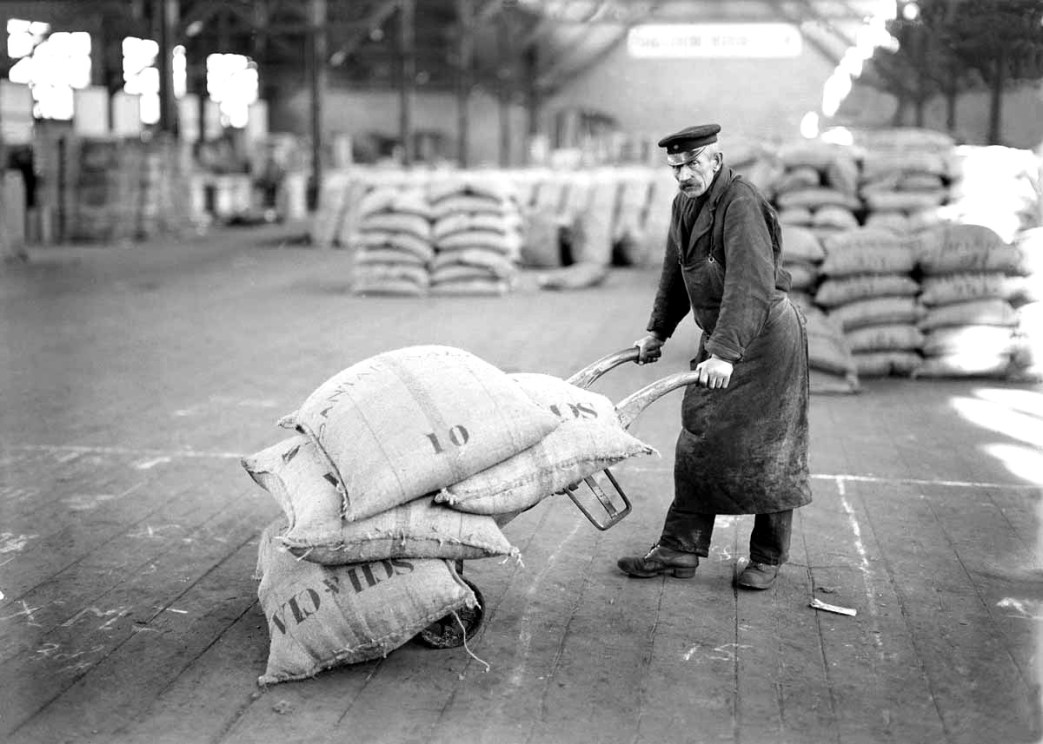
The sharp end of the stick of the post-war German labor movement were the internationalist dock workers of Hamburg.
‘The Struggle of the Hamburg Dock Workers’ by A.H. from International Press Correspondence. Vol. 4 No. 26.April 24, 1924.
The piecemeal surrender of the social and political fruits of the year 1918 in Germany is justified by the leaders of the trade unions on the ground that the proletariat is quite ununited in its will and that the preliminary conditions of the taking up of the struggle to maintain these gains are not present and what makes it still worse is that the proletariat do not wish to fight.
True, numerically, considered as an organization the proletariat, so far as its economic fighting organizations come into question, is split up into organized and unorganized, but the chief blame for this regrettable weakness of the German proletariat must be born by the trade union bureaucrats and the whole leadership of the ADGB. (General German Trade Unions Federation).
The struggle of the Hamburg dock workers has proven that the German proletariat can be weakened in its organization but not in its will to struggle. Fifteen thousand workers unanimous and resolute conducted the struggle without regard to the political and economic organizations to which they belonged. Also thousands of unorganized workers took part in the struggle.
The struggle has all the greater moral significance because it was in its character a sympathetic strike for the 25.000 workers of the shipyards who were locked out for refusing to sacrificing the eight hour day. The employers also demanded from the dock workers that they should work on two shift system instead of a three shift system as had so far been the case and that meant the same thing as giving up the eight hour day. In a plebiscite which was held by the German Traffic Alliance the dock workers decided by more than two thirds majority against the sacrifice of the eight hour day. In spite of the unanimity of the strikers the strike petered out because it was not conducted in accordance with active revolutionary principles.
Officially the committee of the dockworkers section of the Traffic Alliance had the leadership of the strike in their hands but the gathering together of the strikers into meetings was not arranged by them. The leadership was bound to fail because it was not lead by the strikers themselves and therefore did not possess the confidence of those involved in the struggle. Alongside of this official direction of the strike there existed an illegal revolutionary body which was composed of representatives of the shop councils, the representatives of the revolutionary fraction in the Traffic Alliance, the unemployed and the new Dock Workers Union which was founded last year. The decisions of this illegal body were accepted by the masses very hesitatingly at the beginning of the struggle and only in the last stages were the measures they recommended carried out by the strikers. This illegal body had its mistakes also. The chief one was that they also were not elected by the mass of strikers and that they were not under the control of those who were chiefly concerned in the struggle. That was the reason that their decisions were so slowly adopted. Thus the basis upon which they could work was too small. They were not firmly enough anchored in the masses.
The illegal body directing the strike decided to formulate the following demands both for the dock workers and the shipyards workers.
Eight Hour Day.
Real Wages to be the same as in the time before the war. Reduction of the percentual difference in the scale of wages. Equalisation of the wages of juvenile and adult workers. No overtime work.
Re-opening of the closed up businesses and resumption of full production in short time factories.
Re-engagement of unemployed. No compulsory labour.
Abolition of the two shift system.
These demands were adopted by the strikers. They are quite usual and contain nothing that would upset the earth. The employers and the trade union bureaucrats declared them to be extravagant and that no one could possibly take them up. The Emergency Service which was formerly organized by the Social Democrats was put into action. Senator Hense, the former Social Democratic secretary of the Building Workers’ Union placed the sabres of the police at the service of the employers. The Hamburg “Society for Home Defence” to which many Social Democrats belong had the following circular sent to all dock workers as a document of culture:
“What workers earns as much today as before the war?” Answer: “No worker in Germany” with however one exception, namely the dockworkers of Hamburg could have a wage of 5,20 marks for a nine hour day if they would not strike. Before the strike the dockers received only 4,50 marks for an eight hour day and in peace time they received 5,40 for nine hours, so that they have now the offer of 96% of their peace time wages. But they dare not work because the union does not allow it, and the union does not allow the catchword of the eight hour day, because nothing shall be done to upset.
Before the war and after the war the dock workers worked more than eight hours and were actually very glad over every hour of overtime. Hov is it that they are suddenly not able to work nine hours a day.
No worker and no working woman can give a reasonable answer to this. But every worker and working woman knows that one can not live from catchwords and specially not from the catchword of the eight hour day.
The employers have demanded the introduction of the nine hour day and the work in two shifts because through this increase work a greater result will be achieved. Greater results make the dock work cheaper without the dock worker receiving less wages, indeed he actually receives higher wages.
Cheaper work attracts more ships and more cargoes to Hamburg and thus brings more opportunities of work for the workers.
How many ships has this senseless strike already chased away and kept away from Hamburg. How many ships have gone to foreign harbours which nearly came to the harbour of Hamburg and which would have brought work to this harbour if the leaders of the union had come to an agreement with the employers in time and had thrown the catchword of the eight hour day overboard.
If the extra hour’s work and the increased wages which are offered by the employers are introduced into the harbour of Hamburg a large amount of work will come to Hamburg so that the dock workers will be fully employed at good wages.
Therefore it is in the interest of every worker and docker a duty to his family to demand from the leaders of the strike that the offer of the employers 5,20 marks docker’s wages for a nine hour shall be accepted. Nothing is to be gained by the strike. On the contrary each day of the strike increases the loss. Hamburg, March 1924.
Signed: Hamburg Society for Home Defence. The union bureaucrats demanded the acceptance of a decision which had been given by a board of arbitration. In spite of all machinations the workers organized in the Traffic Alliance decided by a vote of 4819 to 1686 to reject it. It is true that the decision decided in favor of the eight hour day but there was no increase in wages and no solution of the strike among the shipyard workers. After the rejection of the award a large scale agitation against the strikers began. The Central Executive of the Traffic Alliance telegraphed that another referendum which they said would be sure to be in favour of the acceptance of the award was to be held. The Federal Minister of Labour came personally to Hamburg as well as a representative of the Central Executive in order to bring about the end of the strike. Braun, the Federal Minister of Labour, succeeded in convincing the trade union bureaucrats as well as the majority of the legal strike committee of the necessity of ending the strike. By circulars, by meetings in the local meeting places the strikers were influenced to give up the strike and to resume work. It was due to this pressure that hundreds and thousands of the strikers became shaky and declared themselves ready to resume work. It did not take place in a body but hesitatingly from day to day so that on the third day the illegal strike committee saw itself obliged to summon a meeting and to decide to end the strike.
The struggle suffered in its force chiefly because it received no support, that is backing, from the other land industries in Hamburg, and before all no support in the other towns of the Baltic and North Sea and further that the international harbour proletariat did not react to the struggle.
The Hamburg Dock strike shows that the workers are prepared to struggle with the employers in great mass struggles for their own naked existence. But at the same time it shows us that mass struggles cannot be conducted upon “old approved lines” of the trade union movement but that these struggles must be born by the activity of the strikers. A preliminary condition is naturally a smoothly working leadership which holds the confidence of the strikers and further that such struggles mass must be still more broadened out.
It is true that the harbour of Hamburg is an important nerve centre of Germany but the ship that come and go can be towed and loaded just as easily in another harbour. If the Hamburg dock workers wish to be victorious they must render it
impossible for strike breaking work to be performed in other harbours. In the case of the dockyard works must be added that the repairs can be carried out in foreign dockyards. Thus one sees how necessary it is that all the dock workers of the North and Baltic should be united into a firm organization and that close touch should be maintained with all harbours of foreign countries, and that it is also necessary that the seafaring proletariat shall unite still more closely with the harbour workers and be joined up with them in an industrial union according to sections. This struggle has also a political significance. If this significance did not become apparent the fact remains firm for us that if the Federal Minister of Labour had not succeeded in ending the strike by his personal intervention the state of siege would have probably been proclaimed over Hamburg and the harbour declared to be a vital industry. That would have meant that the strikers would have been forced by means of machine guns to take up their work.
The proletariat as a whole must take the lesson of the struggle, that it is necessary to proceed now to prepare for the next struggle which will certainly have greater significance than the Hamburg struggle which was broken off.
International Press Correspondence, widely known as”Inprecor” was published by the Executive Committee of the Communist International (ECCI) regularly in German and English, occasionally in many other languages, beginning in 1921 and lasting in English until 1938. Inprecor’s role was to supply translated articles to the English-speaking press of the International from the Comintern’s different sections, as well as news and statements from the ECCI. Many ‘Daily Worker’ and ‘Communist’ articles originated in Inprecor, and it also published articles by American comrades for use in other countries. It was published at least weekly, and often thrice weekly.
PDF of full issue: https://www.marxists.org/history/international/comintern/inprecor/1924/v04n26-apr-24-1924-inprecor.pdf
 Revolution's Newsstand