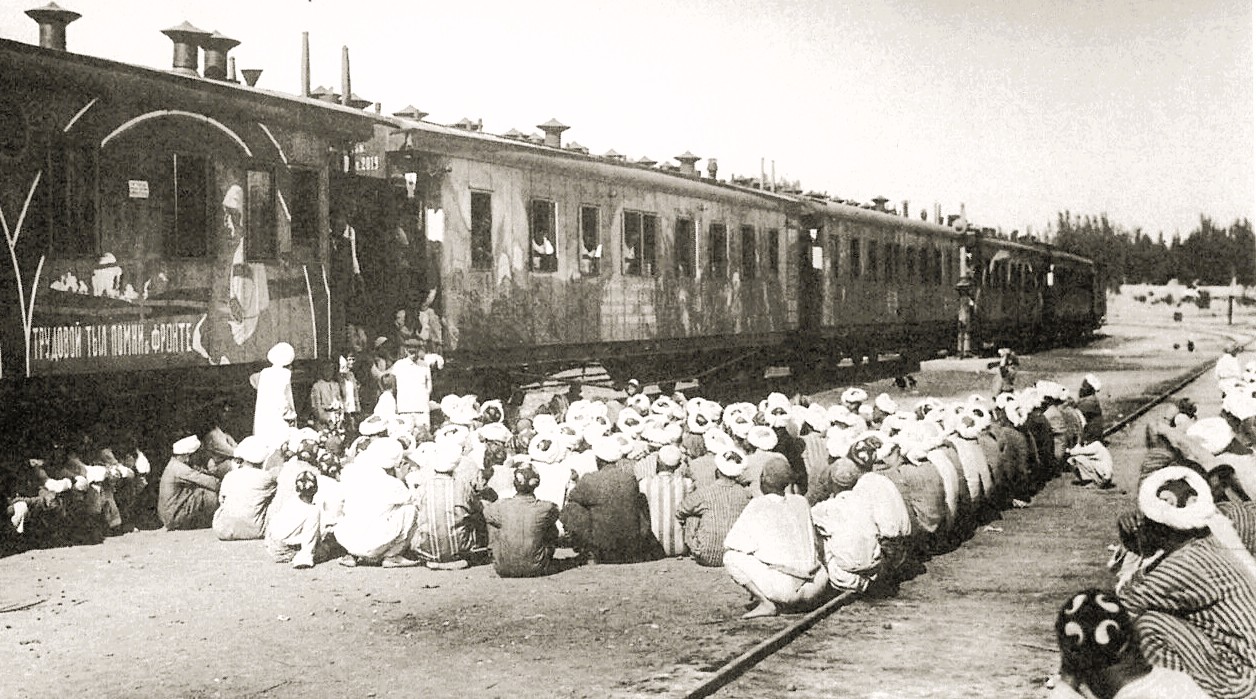
The correspondent for Avanti on the battle for a Soviet Central Asia, and its profound impact on the region, on Soviet Russia, and all of Asia.
‘From the Turkestan Front’ by C. Niccolini from Soviet Russia (New York). Vol.1 No. 25. December 6, 1919.
FOR A NEW CIVILIZATION
FIGHTING has been going on in a part of Orenburg for a long time. The famous Cossack chief Dutov has been one of the first to declare war on the Soviet Republic. This part of Russia is very important, for it constitutes the route to Turkestan, the only cotton market for the textile industry of Russia. In aiding the Orenburg Cossacks, the Entente tried to isolate Turkestan and to compel Russia to close all textile factories for want of cotton.
It is in this region that the Russian army (Red army) has achieved a great victory.
The left wing of the Kolchak army was made up of Orenburg Cossacks and one may say at present that it exists no more. Thus the task which it had set for itself–to unite with the Denikin forces that had taken Tsaritsin–has come to naught.
Five divisions of the Orenburg Cossacks went over to the side of the Soviet army. In the region of Akhtiubinsk, on the Orenburg-Tashkent railroad line, the Soviet army has taken over 12,000 prisoners. In Akhtiubinsk a delegation of the southern army of Kolchak arrived in order to make arrangements for the surrender of twenty thousand soldiers.
This success has a great importance not only from a military standpoint but from an economic standpoint as well. The railroad line from Orenburg to Tashkent has been freed thus and an enormous supply of cotton (400,000 tons) harvested in Turkestan, despite all the efforts of British imperialism, will be capable of being transported to the factories of Soviet Russia.
The union of the Soviet Republic with Turkestan will yield enormous advantages to Bolshevism, and it is therefore that England is so much preoccupied with it. As long as the Churchills and the Lloyd-Georges will continue the war against the Soviet Republic, the latter will not cease perfectly its own propaganda and agitation in Asia. The Mussulmans of Turkestan, upon receiving all they need from Russia, will be able to help their nationals in Afghanistan and India, and England will begin to feel what it means to insist on a continuation of war and, on famishing communist Russia.
India is the backbone of British imperialism. Its breaking up would mean the tottering of the British imperialist colossus.
Turkestan is an autonomous Soviet republic, and this is why it constitutes part of the Russian Soviet Federation: it has its own government, which is composed of the Russian and the Mussulman workers and peasants. In spite of the extended interruption of communication with Russia, in spite of the isolation in which it has been held for over a year, the Russian army of Turkestan has fought heroically the White Guards of Kolchak and of England. The English held already a part of the railroad line from Krasnowodsk to Merv. With the opening of communications, Soviet Russia will obtain an enormous supply of products. It will be able to renew the work upon the magnificent project for the irrigation of Turkestan, which, once it is finished, will make of Turkestan a country that will be able to supply with cotton the whole world, thus overcoming the English supremacy in this commodity.

The Mussulman peasants who suffered so much from czarism and who were so maltreated by their compatriots, the landowners, have already been supporting the Soviet regime with arms in their hands for two years.
It is the Mussulman Socialist and Communist youth which has perfected and is perfecting this. enormous work of propaganda and education They meet of course with a strong opposition on the part of the Mussulman priests and elders. England is trying, as usual, to organize a reactionary movement as in Bokhara and Khiva. Their own Curzon declared some time ago in London the firm determination of England to save Persia from the Bolshevist peril.
The Soviet Republic has the greatest moral influence in the Mussulman world all over Asia. Anyone who is acquainted even superficially with Oriental affairs knows that they are of a nature which cannot be disregarded. There is in the Orient a marvelous supply of raw materials indispensable for industrial production.
It is on account of these future centres of raw material supply that the dissension started and became acute between the two capitalist states: Germany and England; a dissension which flared up in an international conflagration. But the German propaganda in those countries did not hit the mark, because the working population felt as if instinctively that it was a matter of one imperialism against the other, and it did not want to play the game of the possible new masters against the old ones. But the Bolshevik propaganda has taken an entirely different course.
All the appeals, manifestos, the constitution of the Russian Republic, are known everywhere in Asia; the name of Lenin is very popular as well as, in a very high degree, his manifesto to the peoples of Asia.
European public opinion knows but little about the movement in Asia, because the censorship has not permitted correct information to pass. But the governments ought to know if their counsels and informants apprize them truthfully of the occurrences.
It is a very interesting fact that the popular movement in Mongolia and Tibet against the ruling castes and the European domination is under the influence of the Russian socialist revolution and has in it program many of the demands which make up the program of the Bolsheviks. It is truly astonishing to see the sacrifices and hardships with which many tribes from the remotest countries of Asia send their representatives to Russia in order to get in contact, receive information, books, etc., regarding the new communist republic.
From India, from China, from Corea, from every country there comes streaming this host that has heard that Russia, once the domain of the white czar, has been the first to bring down the fire of Prometheus. And as for Asia, there is no necessity for printed matter. He who has lived in the Orient knows how oral propaganda spreads there.
I remember that when the soldiers of the Republic were still fighting against Germany, before the peace of Brest Litovsk, one writer, a Japanese professor, seriously proposed in a Tokio publication an agreement with the Bolsheviks of the following nature: “Since the Bolsheviks– he stated–are good agitators and propagandists, and have already caused the disintegration of the German army, in recompense for the recognition of their government, they must be kept steadily at the front and put under obligation to make propaganda among the German soldiers in order to aid the Entente.”
What will the good professor say now, knowing that also the Japanese soldiers in Siberia and in Corea, and, principally, the sailors of Vladivostok, are beginning to succumb to the subversive propaganda of the Bolsheviks.
The latest news says that England has begun the evacuation of the Caucasus. If it is true that she is withdrawing her troops from Tiflis (the capital of the paradise of the Menshevik Republic of Georgia), it would mean that affairs in Asia are going wrong. Otherwise, England surely would not have left the poor Tseretelli without assistance. It has been stated in the Georgian papers that Italy has supported the English. At any rate, there is little probability that England will withdraw her troops from Baku and the Caucasus, because hardly would the foreign troops have departed, than serious calamities would overcome the secessionist socialist governments of the infinite number of republics in the Caucasus.
Woe to the Japanese, English and French imperialism, should the Asiatic powder-magazine blow up. If we concede that the European proletariat is not capable, because of the baseness of its leaders, to compel its bourgeoisie to cease warring against Russia, the Soviet Republic would be foolish if it did not try to destroy the enemy forces wherever possible, and the resulting damage would be irreparable. The moment of the fall of European domination in Asia will be perhaps the day of liberation for all the peoples in Asia as well as in the rest of the world.
-Avanti, September 24, 1919.
Soviet Russia began in the summer of 1919, published by the Bureau of Information of Soviet Russia and replaced The Weekly Bulletin of the Bureau of Information of Soviet Russia. In lieu of an Embassy the Russian Soviet Government Bureau was the official voice of the Soviets in the US. Soviet Russia was published as the official organ of the RSGB until February 1922 when Soviet Russia became to the official organ of The Friends of Soviet Russia, becoming Soviet Russia Pictorial in 1923. There is no better US-published source for information on the Soviet state at this time, and includes official statements, articles by prominent Bolsheviks, data on the Soviet economy, weekly reports on the wars for survival the Soviets were engaged in, as well as efforts to in the US to lift the blockade and begin trade with the emerging Soviet Union.
PDF of full issue: https://www.marxists.org/history/usa/pubs/srp/v1v2-soviet-russia-Jan-June-1920.pdf
 Revolution's Newsstand