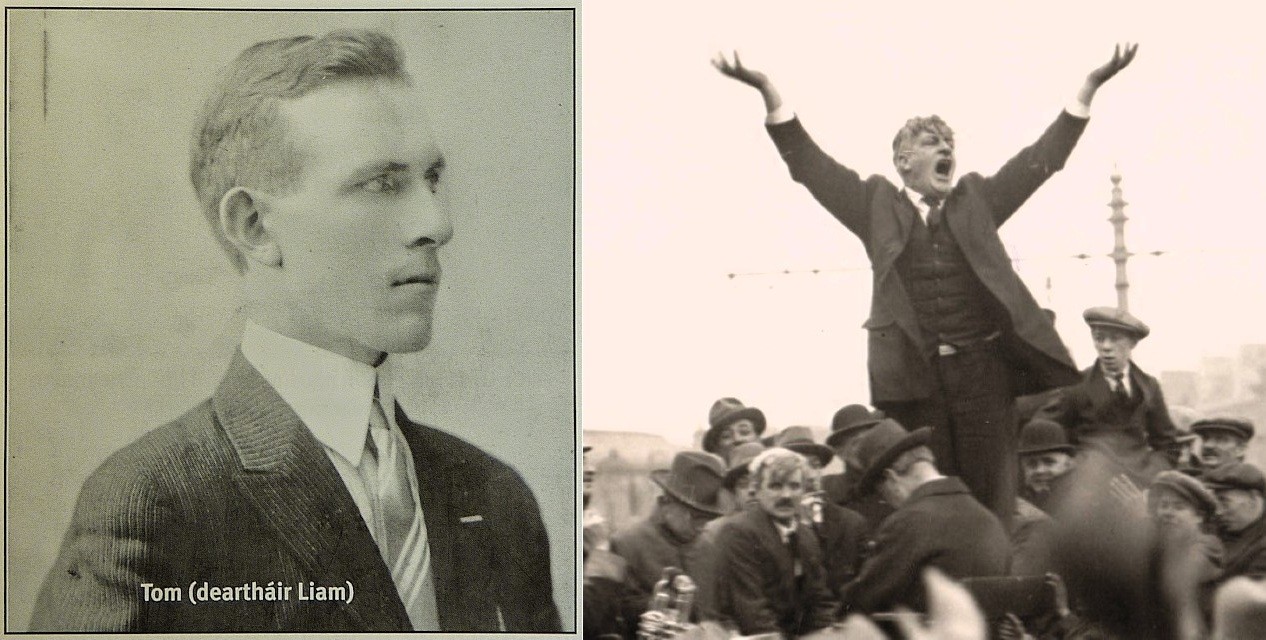
O’Flaherty does not mince his words in his criticisms of James Larkin’s leadership of the I.T.G.W.U.
‘Jim Larkin and the Irish Trade Union Movement’ by T.J. O’Flaherty from The Daily Worker. Vol. 2 No. 18. February 1, 1925.
The trade union movement has gone thru a very severe crisis within the past two years. From 1916 to 1921 the membership of the Irish Transport and General Workers Increased from a few thousand to over one hundred thousand.
Because of favorable economic conditions it was able to secure some wage increases and owing to the glamor lent to its name by James Connolly, the leader of the Easter week revolution, it was looked upon as a revolutionary organization. In fact its official organ, the Voice of Labor, talked glibly of the forming of Soviets and the organization of Red guards.
AFTER the war there was a revolutionary sentiment thruout the ranks of the organization end in several places the workers seized factories and hoisted the red flag. These incidents were frowned upon from headquarters. But some time prior to the advent of the British labor party to office, a wave of industrial depression hit Ireland and the bosses opened an offensive against the Transport Union. Severe losses in membership and wage cuts resulted.
THERE was a considerable left wing sentiment in the Transport Union but it had no leadership. The Communist Party was small, weak and inexperienced. When Jim Larkin was released from Sing Sing in 1923, thru a pardon, the Irish left wingers were happy in the thought that they now had a leader who would organize the scattered radical forces and give them a program. On his return to Ireland he was greeted by thousands of workers. He still had his old place on the executive committee of the Transport Union, the office of general secretary. It was a powerful, strategic position. But Larkin as usual muffed the ball.
AS was the case in America he was surrounded by a group of place hunters and sycophants who were discredited in both the labor and nationalist movements.
They were not radicals. Outside of the Communist fraction, his cronies were disappointed leaders who had no principles and no aims except to gain office. Instead of using his position as general secretary to win over the masses to his views (what they are nobody has yet been able to learn), he decided to make a frontal attack on the old executive committee and charged them with using the funds of the union for political purposes and for the organization and sustenance of a workers’ citizen army. It was quite true that the funds were used for this purpose. It is also true that such use of union funds was in violation of English law but English law was not always all powerful in Ireland.
***
THE charges were threshed out in court and Larkin lost, the executive committee taking care to appear in the role of revolutionists, while Larkin, who talked revolution brought the union into court for having violated an English law. It is bad enough for a trade unionist to resort to a capitalist court anyhow, but this action of Larkin’s was extremely stupid. Even if he could get his hands on the $180,000 which he accused the officials of misappropriating for political purposes, putting up labor candidates, he would have nevertheless suffered a moral defeat before the masses in playing the role of law enforcement agent.
***
HIS expulsion from the union followed the trial and he then organized a dual union, called the Workers’ Union of Ireland. He launched weekly, paper called the Irish Worker.
Those who knew Larkin’s methods did not expect the venture to be anything more than short-lived, particularly in face of the competition of the powerful Transport Union. After several jurisdictional quarrels between the two unions, lawsuits instituted by Larkin on Larkin’s friends, he was adjudged bankrupt by the Dublin courts in November and his examination showed that his assets amounted to something like ten dollars, while he owed five thousand. He should know by now that capitalist courts are dangerous playthings for workers.
***
IN one of the latest issues of his paper to reach here, Larkin threatens to quit unless his supporters came across with money, automobiles, jewelry or anything else that could satisfy a printer. It was something like what Grand Duke Cyril would issue. Whether his paper has given up the ghost or not I do not know, but there is no doubt that his experiment in dual unionism is a fizzle.
***
LARKIN has a reputation of being a revolutionist, but the reputation is not founded on any basis more substantial than a loud voice. His first act on returning to Ireland was to instigate the liquidation of the Communist Party, so that he could hold the center of the stage as the only “revolutionist” in Ireland. He does not believe in organization, unless it takes orders from him. An incurable egomaniac, he refuses to accept advice from anybody. Larkin attended the latest congress of the Red International of Labor Unions, but since his return he never mentioned the Profintern or made any effort to carry out its decisions.
***
LARKIN’S failure, in view of the particularly rosy opportunity that awaited him on his return from the United States, is an object lesson in trade union tactics that should be taken to heart by Communists everywhere. By splitting the union, taking the officials into a capitalist court on the sordid charge that they had used union funds for political purposes calling strikes of members of his dual union against members of the Transport Workers, engaging in business ventures thus laying himself open to suspicion, and in general his all around buffoonery, is a splendid lesson in the wrong way to fight reactionaries in the trade unions.
***
IN addition to those colossal blunders Larkin had no program, neither did he show by word or act that he was more revolutionary than the officials in power. As it was, the workers were confronted with a choice between two evils. Whether the Irish labor movement, which looked so promising during the dark days when the trade union movement on the continent was dragged at the heels of the capitalist war chariot, will soon again play a progressive role, in Europe, is hard to predict. Perhaps the negotiations now taking place between the Russian and British unions may have some beneficial effect in Ireland. The Irish Trade Union Congress is neither affiliated with the R.I.L.U., or with Amsterdam. A Trade Union Educational League is badly needed there. What is needed is organization and discipline and not a Barnum or a Marcus Garvey.
The Daily Worker began in 1924 and was published in New York City by the Communist Party US and its predecessor organizations. Among the most long-lasting and important left publications in US history, it had a circulation of 35,000 at its peak. The Daily Worker came from The Ohio Socialist, published by the Left Wing-dominated Socialist Party of Ohio in Cleveland from 1917 to November 1919, when it became became The Toiler, paper of the Communist Labor Party. In December 1921 the above-ground Workers Party of America merged the Toiler with the paper Workers Council to found The Worker, which became The Daily Worker beginning January 13, 1924.
PDF of full issue: https://www.marxists.org/history/usa/pubs/dailyworker/1925/1925-ny/v02b-n018-NYE-feb-01-1925-DW-LOC.pdf
 Revolution's Newsstand