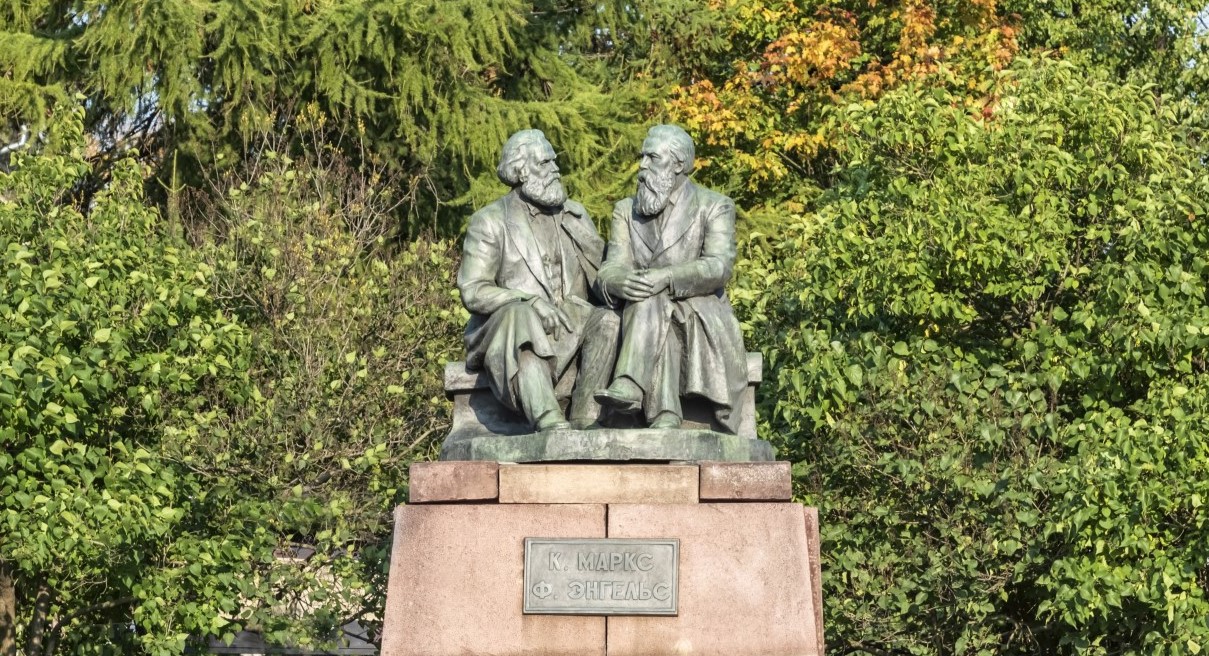
This chapter of Kautsky’s 1908 work as translated by Ernest Untermann looks at the revolutionary traditions of France, English political economy, and Germany philosophy in Marx and Engels.
‘The Historical Achievement of Karl Marx: Marx and Engels’ by Karl Kautsky from The Socialist (Seattle). Vol. 8 Nos. 375. May 10, 1908.
It was his revolutionary proletarian point of view which enabled a mental giant like Marx to lay the foundation for a unified science. But when we speak of Marx, we must never forget that the same great deed was also accomplished by a thinker who was his peer, Frederick Engels, and that without the intimate co-operation of both, the new materialist conception of history and the new historical or dialectic conception of the world could not have manifested itself at the first blow so perfectly and comprehensively.
Engels arrived at this conception on a different road than Marx. Marx was the son of a jurist, and had first been intended for a legal career, later for an academic one. He studied law, philosophy, history, and did not turn his attention to the study of economics until he keenly felt the lack of economic knowledge.
In Paris he studied economics, the history of revolutions, and socialism. Particularly the great thinker Saint Simon seems to have exerted a strong influence on him. These studies led him to understand that society is not made by law, nor by the state, but vice versa, that the society arising from the economic process makes the law, the state, according to its requirements.
Engels, on the other hand, was born as the son of a manufacturer. Not the classic high school, but the ordinary high school gave him the foundation of his knowledge and taught him to think after the manner of natural scientists. Then he became a practical merchant, carried on economics practically and theoretically, in England, in Manchester, the center of English capitalism, where his father had a factory. Being familiar with Hegel’s philosophy through his German training, he knew how to deepen his economic understanding, and his attention was directed mainly towards economic history. At the same time the proletarian class struggle, during the forties of the 19th century, was nowhere so well developed as in England, and in no other country did its connection with capitalist development show itself so plainly.
In this way Engels arrived simultaneously with Marx at the threshold of the same materialist conception of history, only by a different route. While the one came by way of the old mental sciences, law, ethics, history, the other came by way of the new mental sciences, economic history, ethnology and natural history. Both met in the revolution, in socialism. It was the agreement of their ideas, which at once drew them closer to one another when they came into personal touch in Paris, in 1844. This agreement of their ideas soon became a complete amalgamation into a higher unity, in which it is impossible to say, what and how much the one or the other has contributed to it. Marx was indeed the more powerful of the two, and no one has acknowledged this more unselfishly, even Joyously, than Engels himself. After Marx, their mode of thought is also called the Marxian. But Marx could never have accomplished what he did without Engels, from whom he learned a great deal. Of course, the reverse is also true. Each one of them was lifted by the co-operation with the other, and by this means each acquired a farsightedness and universality which he could not have secured by himself alone. Marx would have found the materialist conception of history without Engels, and Engels without Marx, but their development would no doubt have been slower and they would have passed through more mistakes and failures. Marx was the deeper thinker of the two, Engels the more daring. In Marx the power of abstraction was more strongly developed, the gift of discovering in the tangle of concrete phenomena the general; in Engels the power of combination was more pronounced, the gift of constructing out of individual characteristics the whole complex phenomenon in his mind. In Marx the critical power was more vigorous, even the self-critique, which put a bridle on the daring of his thought and constrained it to advance cautiously and examine the ground step by step, whereas the mind of Engels received light wings from his proud joy over the stupendous understanding gained by him and flew over the greatest difficulties.
Among the many suggestions received by Marx from Engels, one became especially significant. He had been tremendously uplifted by overcoming the one-sidedness of German thought and fertilizing German by French ideas. Engels acquainted him also with English thought. By this means alone did his mind rise to the greatest power which it could reach under the prevailing conditions. Nothing is farther from the truth than the assertion that Marxism is a purely German product, it has been international from its very inception.
The Unification of German, French and English Thought
Three nations were the bearers of modern civilization in the 19th century. Only he, who had become Imbued with the spirit of all three, was armed with all achievements of his century, only he could accomplish the best that was possible with the means of this century.
The unification of the thought of these three nations into a higher form, in which the one-sidedness’ of each should be overcome, forms the starting point of the historical achievement of Marx and Engels.
England, as we have already mentioned, had capitalism farther developed in the first half of the 19th century than any other country, owing particularly to its geographical location, which enabled it in the 18th century to draw considerable benefits out of its colonial policy of conquest and spoliation, which bled to death the states of the European continent bordering on the Atlantic Ocean. Thanks to its insular situation it did not have to maintain a large standing army, was enabled to devote its entire strength to the navy and to conquer the supremacy of the sea without exhausting Itself. Its wealth in coal and iron, enabled it to employ the wealth gained by its colonial policy for the development of a great capitalist industry, which in Its turn, through its supremacy of the sea, conquered the world market, that could be opened for the consumption of large masses of goods only by water ways, so long as the railroad systems had not been developed for this purpose.
Capitalism and its tendencies could therefore be studied in England earlier than elsewhere, and so could the proletarian class struggle, called forth by these tendencies, as I have already indicated. So the insight into the laws of the capitalist mode of production, that is, political economy, was nowhere farther advanced than in England. The same was true of economic history and ethnology, thanks to world commerce. Better than in other countries was it possible in England to recognize, what the future carried in its womb, and, thanks to the new mental sciences, to perceive the laws governing the social development of all times and thereby to accomplish the unification of natural and social science.
But England offered only the best material, not the best methods of research, for this purpose.
Just because capitalism developed earlier in England than anywhere else, the capitalist class there conquered the rule of society before feudalism had completely run its race in politics, economics, and in the human mind, and before the capitalist class had come to full self-dependence in every respect. The colonial policy itself, which permeated Capitalism so much, gave new strength also to the feudal lords.
In addition to this, the standing army did not reach a powerful development in England, for reasons which we have already mentioned. This prevented in its turn the rise of a strong centralized government. The bureaucracy remained weak, the self-management of the ruling classes retained its great power in a subordinate position. But this signified that class struggles were but little centralized and frequently split up.
All this caused the spirit of compromise between the old and the new to penetrate the entire life and thought. The thinkers and champions of the rising classes did not oppose christianity, aristocracy, monarchy on principle, their parties did not make any great programs. They did not strive to think their thoughts out, they preferred to champion only individual measures dictated by the practical exigencies of the moment instead of comprehensive programs. Narrowmindedness and conservatism, overestimation of little measures in politics and in science, indifference to all striving for the development of a wide horizon, penetrated all classes.
The situation was quite different in France. This country was economically far more backward, its capitalist Industries were mainly purveyors of luxuries, the small bourgeoisie predominated. The small burghers of a great city like Paris sounded the keynote. There were but a few such large cities with half a million inhabitants before the introduction of railroads, and they played a far different role than today. Armies could be only small before the introduction of railroads, which made the rapid transportation of masses possible. They were scattered through the country, could not be rapidly concentrated, and the mass of the people were not so helpless against the equipment of the military forces as they are today. It was also the Parisians, who had distinguished themselves more than others by opposition, and had forced concessions from the government by several armed revolts long before the great revolution.
Before the introduction of compulsory education, the improvement of the postal system by railroads and telegraphs, the spread of daily papers throughout the country, it was the population of the large cities which was mentally superior to the rest of the country and thus exerted a great influence upon mental life. Social Intercourse at that time offered the only opportunity for the mass of the uneducated to inform themselves, particularly about politics, but also on matters of art and even of science. How much greater was this possibility in a large city than in the country towns and villages! Whoever had esprit in France, crowded into Paris to express and develop it. Whoever expressed himself in Paris, was filled with a higher spirit.
And now this critical, overbearing, audacious population witnessed an unprecedented collapse of the government and of the ruling class.
The same causes, which retarded economic development in France, promoted the decline of feudalism and of the state. Especially the colonial policy entailed infinite sacrifices upon the state, broke its military and financial strength, and accelerated the economic ruin of the peasants no less than of the aristocrats. State, nobility and church were politically and morally bankrupt, and with the exception of the church also financially. Yet they managed to maintain their oppressive rule to the utmost, thanks to the power centralized by the government through the army and a widespread bureaucracy, and thanks to the complete abolition of all independent action and organization among the people.
This led finally to that colossal catastrophe, which we know as the great French revolution, and by which the small bourgeoisie and proletariat of Paris managed to rule all of France and defy all Europe. But even before that the increasing sharpness of the antagonisms, between the needs of the popular masses led by the liberal bourgeoisie and those of the aristocracy and clergy protected by the state power, led to the most radical defeat of all existing things in thought. War was declared against all traditional authority. Materialism and atheism, which had been in England merely a luxurious hobby of a degenerate nobility and vanished quickly with the victory of the bourgeoisie, became in France precisely the mode of thought of the most daring reformers among the rising classes. While in England more than anywhere else the economic root of class antagonisms and class struggles sprang into view, the France of the revolution showed. most clearly, that every class struggle is a struggle for political power, that the task of any great political party is not exhausted in some reform, but rather must keep in view the conquest of political power, and that this conquest, if accomplished by a hitherto suppressed class, always carries with it a change of the entire social fabric. While during the first half of the nineteenth century economic thought was most highly developed in England, political thought was most highly developed in France. While England was dominated by the spirit of compromise, France was ruled by that of radicalism. And while the detail work of gradual organization and upbuilding had its place in England, France was seized by a revolutionary passion that swept everything away.
Radical and daring action was preceded by radical and daring thought which considered nothing sacred, which fearlessly and heedlessly followed up every understanding to its last conclusions, and thought out every thought to the end.
But though the results of this thought and action were brilliant and captivating, it also developed the faults of Its virtues. Impatiently pushing toward the last and extremest alms, it took no time to prepare the way for them. Full of eagerness to storm the fort of the state by revolutionary impetuousness, it neglected the work of preparing and organizing its siege. And the longing to push on t ward the last and highest truths led easily to the most hasty conclusions based upon wholly inadequate material, preferred brilliant and surprising flashes to patient research. It gave rise to the habit of trying to master the infinite wealth of life by a few simple formulae and catchwords. British sober thought was met by Gallic love of phrases.
In Germany, the situation was still different.
Capitalism was even far less developed there than in France, for Germany was almost completely cut off from the great thoroughfare of European world commerce, the Atlantic ocean, and therefore recovered but slowly from the gruesome devastations of the Thirty Years’ War. Germany was still more a small bourgeois country than France, and lacked at the same time a strong central power. Split up into innumerable small states, it had no great capital to show. Petty provincialism and petty village nature made its bourgeoisie narrow, weak and cowardly. The final breakdown of feudalism was not accomplished by an uprising from within, but by an invasion from the outside. Not German burghers, but French soldiers swept it out of the most important parts of Germany. It is true that the great successes of the rising bourgeoisie in England and France excited also the German bourgeoisie. But every one of the fields conquered by the bourgeoisie of Western Europe remained closed to the enterprise of its most energetic and intelligent elements. They could not found any great commercial and industrial enterprises nor conduct them, could not take a hand in molding the destinies of state through a parliament or a powerful press, could not command navies and armies. Reality was dismal for them, nothing remained for them but to turn their backs upon reality and devote themselves to pure thought and idealize reality by art. They threw themselves with full force upon these fields, and accomplished great things upon them. Here the German people excelled France and England. While these produced a
Pitt, a Fox, a Burke, a Mirabeau, Danton, Robespierre, a Nelson and Napoleon, Germany produced a Schiller, a Goethe, a Kant, a Fichte, a Hegel.
Thinking became the foremost occupation of the great Germans, the idea for them constituted itself the ruler of the world, the revolution of thought became for them a means of revolutionizing the world. The more miserable and circumscribed reality was, the more their thought tried to rise above it, to overcome its limitations, to embrace all infinity.
While the English thought out the best methods for the victorious advance of their navies and industries, the French the best methods for the victorious advance of their armies and insurrections, the Germans thought out the best methods for the victorious march of thought and research.
However, this victorious advance, like the French and English, carried in its train disadvantages in theory and practice. The withdrawal from reality generated unfamiliarity with the world and an overestimation of ideas. These assumed life and strength by the themselves independently of the heads of men that produced and would have to realize them. People were satisfied to be right in theory and neglected to reach for power by which the theory might be applied. Though German philosophy was deep, and German science profound, though German idealism was imaginative, though they created magnificent things, under their surface was hidden an indescribable practical impotence and a complete renunciation of all striving for power. The German ideals were far more sublime than the French and decidedly more than the English. But the Germans did not take one step to get nearer to them. It was proclaimed at the outset that an ideal was something unattainable.
As conservatism sticks to the English, the radical phrase. to the French, so inactive idealism still clings in some measure to the German to this day. It is true that the great industrial development of the last decades has strongly restricted it. But even before that it found a counterbalance in the invasion of the French spirit after the revolution. To the mixture of French revolutionary thought with the German philosophical method, Germany owes some of its greatest minds. It is enough to remember Heinrich Heine and Ferdinand Lassalle.
But the result was still more stupendous, when this mixture was fertilized by English economic thought. To this we owe the achievement of Engels and Marx.
They recognized to what extent economies and politics, the detail work of organization and the storm and stress of revolution, are mutual conditions; that detail work remains fruitless without a great aim that is its constant guide and inspiration, and that such an aim floats in the air without the preparation of detail work, which provides the power required for its consummation. But they also recognized that such an aim must not be born out of a mere revolutionary need, if it is to remain free from Illusions and self-intoxication, that it may be gained by the most conscientious application of the methods of scientific research, that it must always be reconciled with the total knowledge of humanity. They also recognized that economics forms the basis of social development, that in it the laws are found by which this development is necessarily brought about.
England offered to them the largest amount of actual economic material, the philosophy of Germany the best method by which to derive from this material the goal of the present social development; the revolution of France, finally, showed to them most clearly the way in which we may acquire power, particularly political power, for the attainment of this goal.
In this way they created modern scientific Socialism by the combination of all the great and good elements in English, French and German thought in a higher unity.
There have been a number of journals in our history named ‘The Socialist’. This Socialist was a printed and edited in Seattle, Washington (with sojourns in Caldwell, Idaho and Toledo, Ohio) by the radical medical doctor, former Baptist minister and socialist, Hermon Titus. The weekly paper began to support Eugene Debs 1900 Presidential run and continued until 1910. The paper became a fairly widely read organ of the national Socialist Party and while it was active, was a leading voice of the Party’s Left Wing. The paper was the source of many fights between the right and left of the Seattle Socialist Party. in 1909, the paper’s associates split with the SP to briefly form the Wage Workers Party in which future Communist Party leader William Z Foster was a central actor. That organization soon perished with many of its activists joining the vibrant Northwest IWW of the time.
PDF of full issue: https://www.marxists.org/history/usa/pubs/thesocialist-seattle/080516-seattlesocialist-v08n375-spaconvention.pdf
 Revolution's Newsstand