Marx’s grandson, Jean Longuet, on Marie Curie and the misogyny of the French Academy.
‘Mme. Currie and the Institute’ by Jean Longuet from The Coming Nation. No. 21. February 4, 1911.
Pre-eminently inclined to an unrestrained and all-pervading stateism (which has nothing in common with Socialism as the ignorant bourgeois pretend), France has succeeded within the last three centuries in establishing as official institutions the various groups of the (self-styled) most eminent representatives of the principal branches of human knowledge.
These institutions are the five Academies, united in the Institut de France. The oldest of these and the most famous is the French literary Academy. The French Academy was founded in 1635 by Richelieu. It comprises sixty members. The Academy of Sciences was founded next by Colbert, minister to Louis XIV, in 1666. It is composed of 66 members and is divided into eleven sections–geometry, mechanics, astronomy, geography and navigation, physics, chemistry, minerology, botany, rural economy, anatomy and zoology, medicine and surgery.
The other academies admitted to the Institute are the Academy of Fine Arts, including painting and sculpture; the Academy of Inscriptions and Belles lettres, historical science, comparative philology, oriental, Greek and Roman antiquities; the Academy of moral and political Sciences, philosophy, ethics, political economy and general history.
Admission to each of these academies is only by vote of the members. This explains why all of the Academies with the single exception of the Academy of Sciences, have remained centers of conservatism and inveterate reaction. The presence of a Socialist, Anatole France in the French Academy, is explainable only in that he is the greatest writer in France at the present moment. Moreover, Anatole France had not yet shown his sympathies for Socialism at the time he was elected to the Academy.
No woman has ever been admitted to any of these academies. So it is that France glories in such names as Mme. de Sevigne, Mme. de Stae and Georges Sand without their having been considered by the French Academy as candidates for membership. It is also true that it would never admit Moliere, because he was an actor, nor Balzac nor Zola!
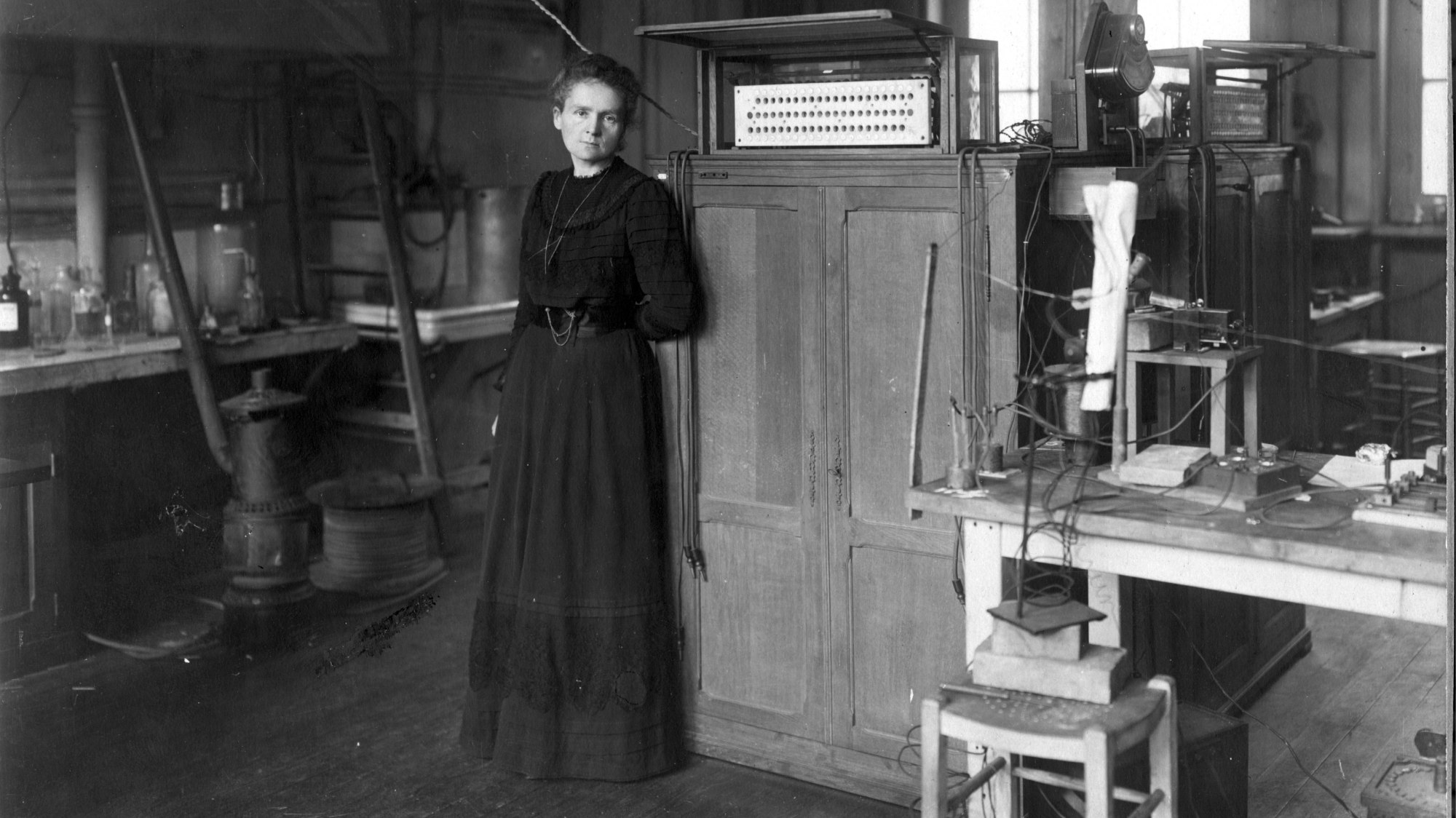
The Academy of Sciences has always exhibited greater liberality, and when the question was raised there some months ago, of admitting a woman, because she was a great scientist and in spite of the fact that she was a woman, the proposition immediately won many and influential supporters. It was a question of admitting Mme. Curie, the first woman that had been admitted as professor at the Sorbonne in the University of Paris; Mme. Curie, who in 1892 in her doctor’s thesis, revealed the discovery of radio activity, thus opening the way to the wonderful discovery of radium by her husband a few years later. Mme. Curie is of Polish origin. Studying at the Sorbonne she became acquainted with the famous scientist, Pierre Curie, and worked faithfully as assistant in his laboratory. When Curie was prematurely snatched from Science by an accident at the age of forty, his wife, as l’Humanite wrote, knew how to bear her sorrow in the most fitting manner, by continuing her husband’s work.
Mme. Curie succeeded her husband at the Sorbonne–that old and glorious University of Paris. She conducted a course there, which attracted learned men from all parts of Europe.
Mme. Curie, like her lamented husband, is not only a great scientist, but also a free spirit and in the first rank. With her husband, she was a member of the French National Association of free thinkers, and both of them in the rare moments of leisure, which their absorbing scientific labors allowed them, often manifested their sympathy for International Socialism.
But when the Academy of Sciences appeared disposed to receive Mme. Curie, and the physics section favored her admission, the defenders of old traditions raised, a violent protest. The opposition was particularly strong at the Academy of Inscriptions and Belles lettres, where an old ultra-reactionary lawyer, M. Betolaud, commenced a veritable crusade against the invasion of the Academies by the “weaker sex.” It was declared that the question could not be settled by the Academy of Sciences alone, but that it must be submitted to a joint meeting of the five academies. It was necessary for the Institut de France as a whole to decide whether women could be admitted to its bosom.
Meanwhile the most ridiculous objections appeared in the bourgeois press; the members of the Institute, in great official ceremonies were bound to appear in embroidered uniforms and bearing a sword, a vestige of ancient customs. How could a woman wear the uniform and carry the sword?
However, the Institute gathered in full assembly to wrestle with this grave problem: should a woman because she is a woman, be excluded from the Academy, although having all the requisite qualifications for admission.
M. Betolaud offered a resolution that the Institute, “without claiming the right to compel the various academies to bend to its decision, believes that there exists a tradition which it would be wise to respect.”
The first part of the resolution was passed by a majority of nine-tenths of the members, the number present showing many absentees. The second part, by a vote of 88 to 52. Such a decision, according to the opinion of M. Darboux and Gaston Dounier of the Academy of Sciences, advised against the admission of women, but left the final decision to the Academy of Sciences, which was to meet shortly after.
Lucky for the old gentlemen of the Institute that they did not have to deal with the terrible English suffragettes and Mme. Parkhurst.
The moral may be drawn from such a situation in the Institute that it is once more apparent that mysogeny and reaction go hand in hand. Engels and Bebel declared long ago that the final enfranchisement of women is closely bound up with the triumph of Socialism; and it is quite probable today that the admission of women to the Institut de France will not come before the abolition of the hireling. The strong minority that supported the proposal is, however, a sign of the times.
The Coming Nation was a weekly publication by Appeal to Reason’s Julius Wayland and Fred D. Warren produced in Girard, Kansas. Edited by A.M. Simons and Charles Edward Russell, it was heavily illustrated with a decided focus on women and children.
PDF of full issue: https://www.marxists.org/history/usa/pubs/coming-nation/110204-comingnation-w021.pdf
 Revolution's Newsstand