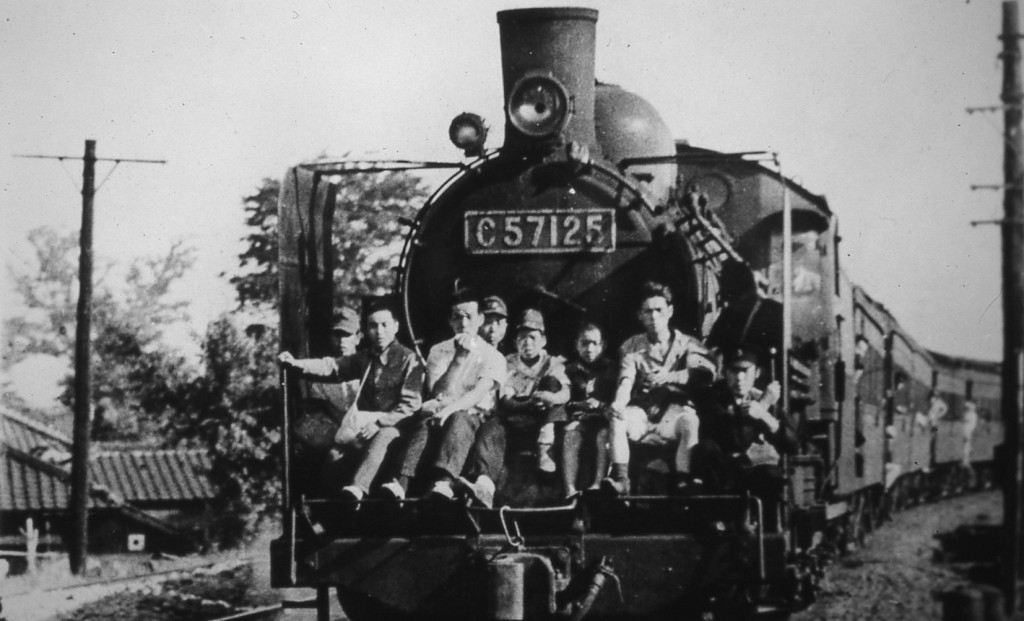
The history of rail workers unions in Japan up culminating in the formation of the All-Japanese Railwaymen’s Union. One of a number of attempts to organize industrial unions by underground C.P. activists in the 1920s, after its initial successes the union would soon be smashed, like so many others, by Japan’s reactionary government.
‘Railwaymen’s Union In Japan’ by G. Atchanow from The Daily Worker. Vol. 4 No. 32. February 19, 1927.
MOST of the railway lines in Japan are owned by the state. It was partly on account of this fact, and owing to the police regime in general, that until quite recently it was difficult to organise trade unions on the railways.
For a great many years the Japanese government, through its agents, had been impressing the minds of the railway officials, as well as of the rank and file, that they were state employees and should faithfully serve their country and government, loyally carrying out all the commands of their superior officers, so as to make faithful servants of the government.
In this manner the proletarian spirit was stultified, and the workers were practically forced to give up any idea of organizing themselves into railwaymen’s unions.
In a word, the regime on the Japanese railways strongly reminds us of the pre-revolutionary regime on the Russian railways.
There were attempts to form a union on the part of the more class-conscious elements among the railwaymen, but they were defeated by the strenuous opposition on the part of the agents of the government.
Thus, the first strike of engine drivers broke out in 1899 on a private railway line owned by the Japanese Railway Company, and the first union of railway enginemen in Japan was formed on the northeastern line, under the name of “Nitetsukio-Seiukai,” but this union was soon forced out of existence.
It was only in 1920 that another attempt was made to form a union of railwaymen under the name of “Dainiton Kikansia Dzomuinkai” (Japanese Enginemen’s Association). With headquarters in Tokyo, and with a membership of 2,100, the union embraced only the enginemen on the following railway lines: Tokaido, Tiuo, Sinetsu, and Tonoku. One year later, however, the new union was subjected to repressive measures by the Ministry of Ways and Communications, and compelled to dissolve.
The formation of the Enginemen’s Union in 1920 coincided with a strong outburst of the labor movement. There was a spontaneous wave of a movement of organization among the masses of the workers to secure better conditions of labor; but it ended in defeat, because neither the leaders nor the workers had a sufficient understanding of the class struggle.
In 1923 the railwaymen took up once again the question of forming a trade union. A series of conferences of railwaymen was called for this purpose in June. More than one-half of the delegates attending those conferences consisted of former members of the Enginemen’s Union. The result was the formation of the Japanese Railwaymen’s League (Dainihon Tezudogengioin Domel).
Some time afterwards a section of the railwaymen, dissatisfied with the league’s position, formed a union composed exclusively of the lower grades of workers. These two organizations represented something like a right and a left wing. The first of these organizations soon began to decline, having utterly failed to gain the support of the masses. On the other hand, the second union was successful in this respect.
In 1925, in connection with the general revival of the labor movement in Japan, the question was raised by the more progressive elements of the workers on the state railways concerning the need for organizing an all-Japanese Railwaymen’s Union, and a campaign in this sense was conducted among the members of the two railwaymen’s unions, leading to negotiations between these unions, which were held from November 25, 1925, until February 11, 1926, and resulted in the formation of the All-Japanese Railwaymen’s Union.
The organizational movement among the railwaymen has been carried out with great success. Since the formation of the Railwaymen’s Union in February, 1926, the organizing activity on the state railways has been carried on with the united support of the right and the left organizations.
From the very outset the union has concentrated its entire attention upon organizational and educational work.
At the time when it was formed, the union had a membership of 1,500; now it has over 5,000 members. Organizational activities are in full swing throughout the country; on the Kiu-Siu, in the central provinces of the island of Konsiu, in Kanto, and in the North East. Three branches are soon to be opened on the eastern railways; at Iskosuka, Sinsuku, and at Sinbasi (Tokyo).
Nevertheless the workers are considerably hindered by the specific spirit of chauvinism and title-worship which has been inculcated among the Japanese railway workers in the course of many years. It is hard for them to get rid of the idea that they are state servants working in the interests of the state, and therefore obliged to put up with any misery for the sake of the Japanese people, whereas in reality they are suffering in the interests of a handful of big capitalists, and of the aristocratic governmental clique.
This constitutes the chief hindrance to the organization of the railwaymen, sowing confusion in the minds of the workers, whose class instinct prompts them to form class organizations and to engage in the class struggle, while the lingering traditions call them back to bureaucratic officialism and chauvinism.
As an instance, we quote below the following declaration by the founders of the All-Japanese Railwaymen’s Union:
“The All-Japanese Railwaymen’s Union does not differ from the other unions, and like all other unions, it has for its object the amelioration of working conditions. Nevertheless in its leading principles and in its activity, it is firmly resolved to take into consideration the specific character of the state railway enterprises which are of such colossal importance to all the public industries in Japan. We, the railwaymen, while endeavoring to improve our social status by means of our own legal organization and activity, pre at the same time prepared to make all sacrifices for the sake of the further prosperity of the public enterprises that are needful to the whole population. Thus, the All-Japanese Railwaymen’s Union, formed upon the principle of trade unionism, will endeavor to make progress while following the practical tactics of honest fulfillment of duties assumed.”
In adopting this platform, the All-Japanese Railwaymen’s Union declares that: “(1) for the purpose of mutual support of the railwaymen in the struggle for existence, it will exert all efforts to stimulate the growth of co-operation among the members. (2) In order to raise the cultural level of the workers and employees, the union proposes to take up the necessary cultural and educational activity on a large scale. (3) Standing for the system of workers’ committees, the union intends to encourage the formation of such committees in all the districts where it has branches, and to render these committees really useful to the masses of the workers in their everyday interests. (4) Our union favors the existence of international workers’ organizations. Although we do not believe them capable of bringing emancipation to the working class, nevertheless we intend taking an active part in them in so far as they serve our interests. (5) Our union intends to make the most advantageous use—from the working class standpoint—of the political rights extended to the union, and to take paid; in political life.” Furthermore, the All-Japanese Railwaymen’s Union, believing in the principle of industrial unionism, solemnly declares that it will at once exert all its efforts to organize the mass of 19,000 laborers on the state railways that are still unorganized.
Worthy of attention is the part of the declaration dealing with the organization of the unorganized, and with raising the cultural level of the railwaymen; but there is complete absence of any aspiration towards raising the class consciousness of the railwaymen. Nevertheless, in spite of all these defects, the formation of the All-Japanese Railwaymen’s Union should be considered a great achievement for the Japanese railwaymen. The healthy principle of industrial unionism forms the foundation of this organization.
Thus, the supreme organ of the union is the congress which is to be convened twice annually. The delegates to the congress are elected by the branches at the rate of 1 delegate per 50 members.
But the Central Committee, elected at the congress, has a fairly complex structure, and is composed of the following sections: Publishing, cultural and educational, organizational, political, international, juridical, co-operative, research on the workers’ committees, and records and bookkeeping. There are also professional sections: Railway telegraphists, water workers, watchmen and road maintenance men, electricians, train crews, yard workers, chauffeurs, tramway workers, train fitters, railway station workers, controllers, and railway yard employes.
This form of organization reminds us of the unions with guild sections, which constituted the first organizations on the Russian railways in 1917-18. This seems to be characteristic of all beginning trade nnons while building up their forms of organization.
The railway authorities have officially declared their non-interference in the work of the newly formed All-Japanese Railwaymen’s Union; but hardly have a few months passed since its formation, and the railway authorities have begun an agitation against the union among the railway workers, and began openly to interfere with the activities of the union.
In June, 1926, the first plenary meeting of its central committee was held, with the assistance of delegates from all the branches. The plenary meeting discussed all the questions which had arisen during the time of the union’s existence, and the fundamental course of policy was outlined until the next congress. Of great importance to the Japanese Railwaymen’s Union are two questions which were discussed by the central committee. The first one related to the union’s tactics on the railways and generally in public life, which reaffirmed the previously stated standpoint of the union. The second one dealt with the methodical plans for the further organizational work of the union. A draft was submitted for a resolution by the C.C. of the union on the question of regulating the apparatus of the organizational section, and of unification of the work. Another draft was submitted of a resolution dealing with the organization of district branches.
The plenary meeting reaffirmed its previous declaration, laying particular stress upon the moderation of the All-Japanese Union, appealing to public sentiments, and asking for the support of the Japanese bourgeoisie.
Not a word about the class struggle and the class interests was contained in this declaration, just as in the preceding one.
It should be noted that the All-Japanese Railwaymen’s Union, by its strategy and tactics, does not differ from the other trade unions of Japan, which partly emulate the British, and partly the American trade unionism, and are aspiring towards class co-operation with the bourgeoisie. But among the Japanese railwaymen there is already a left wing in evidence, even if consisting of a small group, that is striving towards the proletarian class struggle in the trade union movement of Japan.
The Daily Worker began in 1924 and was published in New York City by the Communist Party US and its predecessor organizations. Among the most long-lasting and important left publications in US history, it had a circulation of 35,000 at its peak. The Daily Worker came from The Ohio Socialist, published by the Left Wing-dominated Socialist Party of Ohio in Cleveland from 1917 to November 1919, when it became became The Toiler, paper of the Communist Labor Party. In December 1921 the above-ground Workers Party of America merged the Toiler with the paper Workers Council to found The Worker, which became The Daily Worker beginning January 13, 1924.
PDF of full issue: https://www.marxists.org/history/usa/pubs/dailyworker/1927/1927-ny/v04-n032-new-magazine-feb-19-1927-DW-LOC.pdf
 Revolution's Newsstand