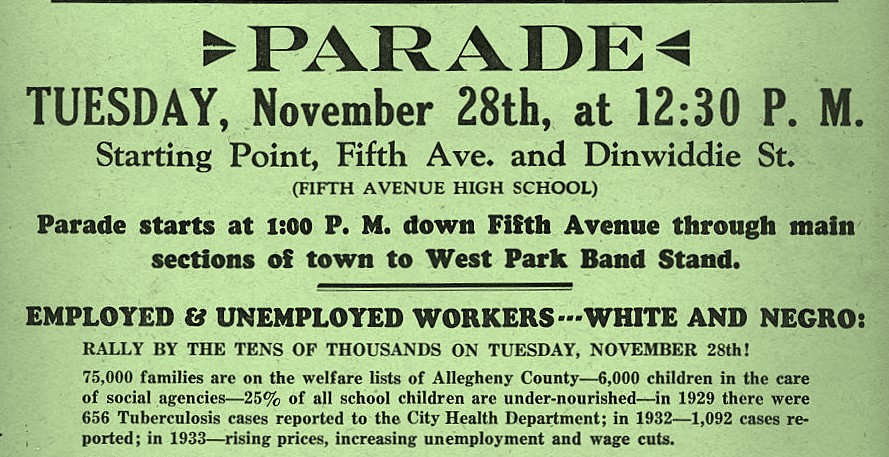
The Organization Secretary for the Communist Party’s District 5 (Western Pennsylvania and West Virginia) reports on the underwhelming recruitment campaign, with an almost one-for-one recruitment to loss ratio. Focused on the area’s steel and mining, in 1934 the District had around 850 dues-paying members.
‘Some Experiences in Recruiting to the Party of District Five’ by Jim Allander from Party Organizer. Vol. 7 No. 12. December, 1934.
AT A RECENT meeting of the District Bureau the problem of recruiting was taken up in line with the general mass work of the Party. The report of the Org. Dept. showed that 364 members had been recruited since March, while we have the task of raising our dues-paying membership to 2,000 before January 21.
Recruitment for the period of a year (August, 1933 to August, 1934) shows a total of 863 recruits or an average of 71 per month, yet recruitment for July, August and September shows the lowest average for the entire year. This would indicate that the activity of the Party was on a low ebb during this period, which was not the case, as we were engaged in a number of very important campaigns such as the Party Anniversary, Election Campaign, etc. The most important was our campaign for the election of a Left wing slate in the U.M.W.A. in coal and the A.A. in steel. With proper methods and attention to recruitment we should have recruited a minimum of 500 new members to the Party during this period.
The discussion of the District Bureau revealed that our leading Party comrades engaged in mass work, as well as our functionaries, had not given the question of recruitment any serious attention, but regarded it as a routine matter.
During the course of the election campaign, more than 100 meetings were held, and in most cases there were never application cards present, no preparations were made beforehand for recruitment into the Party. Our Party units where the meetings took place were not mobilized for this important work among the workers who attended these meetings.
In places where proper attention was given to the problem of recruitment at the meetings and in our mass work around the elections, good results were obtained, as for example, in a local steel town with a good Unemployment Council the face of the Party was brought forward and our comrades openly asked workers to join the Party at their mass meetings. One new unit has been established and the membership more than doubled. Today we have 31 members in this place. Six months ago we had none. Another example is X, where we have had only five members for over a year. They did not ask workers to join the Party. At their first meeting for the election campaign the whole unit was mobilized. 2,000 leaflets were distributed and, to the surprise of our comrades, it turned out to be the biggest political mass meeting held in the City Hall auditorium attracting more workers than any of the other Parties. 250 attended the meeting. Four workers openly joined the Party and a number have since turned in their applications to individual comrades. The Party is now brought forward in all the activities locally and respected by the workers.
Another example of good recruiting during the Election Campaign is the work of two units in the 5th Ward of the Hill Section, which were the only units that were successful in involving non-Party workers to a large extent in the election campaign and work of the unit. Their work was not scattered over the entire ward, but in a selected section. At the end of the campaign this precinct showed the highest vote percentage compared with the entire Communist vote in the Hill. The unit was able to estimate the vote received approximately before the election. Out of the group of non-Party workers active in the election campaign 10 have been recruited to the Party through one unit and eight through the second unit.
Recruiting in Mining and Steel
In mining we have succeeded in building a fair Left wing opposition. The leadership of this opposition assumes a broad character which is directly connected with the different locals of the U.M.W.A. It has established a functioning apparatus with a regular schedule of meetings, program, etc. In this work a number of our most active Party members were active, but, during this campaign our most important mine units stopped functioning. Recruitment of miners to the Party also stopped. The fraction leading the work, within the opposition had no plan for recruitment. The District Bureau, in discussing this work, pointed out quite sharply that every comrade in mass work understood that this had been pointed out in previous resolutions of the District, that such mass work without building the Party and Y.C.L. was doomed to crash, endangering the whole Left wing movement.
In our Left wing work in steel and aluminum we had a somewhat similar situation with favorable opportunities for recruitment. Yet our leading comrades overlooked this possibility’ or hesitated to recruit these new workers to the Party.
After criticizing this failure and weakness the District Bureau set a recruitment quota of 50 employed miners and 25 steel workers for the period of a month. We also assigned each Bureau member the task of reporting at the end of the month how many non-Party workers he spoke to and recruited to the Party. In the application of this plan for recruitment in mining and steel we have already built two new mine units. In addition a unit of seven in an important mine was established, recruiting several individuals who are leaders of their local unions and committees. Our quota will be fulfilled by the end of the month in mining. However, there still remains a weakness in steel and also aluminum. That is, we are not recruiting employed steel workers, members of the A.A., into the Party fast enough to make our quota for the month, while the possibilities are before us for such recruitment.
A Non-Political Method of Recruiting
In analyzing the recent recruitment to the Party throughout the District, the biggest percentage of recruits are listed as unemployed, but upon close examination, when taking up the applicants individually, it was revealed that many of the applicants were employed workers or working part time. Under such circumstances when the applicant was informed that the employed initiation was 50c he in most cases replied, “I was only ‘asked for 10c’”. This reveals that many of our comrades do not recruit in a political way. They approach the worker from the point of view that he is doing us a favor by joining the Party. This kind of recruitment is an insult to the worker. Many times this same method is carried right into the unit in the payment of dues when they know the worker is employed. Still the dues secretaries in some cases hesitate to ask for the additional dues. Such methods as this disgust the new workers, when we handle them in this manner.
Our experiences of the recent period, have raised the problem of our Org. Dept. paying much closer attention to the methods applied to recruiting, and particularly to the individuals and fractions engaged in mass work, to struggle against the failure and “fear” of bringing forward the face of the Party, asking for new recruits; in this manner combating the idea, that first we build the opposition or council then the Party.
The Party Organizer was the internal bulletin of the Communist Party published by its Central Committee beginning in 1927. First published irregularly, than bi-monthly, and then monthly, the Organizer was primarily meant for the Party’s unit, district, and shop organizers. The Organizer offers a much different view of the CP than the Daily Worker, including a much higher proportion of women writers than almost any other CP publication. Its pages are often full of the mundane problems of Party organizing, complaints about resources, debates over policy and personalities, as well as official numbers and information on Party campaigns, locals, organizations, and periodicals making the Party Organizer an important resource for the study and understanding of the Party in its most important years.
PDF of issue: https://www.marxists.org/history/usa/pubs/party-organizer/v07n12-dec-1934-Party%20Organizer.pdf
 Revolution's Newsstand