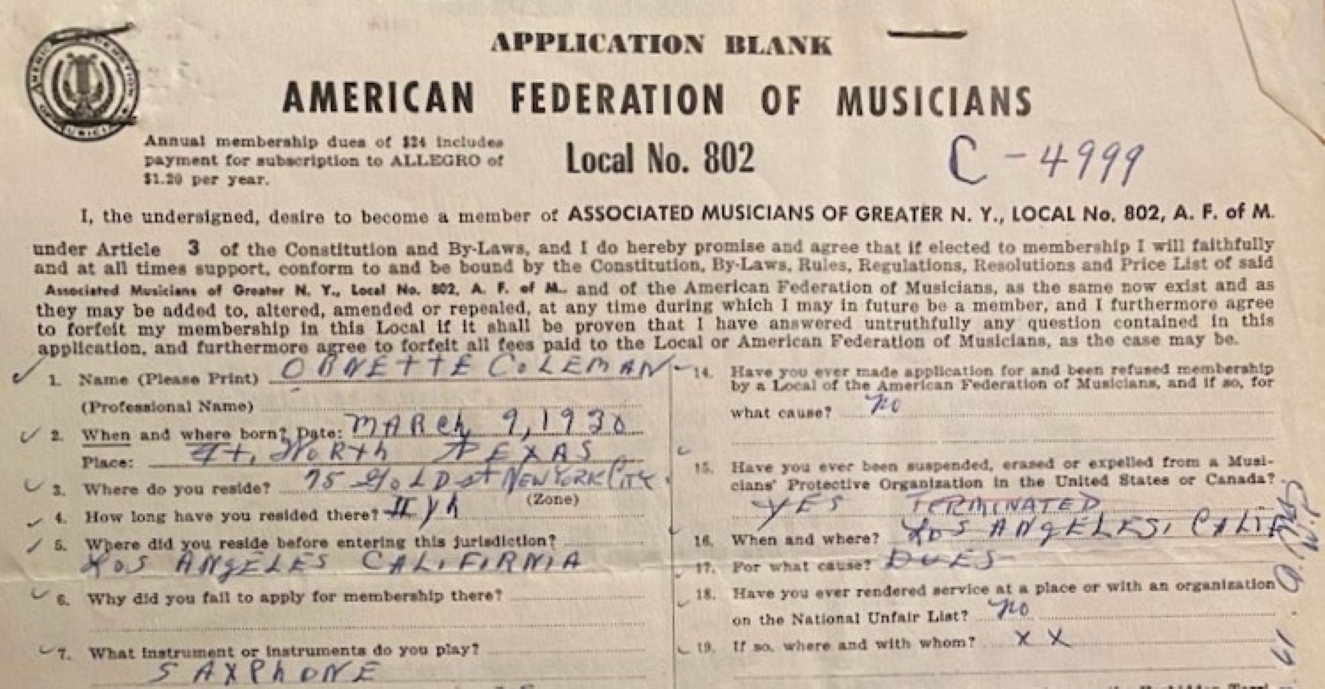
Militants win in the largest local of the American Federation of Musicians, New York’s Local 802. Growing to nearly 30,000 members, it’s likely Local 802 counted more actual geniuses among its historic membership than any other union in U.S. history.
‘Rank and File Victory of Local 802 Musicians Spikes Red Scare Drive’ by Al Steele from The Daily Worker. Vol. 12 No. 6. January 7, 1935.
Entire Slate of “Blue Ticket” Swept Into Office–Militants in Union Block Move of Reactionaries to Expel Members
The recent elections in the Associated Musicians of Greater New York, Local 802 of the American Federation of Musicians, A.F. of L., resulted in a sweeping victory to the rank and file United Membership “Blue” Ticket. This victory also assumes great importance outside of the boundaries of the local when we realize that by voting into office the entire slate of the “Blue Ticket” the membership endorsed the program on which these workers ran.
This program is a complete repudiation of the policies pursued by the top leaders of the Federation and their representatives in 802 who follow in the footsteps of William Green and company. The results of the election prove that the rank and file rejects the attack of Green and his followers in the A F. of M. against all militant workers in the A.F. of L. through his notorious letter to affiliated unions on August 19. demanding the expulsion of Communists.
Officials Blocked Strike
Faced with the growing radicalization. militancy and the readiness to struggle on the part of the workers, the top officials of the A.F. of L. blocked whatever strike action they could. Where they couldn’t, they placed themselves at the head of these struggles with the outright aim to betray the workers.
To further check this militancy they tried to divide the ranks of the workers by working hand in glove with the open agents of the bosses in raising the red scare.
It is interesting to note that one of the outstanding supporters of this red scare at the fifty-fourth convention of the A.F. of L. in San Francisco, was Chauncey A. Weaver, one of the International officers of the American Federation of Musicians and member of the Executive Committee. The fact that he was the only official of the A.F. of M. who spoke on the question and that Joseph N. Weber, president of the Federation, present at the convention, did not find it necessary to disassociate himself from the views expressed by Weaver, is only additional proof that Weber and the rest of the A.F. of M. officials agreed with him. Green’s letter was repudiated by a large number of local unions throughout the country. Large sections of the rank and file and many local leaders of A.F. of L. unions refused to act on the order of the Executive Council.
In his speech. Weaver greeted the time when Green’s order was issued as “…an encouraging, thrilling, inspirational hour through the ranks of organized labor…”
He contends that the vast majority of the membership of A.F. of L. unions support the policies pursued by the top officials of the A. F. of L. and their direct representatives in some of the local Unions.
The best answer to Weaver’s speech was given by the membership of the largest local of his own union, the New York Local 802 of the A.F. of M. The elections were a complete repudiation of the program pursued by Weber. Weaver and the rest of the Executive Committee of the A.F. of M. With the largest vote ever polled in the history of the local in which more than 5.500 votes were cast, the membership voted into office the complete united membership “Blue Ticket” slate.
The “Blue Ticket” represented a united front of the rank and file of the union in opposition to tile corrupt administration of the local and included the Committee of Fifteen who carried on the fight for local autonomy for years and whose expulsion from the union on September 27th was stayed by a court order on the 29th of October.
This was the first time in 14 years that the membership had an opportunity to vote for its officers the Executive and Trial Boards, with the exception of the President. Edward Canavan, who is the only appointed official remaining in the organization. He will remain in office for the next two years with a salary of $10,000 a year.
This right to vote was the culmination of 14 years of struggle for local autonomy. It was only after a bitter fight, of long standing, wholesale expulsions and discrimination against the leaders of this struggle that the Executive Committee of the International A.F. of M. at its June convention, was forced at last to grant this local autonomy.
In addition to retaining Canavan as its appointee the Executive Committee of the A.F. of M. attached other strings to this grant of local autonomy. Among these the Executive Committee, the local officials, sent out a referendum in August 1934 on the question as to whether propaganda or Communists” shall be permitted in the union. This referendum was sent out without the knowledge or consent of the membership.
While Weaver refers to this referendum as proof of repudiation of Communism and Communists by the membership, the results of the poll were to date as yet not announced.
Space does not permit us to go into the history of the splendid struggle conducted by the rank and file of the union. It will suffice to present the program around which the membership of the local rallied in defeating the rule of the Executive Committee through its appointees headed by “King Edward” Canavan.
The demands and the pledges in the program put forth by the “Blue Ticket” which was overwhelmingly endorsed by the membership through the elections is an undisputable repudiation of every contention made by Weaver in his speech in San Francisco.
The new administration of Local 802 was elected into office on the basis of support by the membership of the following demands included in the “Blue Ticket” program:
1. Immediate and unconditional reinstatement of the Committee of Fifteen and all others prosecuted because of their struggle for local autonomy.
2. Full and complete inner democracy in the union.
3. Rigid enforcement of union wage scales on all engagements and improvements of working conditions for members of the union, and,
4. Cessation of all threats, intimidations, fines and expulsions, and all manner of prosecutions against union members because of political, social and economic opinion.
Following are the pledges made by the United Membership “Blue Ticket” in the pre-election campaign:
1. To continue unabated its fight for complete local autonomy.
2. To extend to every member of the union, regardless of race, color, sex or creed, political, social or economic opinion, full and complete rights of free speech and free assemblage.
3. The maintenance of union wage scales and improvement of working conditions.
4. To furnish complete detailed accounts of every penny of income and expense.
5. To always regard the decision of our membership as the highest law in our local.
6. To submit to the membership a new constitution and by-laws, which, after full and complete discussion by the membership, shall be adopted as its collective will and desire, and to abide thereby.
7. To insure that all price lists and working conditions shall be determined by the membership and not by the officials.
8. That none of the officials elected under this ticket will, while they are officials of the union, ever act as contractors or leaders on steady engagements nor will they appoint contractors or place members on any engagements: with regard to this we will always strictly comply with the rules of the membership.
9. To help the unemployed and create work by engaging in a drive for unionization of the entire jurisdiction.
10. To seek unemployment relief for unemployed members and use the full strength of our organization for that purpose, without placing the burden therefore on the backs of those employed; in line with this pledge we will seek to create a fund which shall be administered under the supervision of the membership for the unemployed members in need, this fund to be created by:
a) A drastic reduction of salaries of officers and board members, b) Otherwise reducing overhead expenses in the union wherever possible, and c) Employing every legitimate measure to raise funds.
11. To work jointly with the Allied Theatrical Trades toward the creation of uniformly dated contracts with employers for the best protection of all concerned.
12. To devise ways and means to prevent expulsion of members for inability to pay dues.
While support to this program on the part of the overwhelming majority of the members of Local 802 who partook in the election is a great victory and constitutes an important step forward for the rank and file movement in the American Federation of Labor, the job as far as Local 802 is concerned is by far not completed.
Whether or not the entire membership of the local will be moved in support of the elected administration and whether or not other locals of the Federation will follow the example set by 802, will largely depend on how effectively the program of the “Blue Ticket” will be put into life.
The next step for the rank and file of 802 is the further struggle for local autonomy, the effective application of the program they were elected on by involving the membership as a whole in these practical tasks and the winning over of the rest of the members of the local and the entire Federation behind their program.
The Daily Worker began in 1924 and was published in New York City by the Communist Party US and its predecessor organizations. Among the most long-lasting and important left publications in US history, it had a circulation of 35,000 at its peak. The Daily Worker came from The Ohio Socialist, published by the Left Wing-dominated Socialist Party of Ohio in Cleveland from 1917 to November 1919, when it became became The Toiler, paper of the Communist Labor Party. In December 1921 the above-ground Workers Party of America merged the Toiler with the paper Workers Council to found The Worker, which became The Daily Worker beginning January 13, 1924.
PDF of full issue: https://www.marxists.org/history/usa/pubs/dailyworker/1935/v12-n006-Nat-jan-07-1935-DW-LOC.pdf
 Revolution's Newsstand