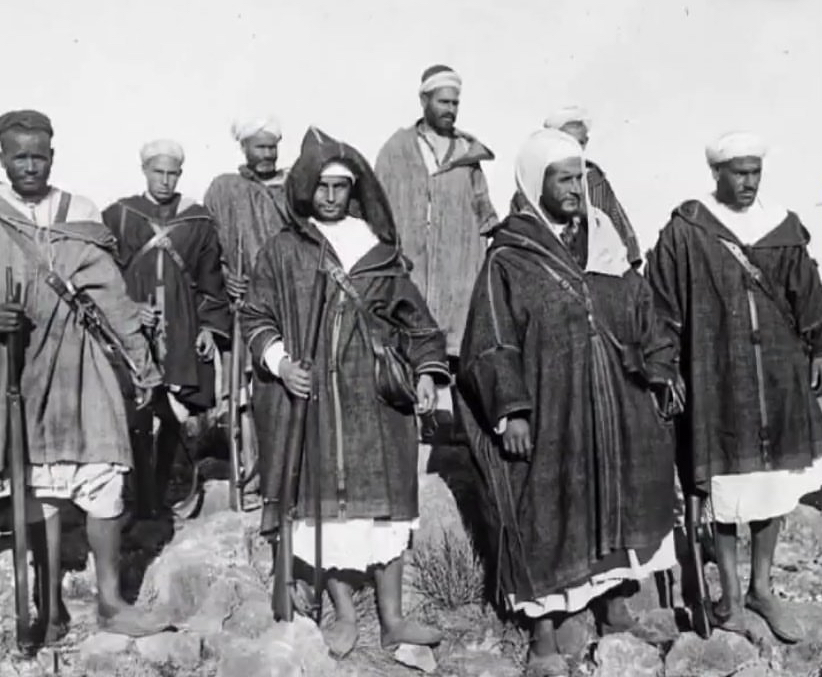
Kitaigorodsky analyzes France’s simultaneous wars of colonization in Syria and, with Spain, in Morocco.
‘The Imperialist Wars in Morocco and Syria’ by P. Kitaigorodsky from International Press Correspondence. Vol. 5 No. 70. September 16, 1925.
According to the most moderate calculations, the Spaniards on their side have landed an army of 100,000 men, so that the 20,000 men under Abd-el-Krim are opposed to a force of 340,000 to 360,000 well-armed men.
The French command is faced with the alternative of now or never! Either they will succeed in crushing Abd-el-Krim before the commencement of the rainy season (about 15th of October), or they will have to abandon their dearly-cherished idea of “rounding off” their possessions in Morocco.
The French have taken on themselves the main task of the campaign to drive Abd-el-Krim back into the real Riff area; they have given the Spaniards the relatively easy task of carrying out the attack on the North Western Riff area. At the cost of really enormous sacrifices, and with the aid of a combined action of the French and Spanish fleets, the Spaniards have succeeded in capturing the isle of Alhucemas, within a stone’s throw of which is “the capital” of the Riff, the little village of Adjir. Abd- el-Krim, however, has removed his headquarters in time into the interior of the Riff. The French are attempting on their side to consolidate their conquered positions, which are populated by the Asul and Bran tribes, and wish to convert them into points of support for their further attack in order to deliver Abd-el-Krim the “final decisive” blow.
It must however be pointed out that the chief forces of Abd- el-Krim, the main body of his troops, have not yet been brought into action. The French have had to deal the whole time with Moroccan tribes living in the French zone. The Riff Kapyles have, for the most part, acted as organisers, instructors, and leaders of the insurgents. The Riff Kabyles divisions have played the role of advance-guards who, by their exemplary self-sacrifice have caused the other tribes to join them. For the rest, however, they are not very numerous and constitute the advance-guard of the fighting Riff tribes and have appeared everywhere where the French least expected them.
In addition to this. Abd-el-Krim has employed tactics which remind one of the old Scythians. When the French commenced an attack they found that they had no one to attack, for the Riff Kabyles, led by the Moroccans, thanks to their excellent mobility, rapidly withdraw from the firing zone. This is the reason for the trifling losses on the side of the Moroccans. The losses of the French, however, according to their own reports, have been considerably greater.
Abd-el-Krim has very many favourable factors on his side. We will only mention two of these. The first is the approach of autumn weather, which will increase the difficulties of military operations a hundred fold, and will cancel all the French successes gained in the last month. Next year the French will have 10 commence all over again, for it is very doubtful whether they will succeed in defeating the main forces of Abd-el-Krim before the setting in of the rainy season. Secondly, a w friend of Abd-el-Krim has appeared in the shape of the insurgent tribe of Jebel Drus, to whom it has been granted to play in Syria a similar role as organisers as the Riff Kabyles are playing in the whole of Morocco.
Thanks to the revolt of the Druses, the French command was compelled to divert to the Syrian front a portion of the striking forces which were intended to be sent to Morocco. Thus, for instance, it is definitely stated that an Algerian division, which has had its head-quarters in Syria, should already have sailed from Beirut harbour to Morocco, when the revolt in Jebel Drus force the French authorities to issue the command to send a division to the Drus front. It may be mentioned, by they way. that two Algerian regiments belonging to this division mutinied and had to be dissolved.
At the end of July the impetuous “attacks” of Abd-el-Krim began grow weaker under the obstinate counter-attacks of the French. At this time the latter were able to increase their army from 80,000 to 220,000 men (which constitutes more than a quarter of the total number of the French army) to convey a fifth of their naval forces to Morocco and to bring into the field a huge quantity of tanks, mountain guns and machine guns.
At the beginning of August the French went over to a general offensive along the whole front, and, after a month of strenuous efforts, huge losses and privations, were able, at many places, especially on the flanks, to recapture their lost position, which had been occupied by the Moroccan insurgents since May. In spite of this, now, on the eve of the combined Franco-Spanish general attack, a considerable portion of the French zone still remains in the hands of the Riff Kabyles.
The position in Syria is similar in many respects to that in Morocco. The patriarchal natural economy of the Riff differs in no way from the economic system of Jebel Drus. The mountainous and waterless area of Jebel Drus in every way resembles the Riff. Jebel Drus, like the Riff, has already for centuries enjoyed an autonomy which the Druses knew how to defend even under the rule of the Turkish Sultan. Jebel Drus, which comprises in all a population of 50,000 people. seems to be destined to play the role of leader in the national emancipation struggle of Syria.
It is true that Syria, especially its Western portion, is politically, economically and socially more developed and advanced than Morocco. In the Lebanon district and in Damascus there already exists a somewhat differentiated population with a relatively large proletariat, with an impoverished peasantry on the one side and a commercial bourgeoisie and class of big landowners on the other side. Of the 2,5 million inhabitants, 750,000 are landless peasants and day workers and 280,000 are town workers. In the small and middle silk mills, tobacco factories and other concerns, there are about 113,000 working men and women. In addition to this there exists in Syria a francosised native intelligentzia, various political groupings, 99% of which it is true are corrupt and open to bribery, and the feeble commencement of a serious proletarian movement.
In Morocco, on the other hand, the medieval regime still prevails practically undisturbed, even in the capital of Morocco. Fez. With the exception of the harbour town of Casablanca, everything has remained as it was a thousand years ago.
In Syria all sympathies are on the side of the Druses. The native bourgeoisie is a trading class (industry in Syria is in the hands of French factory owners), extremely weak in the fight against the European capitalists, who make use of the system of capitulations for their own purposes.
The feudal aristocracy of Western Syria, who have in their possession 60% of all the land, supply the highest officials, ministers, and government officials, behind the backs of whom the French occupation power strengthens itself. This landowning class is entirely on the side of French capital, which protects the class privileges and the estates of the Syrian nobles from the attacks of the people.
On the other hand there exist in Damascus, Aleppo, Beirut, Homes and other towns, a considerable proletariat and a fairly large section of poor craftsmen and small trading bourgeoisie who are ready for revolt. The peasantry of the “advanced” Western portion of Syria have not ceased to rebel against the French occupation authorities.
The French are trying to represent the revolt in Jebel Drus as a manoeuvre on the part of the English. Of course it is not impossible that the leader of the Druses, Al Atrasch, is made use of by the English in the same way as Abd-el-Krim was at one time made use of by the French against the Spanish, and is now being made use of by the English against the French. Al Atrasch is skillfully taking advantage of the Anglo-French antagonisms in Syria. In the revolt of Jebel Drus, which in addition to this has been severely hit by a bad harvest, we have a typical revolutionary revolt of an oppressed people against its oppressors. Al Atrasch aims at rousing all Syria into revolt and is putting forward the following slogans of a general national character: 1. Independence of Syria; 2. Convocation of a Constituent Assembly; 3. Withdrawal of the French troops. This alone renders Al Atrasch the leader of the emancipation movement in the whole of Syria.
The French are in an equally delicate situation in Syria as in Morocco. They must at all costs put an end to the revolt before the setting in of the rainy season. It is doubtful whether they will succeed in this; and in this event the revolt will drag on for a year if not for years, and French imperialism will be compelled to abandon Syria and Morocco.
International Press Correspondence, widely known as”Inprecorr” was published by the Executive Committee of the Communist International (ECCI) regularly in German and English, occasionally in many other languages, beginning in 1921 and lasting in English until 1938. Inprecorr’s role was to supply translated articles to the English-speaking press of the International from the Comintern’s different sections, as well as news and statements from the ECCI. Many ‘Daily Worker’ and ‘Communist’ articles originated in Inprecorr, and it also published articles by American comrades for use in other countries. It was published at least weekly, and often thrice weekly.
PDF of full issue: https://www.marxists.org/history/international/comintern/inprecor/1925/v05n70-sep-16-1925-inprecor.pdf
 Revolution's Newsstand