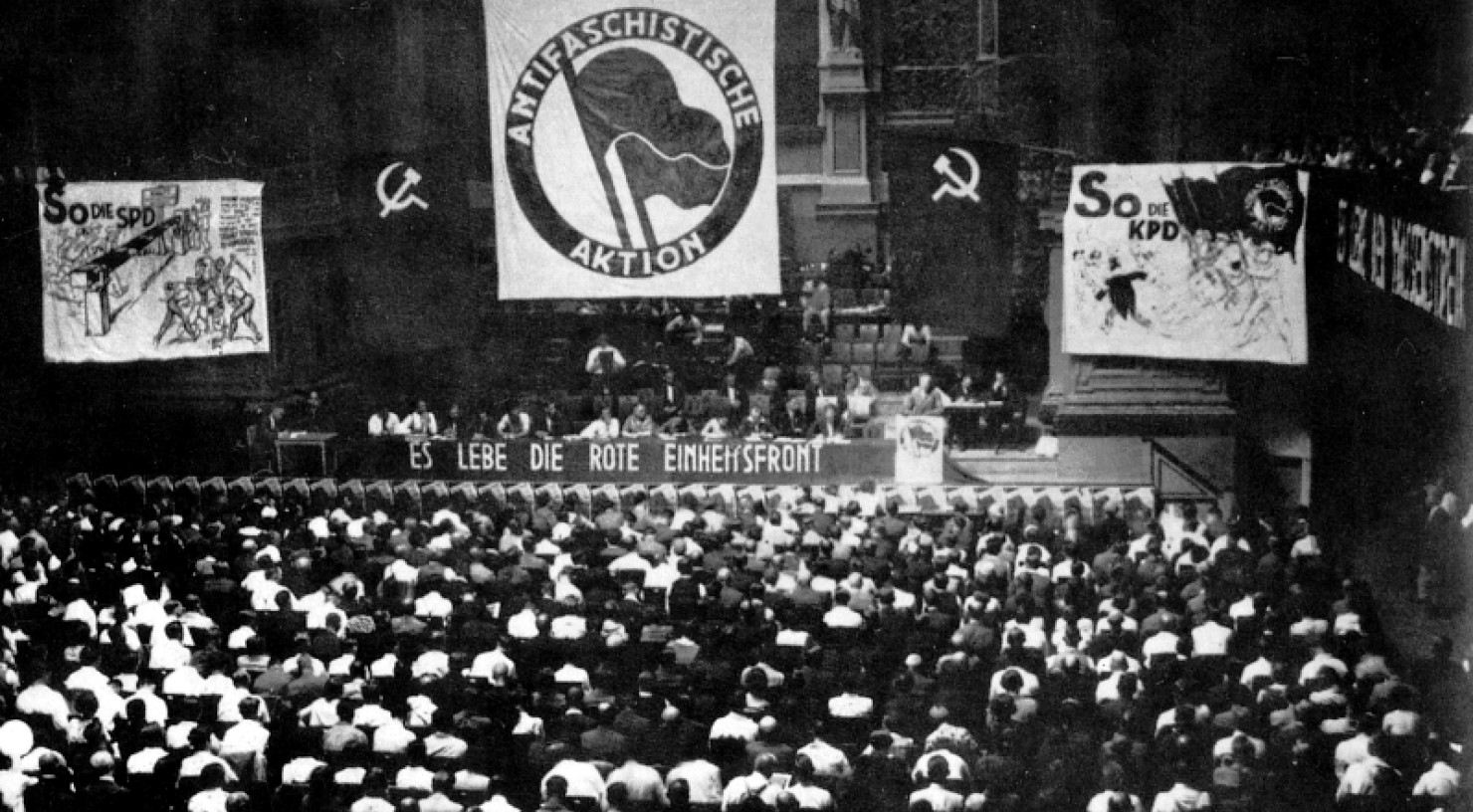
A major article from Muste in his American Workers Party-period on the social roots and role of Fascism, recently victorious in Germany, and its echos in the U.S. As well, he criticizes the failure to stop the Nazis by two of the largest workers’ organizations in the world. He attacks the German Social Democrats for their anti-Communism, class-collaborationist view of struggle, and abstract notions of ‘democracy,’ while condemning the official Communist Party’s position on ‘Social Fascism,’ and sectarian ‘united front from below’ against Fascism which sought to split opponents in the workers movement rather than unite with them.
‘What Is This Fascism?’ by A.J. Muste from Labor Action (A.W.P.). Vol. 2 Nos. 6, 7 & 9. April 2, 16 & May 15, 1934.
I.
IN recent years, and months, we have seen the spectacle of the workers being beaten back rather than advancing in many European countries. In Germany and Austria for example they built powerful unions with millions of members. They had political parties of their own, polling millions of votes. They had organized cooperative movements, built decent, comfortable and attractive cooperative houses for themselves, built their own labor schools, singing societies, sports clubs, theatres.
Now in these countries all these organizations and institutions are smashed. Hundreds of workers trying to defend their own homes have been killed, thousands wounded, thrown into concentration camps, brutally persecuted.
The movement which has thus beaten the workers and crushed their movement–under Mussolini in Italy, under Hitler in Germany, under Dollfus in Austria and which is spreading rapidly and steadily to other countries–is called Fascism.
Important To Know Our Enemy
It is important for us to know our enemy. What is this Fascism? How does it arise? How does it triumph over the workers? How can we prevent or smash it? No questions today are more important for American workers than these.
Fascism has come into existence when the business system–the capitalist or profit system, under which one class owns the resources and the tools and the other class, the worker, have to toil for it–threatened to break down completely. Since, under capitalism, a large part of the national income goes in profit to a few, the masses do not have the money to buy what they produce. So the more machinery there is, the more goods can be turned out, the fewer workers are needed and the less the masses are able to buy the goods. We have “want in the midst of plenty”. “Prosperity” brings on a crash, depression, unemployment, misery. Truly a crazy situation!
The capitalists, however, want to hang on to their profits and power, even at the cost of taking away the few gains the workers have made, and of eventually driving the workers back to pauperism. So they resort to open force, to dictatorship, to all kinds of violence to push the masses down and keep themselves in power. Fascism is the name that has been used to describe this attempt to save the capitalist system by open and brutal dictatorship.
Things do not come to this point all of a sudden, however. Let us try to trace the events which lead to it.
Laissez-faire Gives Way To Monopoly
In one country after another, especially since the Great War, it has become clear the capitalist system in its old form of unrestrained competition cannot be saved. Laissez-faire, as it is called, cut-throat competition, brings about a complete mess. So some modification must be introduced. It is said, therefore, for one thing, that there must be “economic planning”. Some degree of order, of regulation, must be brought into the business system. There must be a point below which prices, for example, are not permitted to fall. What this really comes to is that the “little fellows” are wiped out, so that the “big fellows” are more secure and sure of their profits. What is called “monopoly capitalism” is strengthened.
Next, since one banker of boss or corporation cannot enforce regulation on another–they are engaged in fighting each other for profits the government is called upon to do the regulation. It “interferes” with business, sets wages and prices, “settles” disputes between employers and employed, “stabilizes” things. That means that the old “democratic” theory that government must not interfere with the citizens and their business (“that government is best which governs least”) is given up.
Since in this period of the breakdown of capitalism, international competition is an intense and bitter as competition inside each country, what is called “economic nationalism” or “autarchy” develops. The nation, it is said, must strictly control its foreign trade, keep down imports, be self-sufficient. Each nation must raise and manufacture, if possible, everything its people need, so that it will not dependent upon any other in case of war.
However, the attempt to save the profit system by these various devices doesn’t work. If you say to a business man that his business must be regulated, that we must have “economic planning,” but at the same time, that he must make his business bring a profit in competition with others, it is the same as saying, “You must plan, but you must not plan.” Daughter may go out to swim, but must not go near the water.
Under this set-up, the business man still must either put his prices up or get his costs, including wages, down, or both. That means that the fight between the boss and the worker over wages still exists, though government tries to repress it. Prices still race ahead of wages. You get the “chiseling” and all the other things we have in the good old U.S. today under the New Deal codes.
Also, as long as the profit system is kept, some have more money than they can spend on consumer’s goods, and the masses haven’t enough purchasing power. So the wheels of industry repeatedly get jammed again.
The nation still has a “surplus” to dispose of, though its own people starve, and that surplus must be gotten rid of on the world-market. There, as we know, competition is keen and bitter. There is to be war, therefore. You have to prepare for war, something that the munitions makers of course strongly favor. So develops militarism, one hundred per cent patriotism, tense international relations, war. But expenditures for military equipment are not productive and war itself in the modern world involves colossal destruction of goods, more debts, and so on.
All this means, of course, that “business” dees not get straightened out, “prosperity” in any substantial and permanent sense does not come back. There are ever new and more severe crises, more suffering and misery.
What Is The Labor Movement Doing?
What is the labor movement doing all this time? Where, especially, are the radicals? They always said capitalism was a crazy system and bound to break down and that then labor would control and build a new world. Why doesn’t this happen?
Labor in such countries as we have mentioned, Germany and Austria, has been lead mainly by the socialists, or Social Democrats. Now the Socialists although they used to be revolutionary and still in many cases claim to be, have really acted on the theory that you gradually build Socialism while capitalism also still exists, and you rely entirely on peaceful, political methods, on “ballot-boxing” in order to extend your power and gradually get control of government.
That sounds pretty, and of course every sane person wants to see changes brought about as peacefully and at as little cost as possible. But like many other fine-sounding schemes, it doesn’t work. For one thing, this business of trying to run two economic systems, a profit and a non-profit system, is much like trying to ride two horses going in opposite directions. You don’t get the real benefit of either system. What it really comes down to is keeping capitalism, the profit system alive. But so long as the capitalist system exists, you get all the difficulties that are inherent in such a system which we have already pointed out. That means that new crises constantly arise, the system gets sicker all the time.
A revolutionist would say that this was bound to happen and that the sick system should be put out of its misery and the sane and healthy economy set up. The Socialist or Social Democrat, however, is married to the idea that you must not do anything drastic. You must build the new order gradually. He points to gains in wages or social insurance which the trade unions have gained by gradual pressure, and says that the workers must go easy so as to keep these gains, or lose as little as possible. He completely forgets that capitalism when it is old and sick cannot any longer give the concessions which it could afford in its vigorous youth. Government-owned industries which he mistakenly thinks of as Socialist or a step toward Socialism, are also in trouble in these crises. So he says the first thing to do is to get the boat to stop rocking, to restore “the national credit,” to stabilize business. Then when this has been done, he will begin gradually building socialism again!
Socialist Theory of “Democracy” Ruinous
Thus Labor under Socialist leadership helps to put the profiteers on their feet again, every time they get themselves into trouble. It cooperates to this end with capitalists and capitalist governments, instead of relentlessly fighting them. But under this system Labor never will be able to get rid of its oppressors. A prize fighter who pulls his punches every time his opponent is hard pressed, will not score a knock-out. His opponent is likely to come back and knock him out, and that will be just what he deserved to get.
Furthermore, the Socialists keep on talking about using only peaceful, “democratic” methods, as if there really were democracy under capitalism. The capitalists know that it is a real fight. They always knew that their “democracy” was only a blind. They are perfectly willing to flout the laws which they have themselves made. They constantly use violence against the workers. They take away one democratic right after another. They move constantly toward a more and more open and brutal dictatorship.
By playing the game with them, trusting in them, trying to be peaceful at all costs, the Socialists get themselves and the workers all confused and tangled up. “Democracy” gets killed anyway when the capitalists have no more use for it. Violence is not avoided, only it is the workers alone who suffer from it. Choosing what they call “the lesser evil,” the Socialists get the greater evil anyway. The German Socialists voted for the war lord Hindenburg in order to keep Hitler out of the Presidency, and then Hindenburg opened the way for Hitler to come in as dictator. Up to the very last minute in Austria, they offered all kinds of collaboration to the “Christian Socialist” Dollfuss. He turned Fascist on them himself, bombarded their homes, and killed their women and children.
Thus one crisis after another beats down the workers. The labor movement under Social-Democratic leadership shows no real will to take hold and lead them to battle and victory. When in spite of all they rise up and fight, their militancy is discouraged. At last they begin to lose heart.
II.
THE lower middle classes especially the poor farmers, the white collar workers, the small shop-keepers, the professional people, are also subject to hideous suffering as the capitalist system breaks down. As economic conditions get worse and the income is cut down, the latter cannot buy at the stores, cannot pay their bills for services rendered by doctors, dentists and other professionals. At some point the government probably resorts to inflation. Savings laid up by painful effort over a long period buy less and less, are practically wiped out. Parents sacrifice everything to put their children through college and then there are no jobs for them, or at best the Ph. D. picks up an occasional job digging ditches or polishing shoes.
Lower Middle Classes And The Workers
Between these elements and the workers there are certain differences of interest, real or apparent and differences of viewpoint. The farmer wants high prices for his products but does not like to see wages raised because that means that he must pay more for his hired hand. Farmers are suspicious of “city slickers” and regard all true radical points of view as unpatriotic and godless. White collar workers look upon the factory workers and miners as belonging to the lower orders.
Fundamentally, however, the interests of the industrial workers and these lower middle class groups are much the same. All of them are bled by the industrialists, middle men and bankers. If city workers get no wages they cannot buy the farmers’ products. If they are exploited by the profit-taking of bankers and bosses that means that the farmers have to pay high prices for the things they buy. Besides, technical men who no longer have any real hope of being able to set up in business for themselves, white collar workers whose wages are cut or who lose their jobs altogether, shop-keepers who go bankrupt and become employes for the chain stores, farm laborers, share-croppers–all come to occupy practically the same status as the wage earner. They may have been brought up to abhor strikes but presently they themselves go on strike.
Thus the possibility that all of these groups, or certainly large sections of them, will combine with the industrial workers, or at least will be willing in a crisis to follow the lead of the industrial workers in a movement to overthrow capitalism, arises.
If that should happen, however, it would really mean the end of the capitalist system. Against such a combination the industrial and financial overlords would indeed be helpless.
Therefore, the capitalists will do everything in their power to prevent an understanding among these groups.
Here the Socialists or Social Democrats play into the capitalists’ hands. If they were to give a strong lead to all the exploited masses they would get the support of these masses. When it becomes clear that the Social Democrats’ policy is one of temporizing, that they are not really going to take hold and lead through to the smashing of the capitalist system, despair seizes upon these middle class groups.
Then they hear the siren song, the windy promises of the Fascist demagogue, and they are in a mood to listen. They are ready to listen to anyone who seems to have a program and the courage to carry it out.
Fascists Not Radical But Reactionary
How does the Fascist appeal to these groups? He uses radical phrases. He rants and boasts about what he is going to do to “the international bankers” and the profiteers. He promises a “new day.” This is in itself an evidence of how widespread is the spirit of revolt against the existing system, and suggests again that if the labor movement were prepared to give a clear and courageous lead it could go forward to victory.
The Fascist, however, is not really radical. He does not go “to the root of things.” The only way to do that would be, as the revolutionary workers propose, for the working masses to take things into their own hands, abolish the capitalist system and set the wheels of industry going to turn out plenty for the working masses instead of profits for a few and misery for the masses. The Fascist, while he talks about punishing individual profiteers and “money-changers”, always insists that the system of private ownership and private profits must be maintained.
If the Fascist were really bent upon putting the capitalist class as a whole out of business and abolishing the profit system, he would seek to unite the industrial workers and their organizations with the other oppressed and exploited groups. That would be the sure way to bring about a new deal. The Fascist program is always, however, one of attacking the industrial workers, denouncing their organizations as dangerous, godless, “Marxist,” “Bolshevist,” etc. Thus by arousing the lower middle classes to destroy the workers’ organizations instead of uniting with them, the Fascist makes sure that the capitalists remain in power and therefore that the capitalist system is maintained.
Big Capitalists Finance Fascists
It is not surprising, therefore, that as their system breaks down completely (and it is only by smashing all resistance on the part of the workers against the lowering of their standards that they can hang on to their profits) the big capitalists secretly pour money into the Fascist treasury, building up the “storm troops” with which at last all the people’s rights are to be ridden down, minority groups subjected to shameful persecution, and the smashed workers’ organizations
The economic program of Fascism is a program of reaction, of going backward instead of forward. Similarly, in order to whip its cohorts into the proper frenzy so that they will be ready for their work of bloody destruction, Fascism appeals to the most reactionary ideas and feelings. The ideal of internationalism is scoffed at. The ideal of nationalism, narrow patriotism, every nation against every other, is set forth. World peace is said to be an effeminate ideal; war and militarism are set forth as the only manly and civilized ideals.
Capitalism Turns Against Civilized Mankind
People had begun to believe that it was intelligent and civilized to be tolerant of racial and religious differences. But capitalism does not know what to do with human beings when machinery can turn out goods with fewer and fewer people. Therefore Fascism, in the insane effort to make jobs for its own followers, not only prepares for wars in which millions may be killed off but whips up passion and prejudice against minority groups such as Jews, so that presently they may be slaughtered, exiled, driven out of their jobs.
Civilized peoples were coming to believe in economic and social equality for women. Fascism says that women must go back to the kitchen, to bringing children into the world (to serve as cannon fodder) and to humble subjection to their men folk Fascism not only abolishes the sham democracy which has existed under earlier forms of capitalism but flaunts every ideal of true human democracy and goes back to medieval and barbaric ideas of subjecting the people to absolute tyranny.
Thus when capitalism has to resort to the most extreme methods in order to maintain itself, the Fascist hordes seize power. When that has taken place we find, first, that the capitalists are still in power, the system of private ownership and private property still stands. Second, all the organizations of the workers–trade unions, political parties, cooperatives–whether they have been conservative or radical in their point of view, are ruthlessly smashed. Third, all civil rights, freedom of speech, press, assemblage, etc. are abolished. Capitalism throws away its “democratic” mask. Fourth, preparations for war immediately go forward on a large scale. Just as Fascism diverted the attention of people from the real source of the miseries by playing upon their prejudices against groups of their fellow citizens, so now it continues to divert attention from the real devil, the capitalist system itself by arousing hatred and enmity against the workers and the peoples of other countries.
III.
IN previous installments we have pointed out the ways in which capitalism tries to save itself, eventually resorting to Fascism, that is, open and brutal dictatorship. We have pointed out also how the non-revolutionary policy of the Socialists breaks down.
Under it the workers are forced to beat a retreat and accept a constant worsening of their conditions. Sections of the lower middle class, which might have followed Labor if it had shown a determination to break through and actually build a new economic order, are driven to despair, listen to the Fascist demagog and become the material out of which Fascist mass organizations are built. The big capitalists, when they can no longer save themselves by outwardly respectable methods, finance these Fascist bands and use them to smash the labor movement.
At this point in our discussion a worker arises and asks: “All this may be true. I agree that the Social Democratic policy of gradualism and “ballot boxing” cannot save the nation from Fascism. But Socialists are not the whole labor movement. The movement has a revolutionary section, the Communists. They do not believe that you can stop fascism with speeches. They fight fascism.”
This raises a very important question. In Germany the Communists also failed to stay the advance of Hitlerism. In working out the strategy for preventing Fascism in the United States it is tremendously important that we should know why this happened.
In pointing out the mistakes of the Communists we are not furnishing an alibi for the Socialists and the conservative or reactionary trade unionists who because they cooperate with capitalists and capitalist governments, instead of fighting them, help to pave the way for Fascism.
It is the business of revolutionists to win workers away from false, corrupt and inadequate leadership, to gain the confidence of the workers so that as the crisis becomes more intense, they will rally solidly about the revolutionary leadership. Either revolutionists are wrong in believing this can be done, in which case they might as well go out of business. Or else precisely this is the main job of the revolutionist and in that case he must learn how to do it and must himself shoulder the blame if he fails to learn.
THE tactics of the Communist Party in recent years, have been such as to divide the workers rather than unite them, and to rally the workers behind conservative and Social Democratic leadership instead of winning them away from it.
The Communist Party holds forth day in and day out on the united front. It means something very special, however, by this term, namely, “the united front from below.” According to this theory, if you want united action of the Communist Party, the American Workers Party, the Socialist Party and various unions against some manifestation of fascism, you do not, if you are the Communist Party, go to these other organizations and propose united action. That would be recognizing that there is some good in these organizations, whereas, according to the C.P., they are counter-revolutionary and Social Fascist. So instead of such a united front of organizations, you appeal to the workers who are members of these other political parties and unions, behind the backs of their organizations, over the heads of their leaders, to “united front” with you! Obviously, however, if these workers were thus ready to break away from their own organizations and unite fully under C.P. leadership, there would be no need of a united front. They would all be united under C.P. leadership, even if not all members of the C.P.
The result of C.P. tactics upon workers who still have some faith in their organizations and leaders, is not to win them away from conservative or reactionary leadership but precisely to solidify them behind this leadership. That happened repeatedly in Germany.
THE Communist Party’s united front theory is closely bound up with its theory of Social Fascism. According to this theory, the Socialist or Social Democratic Parties and the unions under their influence cannot prevent the coming of Fascism. Indeed, their policies of compromise and class collaboration open the way for fascism. So far so good. The Communist Party goes on to the most fantastic and illogical conclusion imaginable, namely, that there is no difference between the Socialist party and Social Democratic unions, and fascism. They are twins. Socialists, therefore, are Social Fascists. Therefore you have to destroy the Social Democracy before you can conquer Fascism.
In other words, here are two fellows, a Social Democrat and a Communist. The former is very big but not as strong as he appears and somewhat lacking in courage. The other is not so big but stronger than he looks and courageous. The lion of Fascism is rushing toward them. If they get together they can save themselves and kill the lion. The Communist fellow argues, however, that this Social Democrat, in spite of his imposing appearance, cannot stop the lion. He will, therefore, first kill the Social Democrat and then tackle the lion. The result is that the lion presently devours them both.
Of course it is the duty of a revolutionary party to expose leadership which is compromising and reformist and to win the masses away from such leadership.
But how is this to be done? Chiefly and most effectively by letting the reformist leaders expose themselves, which they are certain to do sooner or later, and usually sooner. If they refuse to enter a united front, if they fail to carry out agreed upon action in militant fashion, if they are passive and will not take aggressive action, if when they find their followers attracted to sound radical leadership they withdraw from the united front, then their weakness and dishonesty are effectively exposed.
The Communists cannot wait for such a truly effective demonstration of the inadequacy of reformist leadership. They usually insist upon using a united front gathering for a general attack on any elements present and especially on trade union leaders not in full agreement with them. No one in his senses can believe that real results can be obtained by inviting a fellow to join with you in an attack on common enemies and then throwing big gobs of garbage at him.
Solidarity, united action are desperately needed in the labor movement. They cannot be achieved, however, under a policy of lying, vilification, double-crossing, chicanery, cheap political tricks and deals. The Communists have done incalculable injury to the labor movement and have themselves been rent with divisions because they have elevated these practices into a policy in their relations with other groups in the labor movement.
THE general trade union policy of the Communist Party likewise plays into the hands of the Fascists. Wherever they have had an opportunity to do so they pursue the tactics of building dual unions all along the line. These unions are under the direct dictatorship of the Communist Party. In practice, that is, they are sectarian organizations, composed of C.P. members and sympathizers, and not real mass organizations. The mass of the workers either remain unorganized, or in the old unions dominated by conservative and reactionary leaders who under the circumstances have little or nothing to fear from militants in their own ranks. In every trade, every industry, the workers are split apart. In struggles over the simplest issues, fights against wage cuts or evictions, they are prevented from acting unitedly. Nothing could be more advantageous for the fascists and all other enemies of the workers.
The American Workers Party believes that the strategy of the conflict against fascism in the United States means one fighting industrial union in every industry and one fighting center of the economic organizations of workers. It means genuine united front of organizations, not fake united fronts from below. It means united action for specific, clearly defined purposes, in a spirit of proletarian decency, honesty and fair play. Corrupt and reformist elements are to be exposed on the basis of their failure to enter into or carry out the given united front, not by dragging in vulgar personalities or issues which are at the moment irrelevant. Criticism is to continue in force but to be based on sound revolutionary principles and on facts, not fabrications. Let such a united front policy prevail among the workers and the doom of Fascism will have been pronounced.
There are a number of periodicals with the name Labor Action in our history. This Labor Action was a bi-weekly newspaper published in 1933-34 by AJ Muste’s American Workers Party. The AWP grew from the Conference for Progressive Labor Action, founded in 1929, and Labor Action replaced the long-running CPLA magazine, Labor Age. Along with Muste, the AWP had activists and writers James Burnham and Art Preis. When the AWP fused with the Trotskyist Communist League of America in late 1934, their joint paper became The New Militant.
PDF of full issue 1: https://www.marxists.org/history/etol/newspape/laboraction-cpla/v2n06-apr-02-1934-LA-Muste.pdf
PDF of issue 2: https://www.marxists.org/history/etol/newspape/laboraction-cpla/v2n07-apr-16-1934-LA-Muste.pdf
PDF of issue 3: https://www.marxists.org/history/etol/newspape/laboraction-cpla/v2n09-may-15-1934-LA-Muste.pdf
 Revolution's Newsstand