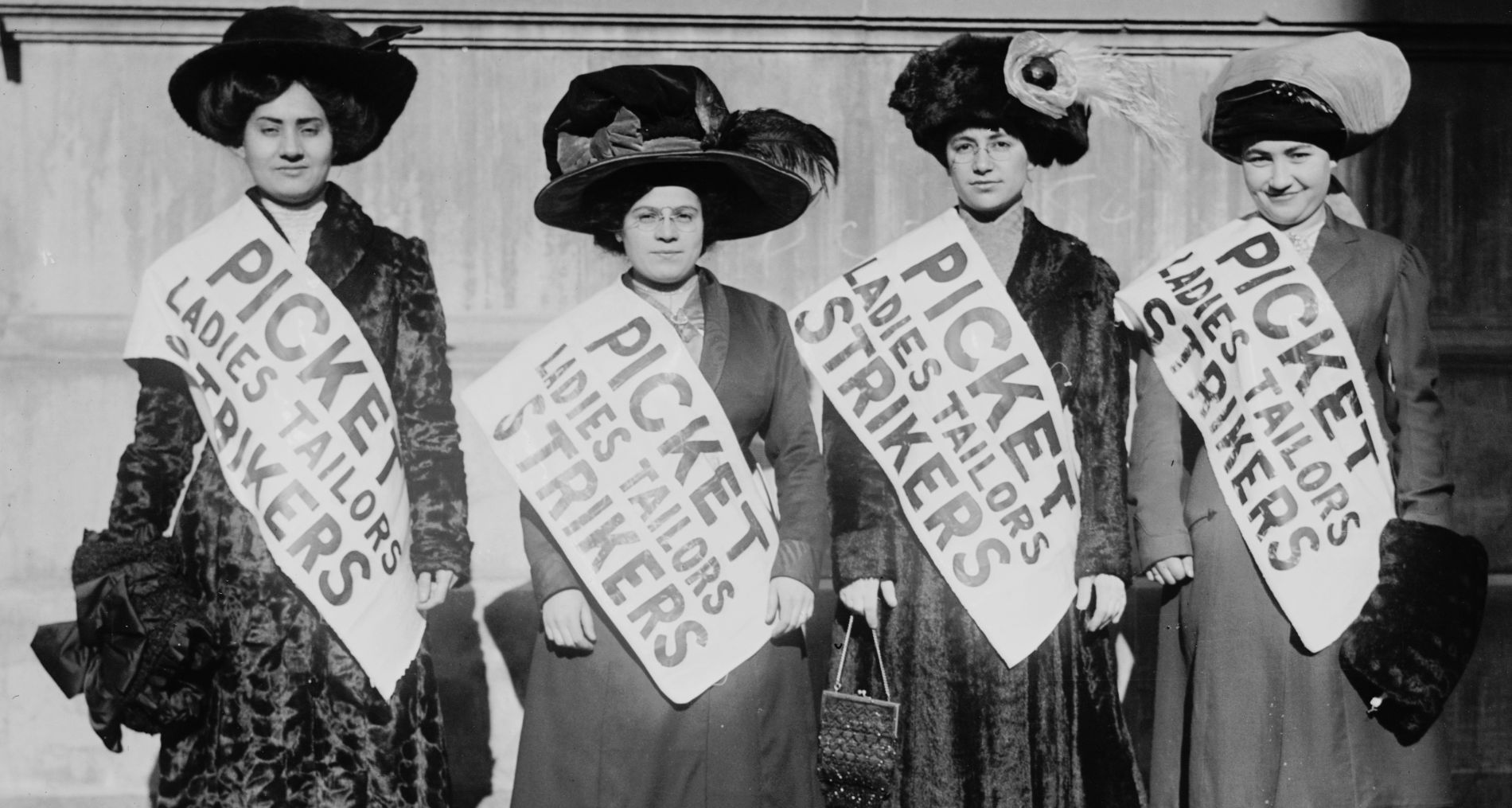
Comrade Scheff, looking at the work of the Women’s Trade Union League in the 1910 Garment Strike, with some insights on theory and practice.
‘Women Fighters’ by Bessie R. Scheff from Revolt (San Francisco). 2 No. 4. July 22, 1911.
Preparing For a Big Strike.
A call for volunteers to help organize the great Shirt Waist Makers strike of a year and a half ago, brought me in contact with the organization known as the Woman’s Trade Union League.
Those of us who volunteered to help in the strike received their orders from the headquarters of the Woman’s Trade Union League, which took hold of the strike situation and directed the work in conjunction with the Organizer of the Shirt Waist Makers Union.
Much has been written about that strike, and no doubt the readers are familiar with every phase of it. Little, however, as far as I know, has been said about the wonderful manner and method the League employs in handling a strike. I could give details of how that strike was conducted, which would be of great interest, but the Shirt Waist Makers’ strike having been so much exploited, I choose to speak about the coming strike of the White Goods Workers in order to bring out my points concerning the Woman’s Trade Union League.
There is a great restlessness amongst the White Goods Workers in New York. About 15,000 are employed at this trade. The trade is divided into two classes of work. There are those who make the fine expensive garments, and those who do the cheap line of work, which one sees at bargain sales in the department stores, and wonders what the workers must get for making them, when they are sold so cheaply.
It is those who make the cheap line of work that are most exploited. At last their endurance seems to have reached the limit. Hence a great deal of talk about a general strike this coming fall.
The Woman’s Trade Union League, being always ready and on the job, has at this early date the situation of the White Goods trade well in hand, and is organizing the workers as fast as possible. In addition to this they have obtained data concerning the conditions in the trade, as to prices, hours employed, duration of the seasons, etc., and a thousand and one means and ways employers have to exploit and oppress the workers. They know how many of the different nationalities are employed, and have an idea of what material they will have to work with in case of a strike.
If anyone were to ask of them for information concerning any shop of the White Goods trade, all they need do is turn to their card system, in which is tabulated all facts prevailing in the shop: prices, hours, sanitary condition, number of employees, fire protection, contract work, etc.
Their methods in obtaining this information are unique. If it were not for the fact that it might interfere with their work, it would be of the greatest interest to give facts and details. The secret of their success in organization is I believe in the fact that they go after the workers individually. If a girl joins the union and fails to come to subsequent meetings, a representative of the League is sent to her home to learn the reason why she absents herself. If in some way the League hears of a worker whose trade is organized and who does not belong to the union, a representative is sent to that worker’s home to try to induce him or her to join the union. If a strike is on and the pickets are harassed by the police and thugs, the League sends someone with the pickets, who stands aside to watch, and later act as a witness in court in case of arrests. In short, nothing human ingenuity, or that conditions suggest and make imperative, is left undone. The result of this is that the workers need no verbal assurance that the League is in earnest in working for their interest. Action, in this case as in others, is most convincing.
There is an element among our Socialist comrades, who in order to gain votes, distort the fundamental principles of Socialism in an effort to make it more palatable to the masses. I would advise them, rather to get busy along the line of activity and in the same manner as the Woman’s Trade Union League as a means for getting votes, and in addition they would gain the genuine respect for their sincerity and the principles for which they stand.
To the Socialist party as a whole I wish to say that as long as we will go on mouthing the fact that the Socialist party stands for the interest of the workers without getting down to the actual work in the fight of the workers’ struggle for existence, we will give rise to those among us who grow impatient with the slowness of the movement and who try to sugar-coat the fundamental principles of Socialism in the hope that it will appeal to the masses more readily. However, in their desire to hasten the movement they retard it by withholding it from the revolutionary stand which it must take in order to accomplish its great mission.
Revolt ‘The Voice Of The Militant Worker’ was a short-lived revolutionary weekly newspaper published by Left Wingers in the Socialist Party in 1911 and 1912 and closely associated with Tom Mooney. The legendary activists and political prisoner Thomas J. Mooney had recently left the I.W.W. and settled in the Bay. He would join with the SP Left in the Bay Area, like Austin Lewis, William McDevitt, Nathan Greist, and Cloudseley Johns to produce The Revolt. The paper ran around 1500 copies weekly, but financial problems ended its run after one year. Mooney was also embroiled in constant legal battles for his role in the Pacific Gas and Electric Strike of the time. The paper epitomizes the revolutionary Left of the SP before World War One with its mix of Marxist orthodoxy, industrial unionism, and counter-cultural attitude. To that it adds some of the best writers in the movement; it deserved a much longer run.
PDF of full issue: https://www.marxists.org/history/usa/pubs/revolt/v2n04-jul-22-1911-Revolt.pdf
 Revolution's Newsstand