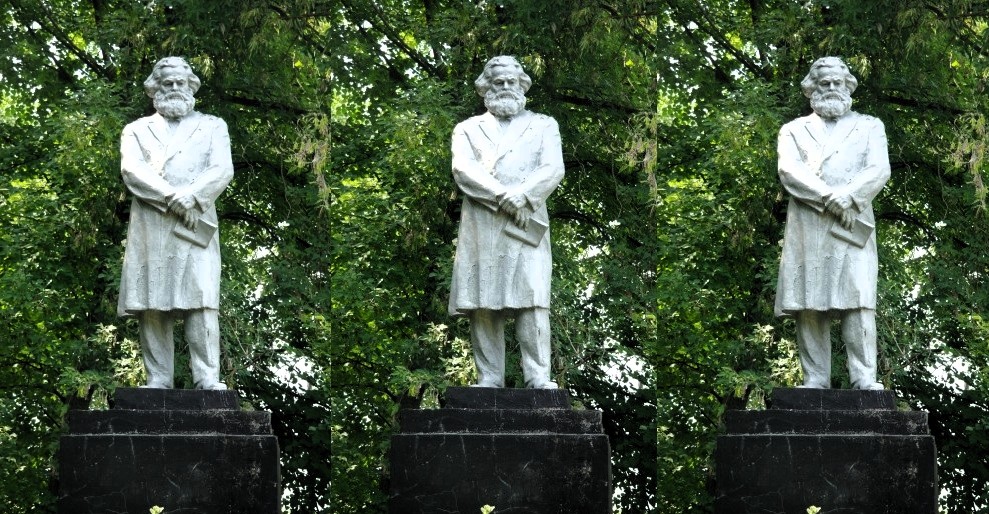
The final installment of Kautsky’s 1908 work as translated by Ernest Untermann.
‘The Historical Achievement of Karl Marx: The Combination of Theory and Practice’ by Karl Kautsky from The Socialist (Seattle). Vol. 8 Nos. 378. June 6, 1908.
We have now considered the most important achievements attained by Marx in co-operation with Engels. But the picture of their work would remain incomplete if we did not refer to one side of it, which marks it to a pronounced degree, namely, the combination of theory and practice.
Bourgeois minds look upon this as a stain upon the bright shield of their scientific greatness, a greatness before which even bourgeois learning must bow down, though reluctantly, grudgingly and without understanding. If they had been merely theorizers, parlor scientists, content to expound their theories in language unintelligible to ordinary mortals and in inaccessible volumes, they might have been forgiven. But it is assumed that they became biased and their integrity doubtful, because their science was born out of the struggle and in its turn served as a weapon in the struggle, a struggle against the existing order.
This mean view conceives of a fighter only as a lawyer, who has no other use for his science than to draw from it arguments for the refutation of the opposing side. It has no inkling of the fact that no one has a greater craving for truth than a genuine fighter, in a terrible struggle, which he cannot hope to carry to a successful issue, unless he clearly understands his situation, his resources, his prospects. The judges who interpret the laws of the state may be cheated by the tricks of a spellbinder familiar with legal science. But the necessity of natural laws can only be ascertained, not hoodwinked or bribed.
A fighter taking this view of the mater will but draw a greater craving for undisguised truth out of the intensity of the struggle. But he will also feel the need of not keeping any acquired truth for himself, but of communicating it to his fellow fighters.
Thus Engels writes in the period from 1845 to 1848, in which he and Marx gained their new scientific results, that it was by no means their intention to “whisper these results in ponderous volumes exclusively to the ‘learned’ world.” On the contrary, they immediately got in touch with proletarian organizations, in order to make propaganda among them for their point of view and the tactics corresponding to it. They succeeded in winning one of the most important revolutionary organizations of proletarians of that period, the international “Communist Club,” for their principles. These found expression a few weeks before the February revolution of 1848 in the Communist Manifesto, which was destined to become the handbook of the proletarian movement of all countries.
The revolution called Marx and Engels from Brussels, where they lived, first to Paris, then to Germany, where the practical exigencies of the revolution completely absorbed their energies for a while.
The decline of the revolution compelled them, since 1850, much against their will, to devote themselves entirely to the theory. But when the labor movement took on new life, in the beginning of the sixties, Marx at once devoted all his strength to a practical participation in it, while Engels was at first prevented by private affairs from doing so. Marx did this in the International Workingmen’s Association, which was founded in 1864 and was soon to become a specter for all bourgeois Europe. The ridiculous police spirit, which led even bourgeois democracy to view every proletarian movement with suspicion, represented the International as an enormous society of conspirators, whose sole aim was supposed to be the planning of riots and revolts. In reality the International followed its aims in broad publicity. These were the unification of all proletarian forces for common action, but also for independent action, apart from bourgeois politics and bourgeois thought, with a view to expropriating capital, conquering all political and economic means of class rule from the possessing classes through the proletariat. The most important and decisive step in this struggle is the conquest of the political power, but the economic emancipation of the working classes is the final goal, “to which every political movement has to subordinate itself as a mere auxiliary.”
As the foremost means for the development of proletarian power, Marx mentions organization.
“The proletarians possess one element of success,” he said in his inaugural address, “numbers. But numbers weigh heavily in the scale only when they are united by organization and led toward a conscious aim.”
Without an aim, no organization. The common aim alone can unite the various individuals for common organization. On the other hand, the difference of aims tends as much to separate as the community of alms tends to unify.
It is precisely the significance of organization for the proletariat which makes the question of its aims paramount. This aim is of the greatest practical importance. Nothing is more impractical than the apparently practical policy which regards the movement as everything and the aim as nothing. Is organization also nothing and the unorganized movement everything?
Socialists had marked out goals for the proletariat long before Marx. But these had called forth only sectarianism, had split the proletariat, since every one of those socialists had laid special stress upon the particular way of solving the social problem which he had invented. There were as many solutions as there were sects.
Marx did not offer any particular solution. He withstood all challenges to become “positive,” to explain in detail the measures by which the proletariat is to be emancipated. He held up only the general goal of organization, in the International, a goal which every proletarian could set for himself, namely, the economic emancipation of his class. The way, likewise, which he showed was one that class instinct pointed out to every proletarian: the economic and political class struggle.
It was above all the organization of trade unions which Marx espoused in the International; they appeared to him as that form of organization which would most rapidly unite large masses permanently in the labor unions he saw also the framework of a labor party. No less diligently than to the extension of labor union organization did he devote himself to the work of filling them with the spirit of the class struggle and teaching them to understand the conditions under which the expropriation of the capitalist class and the emancipation of the proletariat would be possible.
He had to overcome much opposition in this work, precisely among the most advanced laborers, who were still full of the spirit of the old socialists, and who looked with disdain upon labor unions, because they did not touch the wage system. These socialists regarded labor unions as a deviation from the straight road, which to them led to the goal by the formation of organizations which should overcome the wage system directly, such as productive associations. That labor organization nevertheless made rapid progress on the European continent since the second half of the sixties is due above all to the International and to the influence exerted in it and through it by Marx.
But trade unions were not an end in themselves for Marx. They were for him merely means to the end of fighting the class struggle against the capitalist system. He vigorously opposed labor union leaders who tried to turn the unions away from this purpose, whether they were actuated by narrow personal motives or by pure and simple economic views. He opposed especially the English labor leaders, who began to dicker with the Liberals. While Marx was very lenient and tolerant toward the proletarian masses, he was very strict toward those who posed as leaders of these masses. This applied particularly to their theoretical leaders.
Marx welcomed every proletarian in the proletarian organization who came with the honest intention of taking part in the class struggle, no matter what views a man might hold on other subjects, no matter what might be his theoretical motives, or what arguments he might employ; it was immaterial to Marx whether such a man was an atheist or a good Christian, a Proudhonian, Blanquist, Weitlingian, Lasallean, whether he understood the theory of value or whether he considered it quite superfluous, etc.
Of course, it was not immaterial to him whether he had to deal with clearly thinking or confused laborers. He considered it his most important task to enlighten them, but he would have considered it a mistake to repulse laborers or keep them away from his organization merely because they were confused thinkers. He had implicit confidence in the power of the class antagonism and in the logic of the class struggle, which should necessarily push every proletarian into the right path, as soon as he would join an organization which was actually devoted to the real proletarian class struggle. But he acted differently toward men who came to the proletariat as teachers and spread ideas that were apt to destroy the strength and unity of this class struggle. He was not in the least tolerant toward such elements. He met them as an inexorable critic, though their intentions might be the best; their influence seemed pernicious to him under any conditions, provided it produced any results at all and did not prove wholly a waste of energy.
Thanks to this, Marx was one of the most hated men: he was hated not merely by the bourgeoisie, who feared him as their most dangerous enemy, but also by all sectarians, inventors, educated muddleheads and similar elements in the socialist camp, who were so much more indignant over his intolerance,” his “authoritarianism,” his “popery,” his “courts of heresy,” the more deeply his critique cut them.
We Marxians have adopted with the conceptions of Marx also this position of his, and we are proud of it. Only he who feels that he is the weaker complains of the “intolerance” of a purely literary critique. None are criticized more, and with greater sharpness and vindictiveness, than Marx and Marxism. But so far no Marxian has thought of complaining about the intolerance of our literary opponents. We are too sure of our position for that.
We are not so indifferent to the ill humor shown at times by the proletarian masses on account of the literary feuds between Marxism and its critics., This ill humor expresses a very just need: The need of a united class struggle, of a combination of all proletarian elements in a great and compact mass, the fear of disruptions, by which the proletariat might be weakened.
The laborers know very well how much strength there is in their unity; it is worth more to them than theoretical clearness, and they execrate theoretical discussions which threaten to lead to disruption. This is right, for the striving for theoretical clearness would accomplish the opposite of what it should, if it were to weaken instead of strengthen the proletariat.
A Marxian who would carry a theoretical difference to the point of splitting a proletarian fighting organization would not act as a Marxian, would not comply with the Marxian theory of the class struggle, for to it every step of the actual movement is more important than a dozen programs.
Already in the “Communist Manifesto” have Marx and Engels explained the attitude to be taken by Marxians within proletarian organizations. Read the section entitled “Proletarians and Communists.” The Communists were then about the same that Marxians are now.
There they said:
“In what relation do the Communists stand to the proletarians as a whole?
“The Communists do not form a separate party opposed to other working-class parties.
“They have no interests separate and apart from those of the proletariat as a whole.
“They do not set up any sectarian principles of their own, by which to shape and mould the proletarian movement.
“The Communists are distinguished from the other working-class parties by this only: 1. In the national struggles of the proletarians of the different countries they point out and bring to the front the common interests of the entire proletariat, Independently of all nationality. 2. In the various stages of development which the struggle of the working class against the bourgeoisie has to pass through, they always and everywhere represent the interests of the movement as a whole.
“The Communists, therefore, are on the one hand practically the most advanced and resolute section of the working class parties of every country, that section which pushes forward all others; on the other hand, theoretically, they have over the great mass of the proletariat the advantage of clearly understanding the line of march, the conditions, and the ultimate general results of the proletarian movement.
“The Immediate aim of the Communists is the same as that of all the other proletarian parties: formation of the proletariat into a class, overthrow of the bourgeois supremacy, conquest of political power by the proletariat.
The theoretical conclusions of the Communists are in no way based on ideas or principles that have been invented or discovered by this or that would-be universal reformer.
“They merely express in general terms actual relations spring from an existing class struggle, from a historical movement going on under our very eyes.” (Kerr edition, pages 32 and 33.)
During the sixty years since this was written a good many things have changed, so that these sentences cannot be applied to the letter. In 1848 no great and united labor parties existed, with comprehensive socialist programs, and numerous other far more widespread socialist theories existed outside of the Marxian.
Today only one socialist theory, the Marxian, is alive In the fighting proletariat, which is united in mass parties. Not all members of the labor parties are Marxians, still less are all of them thoroughly grounded Marxians. But those among them who do not accept the Marxian theory have no theory at all. Either they deny the necessity of all theories and all programs, or they brew a socialist hash from fragments of pre-Marxian modes of thought, such as we have just discussed and which have not disappeared altogether, with some chunks of Marxism thrown in. This sort of socialism has the advantage that anything may be left out of it which does not suit momentary purposes, and everything adopted into it which seems momentarily useful. This is far more easy than a consistent Marxism, but It fails completely at the points where a theory is most needed. It suffices for the ordinary purposes of popular agitation, but fails whenever it is a question of finding your way through the reality of new and unforeseen events. Out of such yielding and soft material no structure can be built that will defy all storms. Neither can it serve as a guide for explorers, because it is wholly determined by the individual requirements of those who think for a day.
Marxism is no longer compelled to struggle with other socialist theories in the proletariat for its supremacy. Its critics no longer meet it with other theories, but merely with doubts as to the necessity of either all theories or any consistent theory. They offer only phrases, such as that about our “dogmatism,” our “orthodoxy” and the like, not any new and compact systems which are opposed to Marxism in the proletarian movement.
But this is for us Marxians only a reason for avoiding every attempt to form a separate Marxian sect within the labor movement, apart from the other strata of the fighting proletariat. We, like Marx, consider it our duty to unite the whole proletariat in a fighting organism. Within this organism we shall always aim to be “practically the most advanced and resolute section which pushes forward all others; on the other hand, theoretically, the section which has over the great mass of the proletariat the advantage of clearly understanding the line of march, the conditions and the ultimate general results of the proletarian movement.” In other words, we shall always endeavor to attain to the highest in practical energy and theoretical understanding that can be attained with the existing means. Only in this, in the superiority of our work, which is due to the superiority of the Marxian point of view, do we aim to occupy a marked position in the total organism of the proletariat organized in a class party. Moreover, the proletariat is pushed more and more into Marxian ways by the logic of events, even where it is not yet fully imbued with a conscious Marxism.
Besides, there has hardly ever been any Marxian, or any group of Marxians, who have caused disruption by purely theoretical differences. Whenever any split took place it was due to practical, not to theoretical, differences, to questions of tactics or organization, and the theory was only the scapegoat that had to carry all the sins committed under these circumstances. For instance, the thing called intolerance for some years by a portion of the French socialists reveals itself on closer scrutiny merely as a fight of a few literary men and parliamentarians against proletarian discipline, which is felt as a degradation by them. They demand discipline only for the great mass, but not for such exalted beings as they are themselves. The champions of proletarian discipline, on the other hand, have always been Marxians in France, and in this they have shown themselves as excellent disciples of their master.
He did not merely show the way by which the proletariat can best reach its great goal, but he also advanced upon it practically. By his work in the International he has become typical for all our practical activity.
Not only as a thinker, but also as an example, should we celebrate Marx, or rather to act more in accordance with his ideas, study him. We derive no less advantage from the history of his personal activity than we do from his theoretical analyses.
He became a model for us in his activity not merely by his knowledge, his superior mind, but also by his daring, his indefatigableness, which was combined with the greatest goodness, unselfishness and a firm equanimity.
Whoever wishes to get an idea of his daring should read his process, which was opened against him in Cologne, on February 9, 1848, because he had called upon the people to resist the government by force of arms, and in which he demonstrated the necessity of a new revolution. His goodness and unselfishness is shown by the alert solicitude which he, living in the greatest poverty, exhibited for his comrades, of whom he always thought, rather than of himself, as he did after the collapse of the revolution of 1848, and after the downfall of the Paris Commune of 1871. Finally, his whole life was an uninterrupted chain of trials, which could be borne only by a man whose indefatigableness and firmness far exceeded the ordinary measure.
From the beginning of his work on the “Rheinische Zeitung,” in 1842, he was hounded from country to country, until the revolution of 1848 promised him the starting of a victorious advance. By its failure he saw himself hurled back into political and personal misery, which seemed so much more hopeless as the bourgeois democracy, on the one hand, boycotted him in his exile, and some communists, on the other hand, fought him, while many of his faithful comrades were burled for years in Prussian military prisons. After a long time a ray of light fell into his life, the International, but after a few years it was again obscured by the fall of the Paris Commune, which was soon followed by the dissolution of the International through internal dissensions. It is true, the International had fulfilled its duty excellently, but for this reason the proletarian movements of the different countries had become more independent. The more they grew, the more did the International need a more elastic organization, which should leave sufficient playroom for the proletarian movements of the various countries. But at the same time, in which this became necessary, the English labor union leaders, who wanted to work together with the Liberals, felt hemmed in by the theory of the class struggle, while in the Latin countries Bakounist anarchism rebelled against the participation of laborers in politics. These events compelled the General Council of the International to exert its centralized powers at the very moment when more local autonomy became more necessary than ever. This contradiction wrecked the proud ship, whose helm was in the hands of Karl Marx.
This was a bitter disappointment for Marx. It is true, the brilliant rise of the German social democracy followed later, and the revolutionary movement in Russia gained strength. But the laws of exception against socialists stopped the growth of the socialist party in Germany for a while, and Russian terrorism reached its culmination in 1881. After that terrorism declined rapidly.
Thus the political activity of Marx was an uninterrupted chain of failures and disappointments. And so was his scientific activity. His life’s work, “Capital,” upon which he built such great hopes, seemed to remain without notice and success, even in his own party, for even here it was but little understood until the beginning of the eighties.
Marx died on the threshold of his time, in which the fruit was at last to mature which he had sown in the wildest storms and the darkest days. He died when the time approached in which the proletarian movement seized all Europe and filled itself everywhere with his spirit, stood upon his foundations, and for this reason began a period of uninterrupted and victorious advances for the proletariat which is brilliantly distinct from those days in which Marx struggled as a lonely, little understood and much hated fighter against a world of enemies for an understanding of his ideas among the proletariat.
Discouraging, or even hopeless, as this situation would have been for every ordinary man, Marx never lost his smiling equanimity nor his proud confidence. He towered so high above his contemporaries, he looked so far beyond them, that he clearly saw the promised land which the overwhelming mass of his fellow beings did not even dream of. It was his scientific greatness, it was the depth of his theory from which he derived the best strength of his character, in which were rooted his firmness and confidence, which kept him free from all vacillation and moods, from that restless excess of feeling, which is elated to the skies today and grieved unto death tomorrow.
We also must drink from this fountain, then we shall be certain of holding our own in the great struggles which we shall have to meet and of developing the highest strength of which we are capable. Then we may expect to reach our goal more quickly than we might ordinarily. The banner of proletarian emancipation and of all humanity which Marx unfurled and carried before us more than a generation, in ever renewed advances, never tiring, never fearing, that banner shall be planted triumphantly upon the ruins of the capitalist dungeon by the fighters whom he has trained.
There have been a number of journals in our history named ‘The Socialist’. This Socialist was a printed and edited in Seattle, Washington (with sojourns in Caldwell, Idaho and Toledo, Ohio) by the radical medical doctor, former Baptist minister and socialist, Hermon Titus. The weekly paper began to support Eugene Debs 1900 Presidential run and continued until 1910. The paper became a fairly widely read organ of the national Socialist Party and while it was active, was a leading voice of the Party’s Left Wing. The paper was the source of many fights between the right and left of the Seattle Socialist Party. in 1909, the paper’s associates split with the SP to briefly form the Wage Workers Party in which future Communist Party leader William Z Foster was a central actor. That organization soon perished with many of its activists joining the vibrant Northwest IWW of the time.
PDF of full issue: https://www.marxists.org/history/usa/pubs/thesocialist-seattle/080606-seattlesocialist-v08n378.pdf
 Revolution's Newsstand