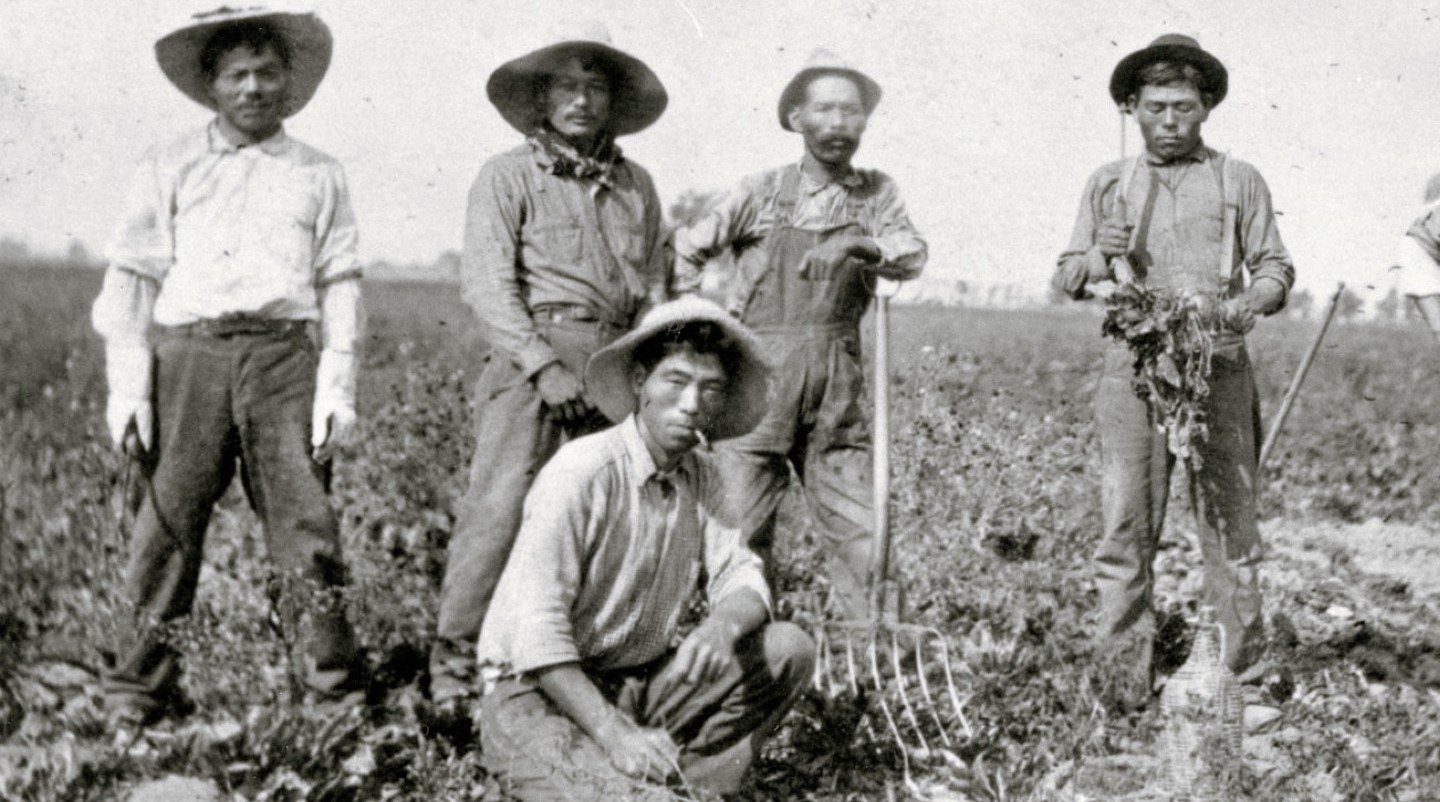
The formation of the Japanese-Mexican Labor Association and 1903 strike in the sugar beet fields of Oxnard, California was a historic moment in the U.S. and international workers’ movement. In a furtherance of that remarkable episode, here the Mexican Sugar Beet and Farm Laborers’ Union writes to Gompers, rejecting the charter granted to them by the A.F. of L. because it refused admittance to their fellow Japanese workers.
‘Mexican Union Refuses Charter’ from American Labor Union Journal. Vol. 1 No. 38. June 25, 1903.
The Oxnard Sugar Beet Workers Demand That The Japanese Be Recognized By The A.F. of L.
“Better go to hell with your family than to heaven by yourself,” said the speaker whose stirring words decided the member of the Mexican Sugar Beet and Farm Laborers’ Union of Oxnard to send back their charter, just received from the American Federation of Labor, and refuse to affiliate with that national body as long as its president, Samuel Gompers, declines to grant a similar charter to the Japanese union. Without the Japanese union the late victory of organized labor in Oxnard against the Beet Sugar company would have been impossible. The Japanese were the first to organize. Yamagachi was the first man to hold a public meeting in Oxnard for the purpose of uniting the field workers and urging them to strike for a fair living wage, for doing which he was promptly arrested by the town authorities. When the hired assassins of the corporate interests fired upon the unarmed union men, killing one and wounding others, Japanese and Mexican blood poured out together, such a bond cannot be lightly broken not even to gain admittance to the American Federation of Labor and so the Mexican union has refused to accept its charter unless like rights and privileges are granted to the Japanese.
President Gompers, in his letter to Secretary J.M. Lizarraras, makes the following remarkable statement: “It is further understood that in issuing this charter to your union it will under no circumstances accept membership of any Chinese or Japanese. The laws of our country prohibit Chinese workmen or laborers from entering the United States and propositions for the extension of the exclusion laws to the Japanese have been made on several occasions.”
In making such an extraordinary ruling President Gompers has violated the expressed principals of the A.F. of L, which states that race, color, religion or nationality shall be no bar to fellowship in the American Federation of Labor.
It will be impossible, as long as this ruling is sustained, to organize the wage workers of California for the protection of their interests, for there are between forty and fifty thousand Japanese in this state, who hold the balance of power among the field workers, and nothing can be effectually done without their co-operation.
In the recent strike in Los Angeles, upon the Huntington street car lines, our failure to accomplish all that we attempted was principally due to our inability to promise the Japanese, who were at work on the road, admission into the A.F. of L. How could we ask them to come out with their Mexican co-workers when no recognition of their rights as wage workers would be all their reward? It was at the risk of broken heads and starvation that the Mexican Federal Labor Union of Los Angeles was formed–for the police used their clubs on the men who dared to lay down their tools–and in such a warfare to raise race prejudice is unpardonable folly, a folly for which President Gompers must soon answer to the unions of southern California who are unanimous in demanding recognition for their brother wage workers, the Japanese.
The following communication was addressed to President Gompers by the Mexican union of Oxnard:
“Oxnard, Cal., June 8, 1993. “Mr. Samuel Gompers, President American Federation of Labor, Washington, D.C.:
“Dear Sir–Your letter of May 15th In which you say the admission with us of the Japanese Sugar Beet and Farm Laborers into the American Federation of Labor cannot be considered, is received.
“We beg to say in reply that our Japanese brothers here were the first to recognize the importance of co-operating and uniting in demanding a fair wage scale.
“They are composed mostly of men without families, unlike the Mexicans in this respect.
“They were not only just with us, but they were generous. When one of our men was murdered by hired assassins of the oppressors of labor, they gave expression to their sympathy in a very substantial form.
“In the past we have counselled, fought and lived on very short rations with our Japanese brothers, and toiled with them in the fields, and they have been uniformly kind and considerate. We would be false to them and to ourselves and to the cause of unionism if we now accepted privileges for ourselves which are not accorded to them. We are going to stand by men who stood by us in the long, hard fight which ended in a victory over the enemy. We therefore respectfully petition the A.F. of L. to grant us a charter under which we can unite all the sugar beet and field laborers of Oxnard without regard to their color or race. We will refuse any other kind of a charter except one which will wipe out race prejudices and recognize our fellow workers as being as good as ourselves.
“I am ordered by the Mexican union to write this letter to you and they fully approve its words.
“J.M. LAZARRARAS. “Secretary S.B. and F.L. Union, Oxnard.”
American Labor Union Journal was the official paper of the ALU, formed by the Western Federation of Miners and a direct predecessor to the I.W.W. Published every Thursday in Butte, Montana beginning in October, 1902 before moving to Chicago in early 1904. The ALU supported the new Socialist Party of America for its first years, but withdrew by 1904 as the union and paper grew more syndicalist with “No Politics in the Union” appearing on its masthead and going to a monthly. In early 1905, the Journal was renamed Voice of Labor, folding into the Industrial Workers of the World later that year. The Journal covered the Western Federation of Miners and the United Brotherhood of Railway Employees, as well as the powerful labor movement in Butte.
PDF of full issue: https://www.marxists.org/history/usa/pubs/american-labor-union-journal/030625-alujournal-v1n38.pdf
 Revolution's Newsstand