One of the ‘issues’ that created hostility between Communists and Socialists in Germany, making uniting against the existential fascist threat almost impossible, were the hundreds, no thousands, of murders committed by Social Democratic governments of Communists and militant workers during the Weimar years. Peter Maslovsky on the shooting to death of eight participants at a C.P. election rally on Halle on March 15, 1925 and the mass proletarian funeral that followed.
‘The Slaughter of Workers in Halle’ by Peter Maslovsky from International Press Correspondence. Vol. 5 Nos. 21 & 25. March 26 & April 2, 1925.
I. A Prelude to the Presidential Elections in Germany.
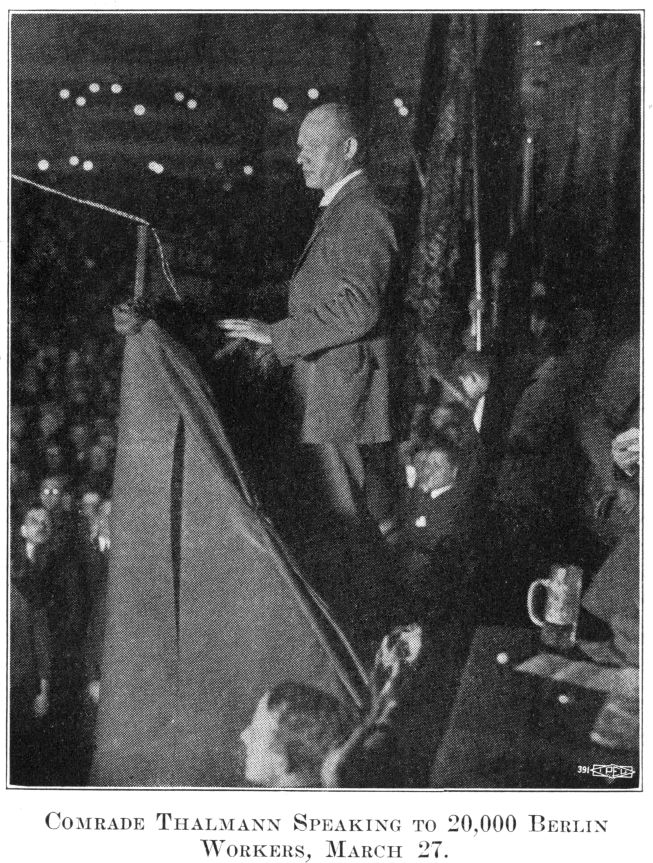
THE C.P. of Germany arranged its first meeting in the presidential election campaign for Friday, March 15th, in the “red heart of Germany,” in Halle. The meeting was held in the “Volkspark,” the historical place where in 1921, the majority of the Independent Socialist Party, after hearing the speech of Comrade Zinoviev, decided for Moscow. Huge masses such as had never been seen before in the Volkspark attended the meeting: workers, clerks, officials, even members of the bourgeoisie, who were obviously present in order to enjoy the sensation of hearing the “Red President” speak. In addition to this there was an enormous over. flow meeting in the garden of the Volkspark. At least 10,000 people were present.
The social democratic police president Runge had, from the commencement, handed over the leadership of the police action against the C.P. of Germany, obviously planned beforehand, to the notorious police blood-hound, Lieutenant Pietzker. Although foreigners have spoken at all sorts of demonstrations of the black-red-gold parties, the police, as they could not very well forbid the election meeting, used the announcement of a French and an English speaker as a pretext for sending a heavily armed force into the meeting hall itself, in addition to placing a strong guard at the entrances. The two foreign comrades, who spoke in the name of the French and English proletariat respectively, were allowed to express sympathy with the red candidate for the presidential election, Thalmann, in their own language, without interference.
It was only when the chairman of the meeting announced Comrade Thalmann—who was greeted with loud cries of “Long live the Red President”—as the speaker, and even before the speeches of our two foreign comrades had been translated, that Lieutenant Pietzker suddenly sprang on to the table and forbade the meeting, while at the same time he flourished a revolver in the air like one possessed. The chairman immediately endeavored to calm the meeting. He offered to close the meeting in perfect order if the chief of the police would withdraw his men, who were already standing with drawn truncheons, revolvers and machine-guns ready to attack. The chief of police, who according to sworn witnesses had already before the commencement of the meeting spoken of “breaking up the meeting” and had also said that “something will happen today,” threatened to shoot the chairman immediately. And as the crowd, which were tremendously excited, naturally broke out into cries of protest, he gave the order to fire.
About fifty to sixty shots from machine-guns and revolvers were fired into the dense crowd of people who were trying to escape. A fearful panic arose. The masses made for the exits which were too narrow for such a crowd. The rail of a staircase proved too weak to stand the pressure of such a weight of fleeing humanity. Although made of iron it bent like lead and broke. Men and women, one after another came crashing down below.
Then deaths are to be recorded up to the present, among them being two women, and forty wounded. After the shooting the police behaved like beasts. People who came to inquire after their wounded relatives were driven from the hall with truncheons. Members of the Workers’ First Aid Corps were also beaten. A policeman who broke into tears when proletarian women called “murderer” after him, and swore that he had not taken part in the shooting, was discharged by Runge.
The indignation in Halle and throughout all Germany is enormous. On Sunday, twenty-four hours after the outrage, demonstrations were arranged by the C.P. of Germany in all parts of the country. In Halle this protest demonstration was more strongly attended than the Thalmann meeting at which the massacre took place. At least 12,000 people attended. At the conclusion of the meetings the masses demonstrated before the police presidium crying: “Down with the murderers!” In view of the enormous masses, the tremendous excitement and the revolutionary mood the police did not venture to disturb these meetings.
Meanwhile a factory council meeting in Halle demanded the removal of the Police President Runge, the arrest and punishment of the murderer Pietzker, the maintenance of the dependents of the victims, the burial of the victims from public funds, ample compensation for the wounded and the complete withdrawal of the police from all workers’ meetings. A committee consisting of five members of factory councils of the five greatest factories in Halle, among them a social democratic worker, constituted itself as a workers’ committee of investigation.
The Communist fractions in the Reichstag and Prussian Landtag demanded that measures be taken against all officials connected with the massacre, and repeated the demands of the factory councils. The dismissal of Runge has already been forced through.
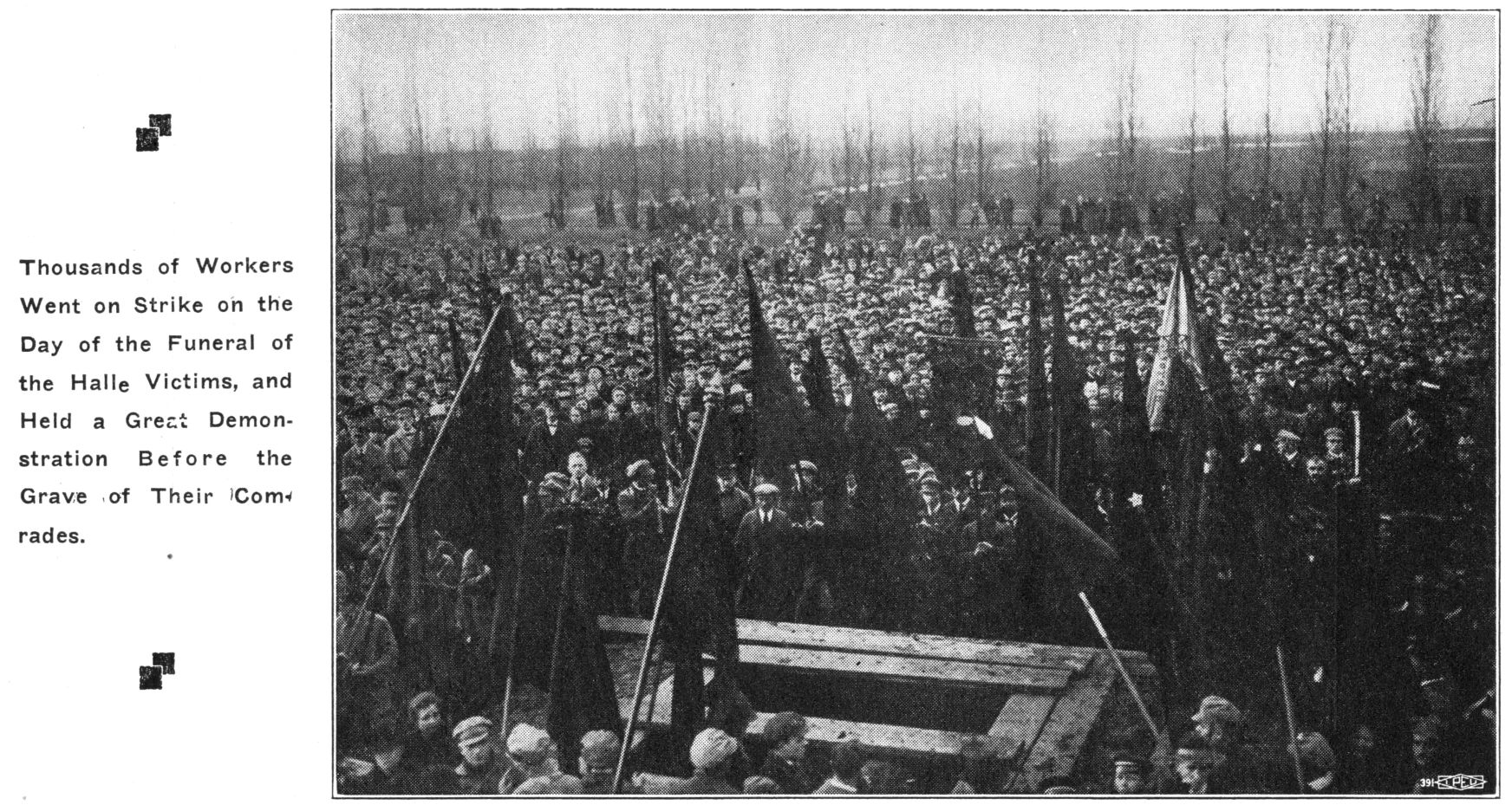
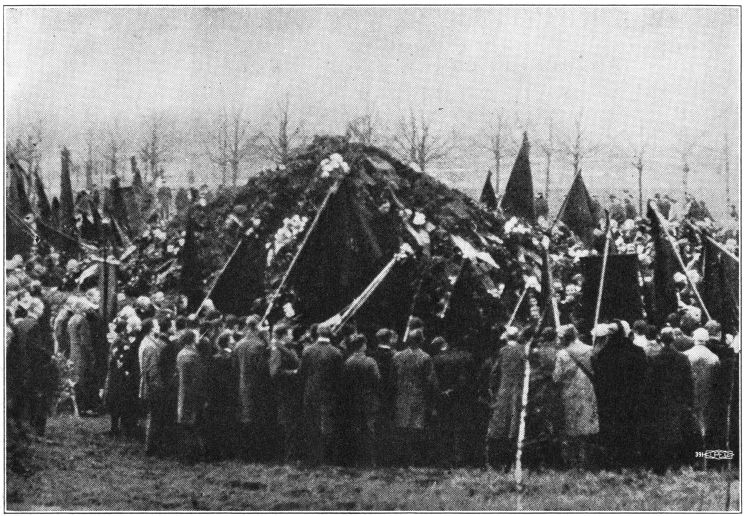
On the day of the funeral of the Halle victims tens of thousands struck work in the shops of the city. An immense crowd of workers, bearing red banners, accompanied the coffins, red-draped and heaped with crimson blossoms, to the cemetery, where a great demonstration was held despite the efforts of the social-democratic police.
Even in the bloody post-revolutionary history of Germany the Halle massacre is unique as regards its brutality, baseness and cynical blood-lust. That workers are shot down at demonstrations or in open struggles, that has up to now been part of the order of the day. But that unarmed working men and women who attend a perfectly legal election meeting, should be shot down like dogs in a closed room, that exceeds even the Noske terror.
But the brutality of the massacre is surpassed by the profound baseness with which the bourgeois and before all the social democratic press are seeking to deceive the public regarding the massacre of Halle. According to these lying reports, it was the participants at the meeting who fired first. This lie is so absurd that it can only be attributed to the bad conscience and the fear of the murderers and of their social democratic supporters. The ten dead and 2 severely wounded were all participants at the meeting. If however, as the bourgeois and social democratic press report, there was shooting on both sides, then it is very remarkable that not a single police officer received any injury.
This palpable fraud on the part of the enemies of labor is having an effect favorable to the Communists, upon the indifferent masses as well as upon the social democratic workers, many of whom were present at the Thalmann meeting and saw with their own eyes what took place.
It is not a mere chance that the murderers selected the first demonstration on behalf of the Communist candidate in order to carry out a massacre. The social democratic police president Runge and the social democratic provincial governor of Halle, Grutzner, wished to furnish a fresh testimonial as to their reliability for the bourgeoisie in view of their threatened “dismissal.” But this time the case is too monstrous. The murder will recoil on their own heads: the German workers recognize in the murders of Halle all the more clearly the nature of the fascist republic which is draped with the black-red-gold colors. The murder gang have shown to the proletarians the necessity of the united class front.
II. After the Halle Murder.
On Thursday, March 19th, in the midday hours, the bodies of eight members of the proletariat lay in state in the “Volkspark”, at the very spot where the police of the Social Democratic Police President Runge fired on a legal meeting of voters of the Communist Party, killing these eight and wounding about 40 workers, men and women, some very severely.
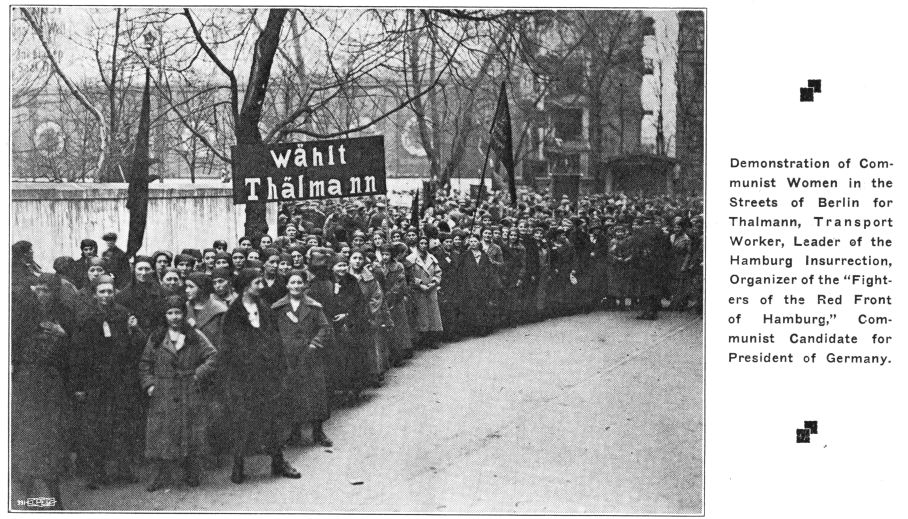
From the early hours of the morning, the streets of Halle began to be enlivened with the red colour of the revolution. An almost uninterrupted stream of the workers of the factories flowed towards the “Volkspark”; delegations of workers from all parts of the Republic advanced in serried ranks. Groups of women in red kerchiefs, proletarian young brigades, Red front, fighters and groups of children of the “Jung-Spartakus” mingled with the defiles of workers. Long before the funeral ceremonies began, the three halls of the “Volkspark” were full; shortly afterwards, the whole park was overcrowded. And still the masses streamed up, singing defiant revolutionary songs, so that, before long, all the streets leading to the “Volkspark” were crowded with people. It is estimated that more than 30,000 proletarians were assembled in and round the “Volkspark”.
The speakers addressed the assembled people in front of the pavilion in which the coffins were deposited. It was an impressive moment when, at the demand of a Comrade, thousands of proletarians raised their clenched fists, testifying by this sea of fists to their will to take revenge on the capitalistic system of murder.
The funeral procession which then moved through the main streets of Halle to the “Gertrauden” cemetery, was of vaster proportions than even Halle, in which city the Communist Party is by far the strongest, has ever seen. Above all, this vast funeral procession was purely proletarian in character. Not a single black red and gold flag of the social traitors was to be seen. All the banners, streamers on the wreaths and kerchiefs were red, doubly-dyed. The workers would, as a matter of fact, not have tolerated the presence of a black, red and gold flag in the funeral procession of their murdered comrades. Black, red and gold are the colours under which the republican police under Severing had murdered the proletarians.
The police kept fairly well out of sight on the streets, only in the side streets were police-troops, armed to the teeth, and many divisions of mounted “Schupo” to be seen. Whenever the crowd caught sight of the police, it broke out spontaneously into cries of “Shame!” and execrations such as “Down with the murderers!”
The crowd took an hour to pass, so that at a careful estimate 30,000 proletarians must have marched in the procession. This is not counting the thousands who, especially in the streets of a proletarian character, stood on the pavement, and with bared heads paid their last respects to their dead comrades. More than 200 red banners were counted, among them six with Russian inscriptions, and about 250 large wreaths with revolutionary inscriptions.
In the very “Gertrauden” cemetery, where more than 200 of those who fell in the Kapp Putsch and in the March fights in 1921 are buried, the eight murdered comrades of Halle were laid to rest.
The bourgeois pack of liars who, immediately after the murder of the Halle proletarians, shielded the murderers by an infamous campaign of deceit, did not fail to pursue with hatred and malevolence this procession of the masses under the sign of the red flag, the emblem of class war. When on the next day the workers returned to work, they were, at five factories, dismissed without notice for having taken part in the funeral demonstration. It reveals the attitude of the “black, red and golds” that the owner of the firm Heilbrunn & Pinner, who dismissed 21 proletarian girls for having taken part in the funeral demonstration, is a member of the Social Democratic black, red and gold “Reichsbanner”. Such brutal agitators play an important part in the “Reichsbanner!” These disciplinary measures are however the best evidence of what an enormous impression the procession of the masses made on the public.
These disciplinary measures seem to be the preliminaries for new struggles. The masses who paid their last respects to the dead proletarians, feel it as though it were a blow aimed at their murdered comrades themselves, that their fellow-workers are now turned on to the streets for what they did. Just as 30,000 of them followed the coffins of the murdered men as one united red front, the workers of Halle are preparing to take as firm a stand in defence of their dismissed comrades if the employers do not at once cease from provocation. A strike in Halle, which would easily spread throughout Central Germany and even beyond it, has become imminent.
In the meantime the sanguinary deed of Halle was discussed in the Parliaments, in consequence of the proposals on the part of the Communists, that the relatives who had been dependent on the victims of the Severing police, should be given succour. On this occasion the nature of bourgeois parliamentarism was once more unmasked before the masses of the proletariat. Both in the “Reichstag” and in the Prussian Diet, the very ministers and deputies, who are responsible for the 715 millions which were squandered on the Ruhr industrials, the same deputies who, as bosom friends of Barmat and his companions, are deeply sunk in the slough of corruption, the same so-called representatives of the people, refused all support to the victims with mockery and scorn.
This happened in spite of the plainest evidence that the Halle police, even from the bourgeois point of view, acted in defiance of the law in penetrating into the legal assembly, that the murderous bandits, without being menaced, fired on the masses, who were already in flight, and that many witnesses of the various parties, who were at the Thälmann assembly, have offered to give evidence on oath as to these facts.
The persecution of Communists, inside and outside Parliament, the insolence of declaring that not the murderers but the murdered were guilty, and the refusal of any support to the victims, represents a record even for the Noske Democracy which rules in Germany. Only a society which is in its decline, is capable of such brutality and vileness.
The situation which was created in Germany by the murder of proletarians in Halle is characterised by the enormous mass demonstrations which took place immediately not only in Halle but throughout Germany. In Berlin above all, a demonstration took place on the same day on which the victims of Halle were laid to rest, in which it is estimated that a hundred thousand persons took part.
The murder in Halle had tremendously stirring effect as the introduction to the presidential election in Germany. It is not for nothing that the social democratic Press is foaming at the mouth over the “Communist agitation corpses”. The Barmat party realises that even the eyes of the social democrat workers are beginning to be openend after the incident in Halle. For the social democrat Severing is Prussian Police Minister, the social democrat Runge was Police President in Halle! And it is only as an attempt to calm the social democratic workers, that Runge has been made sacrificed by being removed from his post. But it will be a vain attempt. The social democratic Press is behaving in a too stupidly brutal way, to bring this about; in the consciousness of its weakness, it is guilty of the greatest follies. The Halle “Volksblatt” of the S.P. of Germany for instance pours fire and brimstone on the Communists as being guilty of the murder, although innumerable Social Democratic workers were present at the Thälmann meeting and saw with their own eyes the monstrous proceedings of the police.
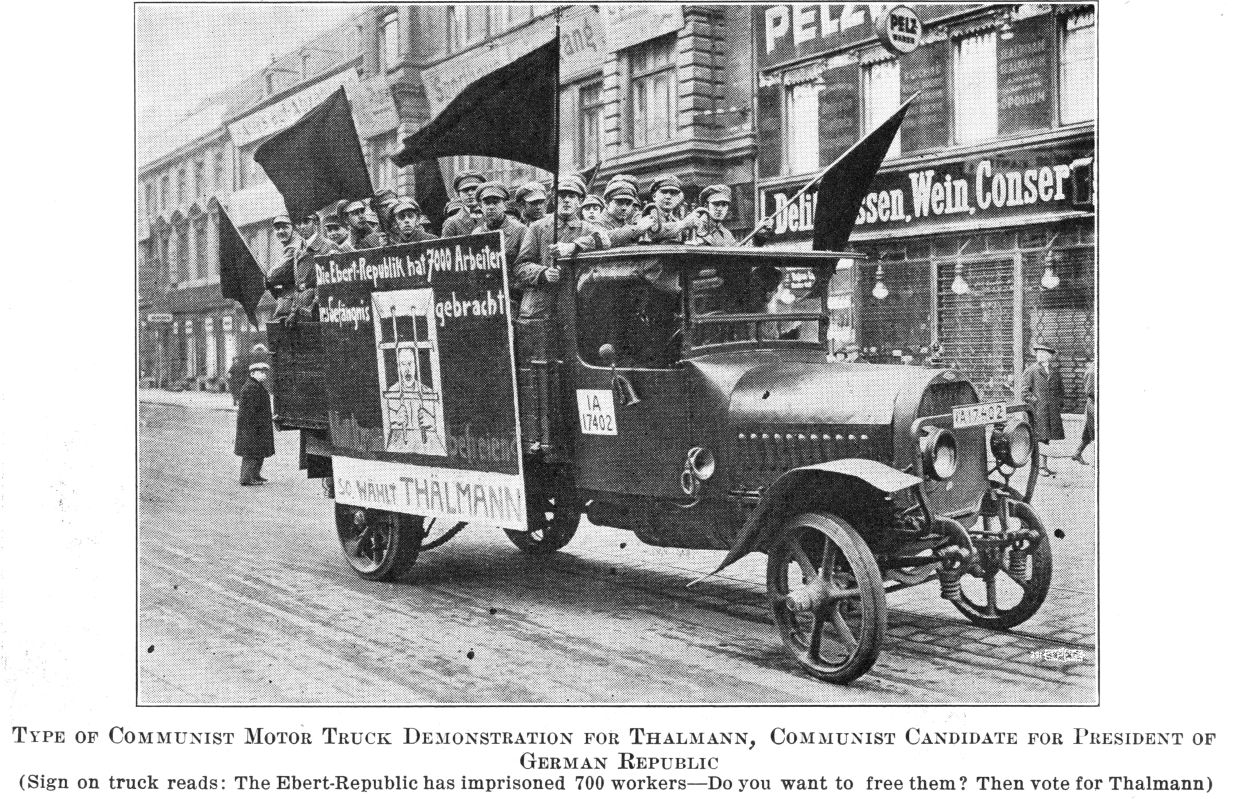
In this sense the S.P. of Germany is, it is true, in the right, when it sees in the workers, murdered by the Social Democrats an agitation in favour of Communism and consequently foams with rage. The incident at Halle gave a mighty impulse to the fight of the German proletariat against the monarchist Luther Government, supported by heavy industry, against the social traitors, the fight to obtain expiation from the murderers of Halle, the liberation of all political prisoners and the election of the Red Labour candidate Ernst Thälman as President of the Republic. The red front of the proletariat is on the advance in Germany. The wave of revolution is rising once more. The sanguinary act in Halle clearly shows this to be the case.
International Press Correspondence, widely known as”Inprecorr” was published by the Executive Committee of the Communist International (ECCI) regularly in German and English, occasionally in many other languages, beginning in 1921 and lasting in English until 1938. Inprecorr’s role was to supply translated articles to the English-speaking press of the International from the Comintern’s different sections, as well as news and statements from the ECCI. Many ‘Daily Worker’ and ‘Communist’ articles originated in Inprecorr, and it also published articles by American comrades for use in other countries. It was published at least weekly, and often thrice weekly.
PDF of full issue: https://www.marxists.org/history/international/comintern/inprecor/1925/v05n21-mar-26-1925-inprecor.pdf
PDF of full issue 2: https://www.marxists.org/history/international/comintern/inprecor/1925/v05n25-apr-02-1925-inprecor.pdf
 Revolution's Newsstand