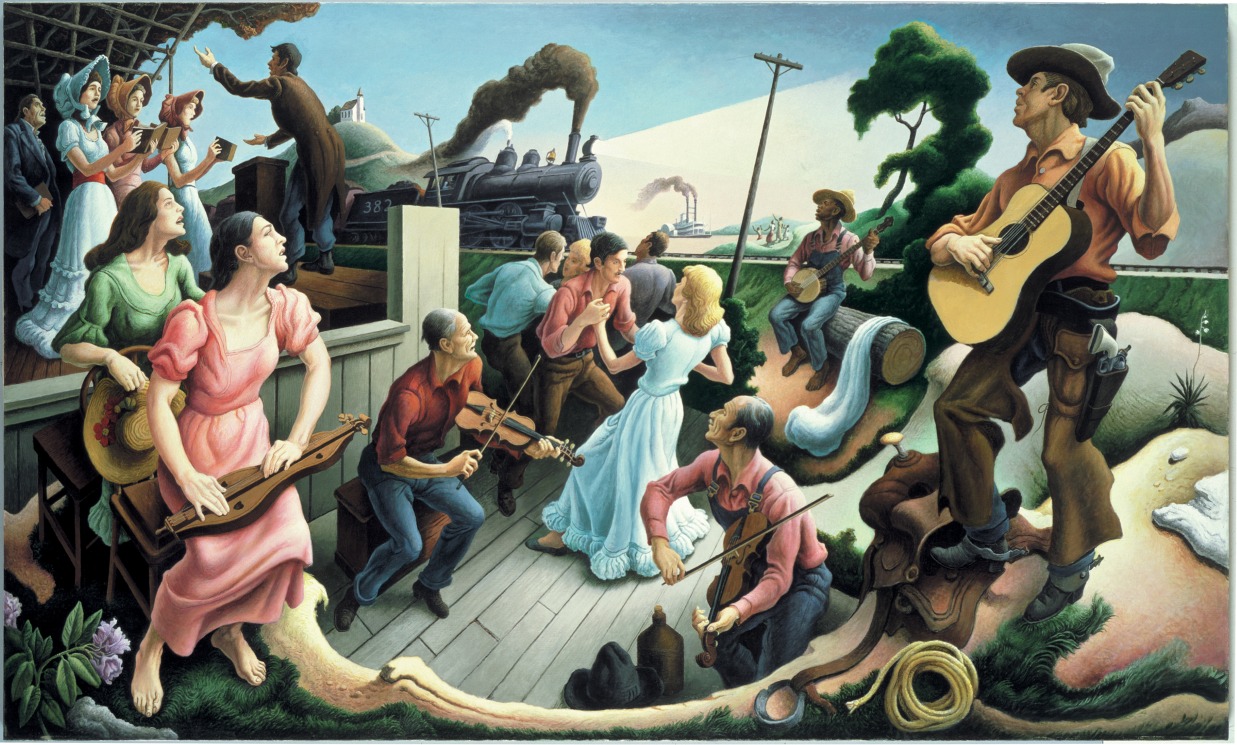
Another sharp review from Marxist art critic Meyer Schapiro on the art and political of Thomas Hart Benton.
‘Thomas Benton’s Populist Realism’ by Meyer Schapiro from Partisan Review. Vol. 4 No. 2. January, 1937.
Benton’s autobiography is a manifesto addressed to abstractionists, radicals and true Americans. He tells how he grew up in a philistine Missouri community at the end of the last century, became an artist from sheer bravado, fled to Chicago and then to Paris and New York, and painted abstractions until the war when he turned to objects and conceived the historical murals for which he is famous. Through this conversion he regained a sense of solidarity with the world about him which he painfully lacked when he was struggling as an abstract artist. But New York in the ’30s, with its radical intellectuals and sectarian criticism was too much for him; he felt isolated in the big un-American city. Knowing America as he did, the communist theories seemed ineffectual and foreign and threatened his liberty as an artist. In the last chapter he packs up and returns to the Middle West where he hopes to be free of such pressure. He had travelled in the South during the years after the War and come to like the plain people, the farmers, boatmen, Negroes and cowboys; he found in them the subjects for his new realistic art. The greater part of the book consists of anecdotes of these travels, stories of odd encounters and conversations, and some general reflections on the people and the country.
Others have written of the South with more pungency and insight and with less self-consciousness. But the book has a special interest as the experience of a painter converted from a formalizing to a realistic art and as an account of the impact of the economic crisis on an artist with a stabilized manner. But of his own experience as a painter, Benton says very little; and despite his frankness and his admission of doubts, the story of his pivotal decisions and their effects is too much on the surface, too rationalized, to be altogether convincing. The reader is disposed to penetrate it with his own suspicions. Benton brusquely disavows his abstractionist past and presents his later experience in facile antitheses to illustrate his theoretical oppositions of the country to the city, the native to the foreign and realism to abstraction. Towards the large movement of modern art he adopts a purely philistine attitude, judging it not by its best works or in the light of problems posed by the time, but by his own uneasiness with it and by the personalities of secondary rival painters. He ignores its distinctive character as an art and describes it as a product of neurotic minds or simply as a theory, an exhibition of principles formulated in talk. His own obvious indebtedness to it he veils by referring naively to the time when he finally rid himself of all its traces. “We were essentially Bohemians adrift from the currents of our land.”
In turning from geometrical forms to objects, Benton imagines that he has entered fully into the life of his time. The mere representation of railroad trains and farmers gives him the illusion of a mystical rapport with a superior American reality. Just as he once assumed that geometrical forms brought the artist in touch with the inner structure of the world or the essence of art, so he now seems to believe that by depicting native objects he is grasping the essence of American life. But this essence is only an aspect or a segment, and its claim to permanence or inherence or primacy is refuted by its own history. We have only to read Benton’s story of his conversion, short as it is, to see the limitations of his view.
When America entered the War, he and Craven “were well aware of the fact that the country was out to defend the affairs of citizens with whom we had little or nothing in common. We could see no point in taking risks for dollars which we could never share.” Through a friend of the family—the Bentons had been politically important in Missouri—he managed to be placed as a draftsman in the Norfolk naval base, making pictures for the architects. “My interests became, in a flash, of an objective nature. The mechanical contrivances of building, the new airplanes, the blimps, the dredges, the ships of the base, because they were so interesting in themselves, tore me away from all my grooved habits, from my play with colored cubes and classic attenuations, from aesthetic drivelings and morbid self-concerns. I left for good the art-for-art’s sake world in which I had hitherto lived.” He got along well with the southern boys at the naval base, feeling more secure with them than with “the cultivated people of the art worlds”; they were like his childhood friends in Missouri. “They were objective. They were interested in things, rather than in selves.” After the War, returning to the city, he “proclaimed heresies around New York. I set out painting American histories in defiance of all the conventions of our art world. I talked too much, and trod on all sorts of sensibilities and made enemies. But I didn’t care.” Apparently, in substituting blimps for cubes he was still an abstracting eye, remote from the “main currents of our land.” He still belongs to this art world that he affects to despise; and his work remains infected with a clumsy, stiff formalism inherited from his abstractionist days. His objectivity as a painter, limited to buildings and machines and the picturesqueness of native “types,” exacted no deeper insight into American life. And although his conversion was a result of the war on which he held such decided and penetrating views, he disavows any “social ideas” and feels no need to reconcile his new sympathy for the people with his indifference to their betrayal in the War.
His idea of a realistic art is expressed as an opposition to two extremes. In criticizing abstract art, he isolates objects as the true field of painting; in criticizing a realism guided by radical values and a desire for change, he poses the stable, unpolitical everyday world and the corresponding historical past as the proper subjects for art. If we must not escape from this world, neither should we try to change it. He thus implies a “just middle,” like the academic compromise in the last century. Benton’s vehemence against both sides, his constant assertion of individual freedom and his petty unconventionalism conceal his essential conformity. The common energy of his figures, each moving in its own way, a vast perspective field, resembles the optimistic idea of an expanding American world in which everyone is active and free to follow his own ends in a limitless space. His reduction of the tense historical reality of our time to fragmentary candid shots, interchangeable incidents, figures and machines in a formally supervised panorama of unfocussed activity has also its political parallel. It corresponds to the liberal conservatism (resting especially on the support of the lower middle class) which addresses the people as a unity without classes, which admits only an accidentally privileged, immoral minority of wealth and idealizes an earlier stage of popular rule as a norm of democracy constantly threatened and regained.
Although Benton talks as if he represents the people as a whole, this fiction disappears when we regard his comments on oppressed groups or his particular choice of material and even his style of painting. In describing the South he is forced in 1937 to observe the oppression of the Negroes and the poor white farmers; in his earlier realistic painting their misery is for him a local and picturesque affair. If it is now a condition to be improved through good will, the chief obstacle is the peculiar psychology of the southern masters. He may at one point praise the liberals who try to improve these conditions; but against those who wish to organize the Negroes politically, he argues that the Negroes are too uneducated and that this will only antagonize the whites and bring on fascism. The conciliation which underlies this view appears in other details. In the face of insecurity and discontent he hopes to recreate a respect for old ways, for local history and peculiarities, to win people back to native traditions. The division into regions becomes more important than the division into classes. The more crucial history, including our own time, is obscured or fractioned into bits of local genre. If he represents a political meeting in dramatic linear contrasts, it is without reference to the clash of interests, but has the sense of a local domestic custom; the kids squabble and a mother changes the baby’s diaper. His theory of art, like the liberal aesthetics of the colleges, supports the same attitude, though it hardly does justice to the complexity of his own art. The real purpose of painting is to get people to see the qualities of things, apart from their use. This is a domestic impressionist view which, in opening our eyes to our surroundings (a value we must not underestimate), detaches art from fantasy and drama and from the more massive and disturbing reality of passions and conflicts. It admits change only at the expense of history, by infusing all things equally with the same phenomenal motion.
If Benton’s Middle West was once intolerable to him as an artist because its hard practicality made a disinterested love of nature and art impossible, he now regards it as the region most favorable to art because it seems to offer him an escape from the demands of the crisis. However much he may attribute radicalism in art to the influence of un-American intellectuals, he himself cannot evade the conditions which have given a new value to these foreign ideas. But how pitiful and inept are his alternative conclusions! and how they illuminate the character of his art! This man who speaks of having read Marx and Dewey builds a new American culture on the “failure of capitalism” and on the “great change which is already taking place. “The age of raging greed is past…Approaching death leads to reflection and reflection leads to appreciation of the drama of life, of the values of simple existence which stand apart from ends and purposes.” And this in turn promotes a new interest in art in the Middle West, which bears the promise of a great American art, “for it is in the drama of things that are that art must take its first original steps.” The future lies in the small towns and the country. “The great cities are dead. They offer nothing but coffins for living and thinking.”
The first steps are the murals of Benton of which the originality lies, I think, in the coincidence of homely popular genre and artificial, energetic, monumental effects. He aspires to create an official art, local in content, national in scale. It is monumental about small things, small about crucial momentous changes, full of activity, but with little movement of ideas and sentiments. His murals are enlargements of intimate, trivial and amusing scenes, well adapted to the casual eye of the tourist or hearty philistine spectator. The small occasions of life are not deepened as in older genre painting, but simply magnified. In his most recent murals, reproduced in part on the jacket of the book, the foreground is filled with ingratiating domestic details—the dogs, the mother wiping her baby’s bottom, the munching, overalled boy beside the mother rolling the dough, and the naked muscle-bound backs of the men, one sawing wood away from the spectator, the other washing his neck toward the spectator. These are arranged in a banal symmetrical scheme, unrelated to any larger meaning of the figures, and are cast in a visual melodrama of diagonal perspectives, strained, insistent, metropolitan, with the formal strategy of a piece of advertising. The visceral involvement of groups is a formalized linking of essentially disconnected objects. Since the composition of Benton has been compared with Rubens’, it must be observed that in Benton the analogy and contrast of adjacent lines is relatively inexpressive, at any rate has little to do with the human connections of the represented figures. It relates to Rubens’ as modern blank verse to Shakespeare’s. The exaggerated awkward energy is the male counterpart of the effeminacy that he cannot tolerate in homosexuals and that he cheaply denounces in this book as a menace to the coming American culture. It is a mannered art, for Benton imposes his tics and ambitions on everything. His lack of delicacy, of refinement and of pathos make us regret that he is not more feminine. The coarse, sweetish coloring reminds one of commercial painting; its absence from his black-and-whites make these at once more agreeable and releases their touch of honest poetry.
Benton has been criticized as fascist, but such a judgment is premature. To accept his ideas and art on their face value, to welcome them as an expression of “democratic individualism,” would be no less absurd. Benton repudiates European fascism, but fascism draws on many streams including the traditional democratic. The appeal to the national sentiment should set us on guard, whatever its source. And when it comes as does Benton’s with his conceited anti-intellectualism (he has also his own pretentious intellectuality), his hatred of the foreign, his emphasis on the strong and the masculine, his uncritical and unhistorical elevation of the folk, his antagonism to the cities, his ignorant and violent remarks on radicalism, we have good reason to doubt his professed liberalism and to expose its inconsistencies.
AN ARTIST IN AMERICA. By Thomas Benton. McBride. $3.75.
Partisan Review began in New York City in 1934 as a ‘Bi-Monthly of Revolutionary Literature’ by the CP-sponsored John Reed Club of New York. Published and edited by Philip Rahv and William Phillips, in some ways PR was seen as an auxiliary and refutation of The New Masses. Focused on fiction and Marxist artistic and literary discussion, at the beginning Partisan Review attracted writers outside of the Communist Party, and its seeming independence brought into conflict with Party stalwarts like Mike Gold and Granville Hicks. In 1936 as part of its Popular Front, the Communist Party wound down the John Reed Clubs and launched the League of American Writers. The editors of PR editors Phillips and Rahv were unconvinced by the change, and the Party suspended publication from October 1936 until it was relaunched in December 1937. Soon, a new cast of editors and writers, including Dwight Macdonald and F. W. Dupee, James Burnham and Sidney Hook brought PR out of the Communist Party orbit entirely, while still maintaining a radical orientation, leading the CP to complain bitterly that their paper had been ‘stolen’ by ‘Trotskyites.’ By the end of the 1930s, with the Nazi-Soviet Pact of 1939, the magazine, including old editors Rahv and Phillips, increasingly moved to an anti-Communist position. Anti-Communism becoming its main preoccupation after the war as it continued to move to the right until it became an asset of the CIA’s in the 1950s.
PDF of full issue: https://archive.org/details/sim_partisan-review_1938-01_4_2/page/57/mode/1up?view=theater
 Revolution's Newsstand