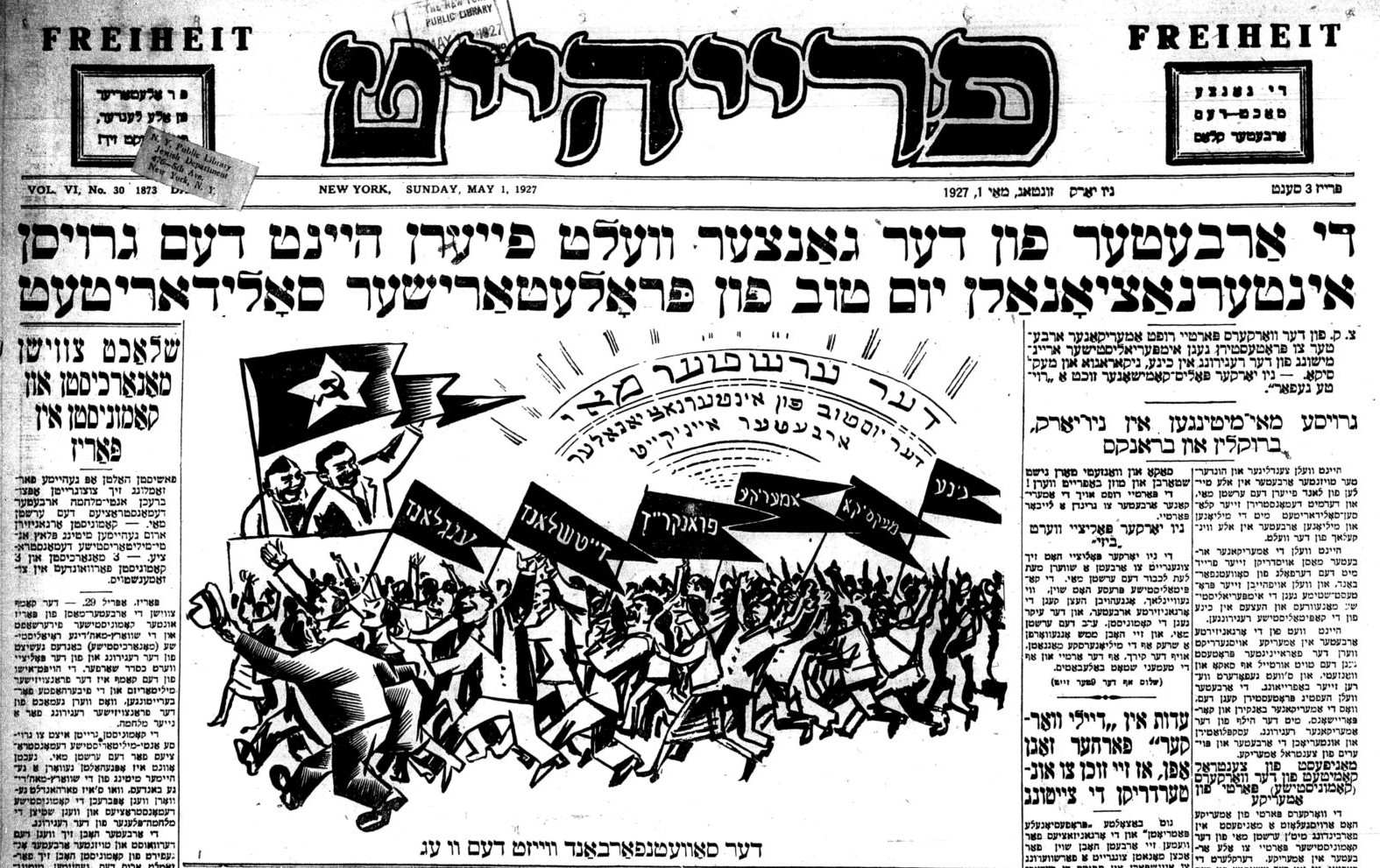
Editor Olgin celebrates the fifth anniversary of among the most important Communist publications in U.S. history. Morgen Freiheit (מאָרגן־פרײהײט; Morning Freedom) was the long-time daily Yiddish language newspaper of the Communist Party. Founded in 1922 by Moissaye Olgin, who had recently left the Socialist Party with the Workers Council group, the paper often outsold the Daily Worker and was a vibrant cultural as well as political voice for Jewish workers. Olgin edited the paper until his death in 1939 at which point Paul Novick took over editorship. Along with Morgen Freiheit, C.P. affiliated bodies published dozens of regular and irregular Yiddish works, including a monthly magazine, The Hammer. Morgen Freiheit continued until 1988.
‘Celebrating Freiheit’s Fifth Anniversary’ by Moissaye J. Olgin from The Daily Worker. Vol. 4 No. 68. April 2, 1927.
THIS evening the workers of New York and vicinity gather to celebrate the fifth anniversary of the Jewish Daily Communist Freiheit, the first copy of which appeared on April 2, 1922. The very fact that a labor newspaper is marking its birthday by a meeting in the greatest hall in New York City speaks of the mass character and influence of the paper.
During those five years the Freiheit has become one of the most influential labor papers in this country.
GREW OUT OF WORKERS’ NEEDS.
The Freiheit grew out of the economic needs of the great masses of the Jewish workers, mainly concentrated in the needle trades. The Jewish workers, trained both in the places of their birth and in this country in the spirit of socialism gradually awoke to the realization that they were saddled by a union bureaucracy no better than the bureaucracy of other unions. Though professing adherence to the socialist party, the chiefs of the “Jewish” needle unions gradually abandoned their contact with the masses, adopted the class collaboration psychology, used their offices to perpetuate their own domination, and stifled every attempt at protest on the part of the rank and file workers. From leaders they became traitors of the working masses. This betrayal was fostered, defended and led by the “socialist” Jewish Daily Forward, which became the ideological and organizational center of all that is rotten, bourgeois and anti-proletarian in the labor movement. The rift between the prosperous, well-fed, well-clothed and secure “aristocracy” of the Jewish workers on the one hand and the mass of the exploited, underpaid and hounded rank and filers on the other hand, became wider and wider.
The Jewish workers, alert, sensitive, educated to the understanding of their class interests, began to chafe under the weight of self-satisfied leeches. Conditions where the union officials were placing all their hopes in arbitration machinery headed by representatives of the bourgeoisie, where the workers were shown one kind of a union agreement, whereas, secretly, the employers were granted much more freedom to exploit them (so-called supplementary agreements), where fights of the masses against the employers were looked upon with disfavor and the boss was considered the best aid of the union officials in maintaining the union organization—such conditions could not fail to arouse the workers. A general revolt followed.
Revolt Let By The Freiheit.
The revolt was led by the Freiheit. This is its chief contribution to the labor movement, but it is not the only one.
The Freiheit points the way for the labor press of this country in very many respects.
The Freiheit Is a Communist paper. That means to say that in all its activities it is guided by a general idea, by the broadest and most comprehensive conception of the social forces that mako history. At the same time, however, the Freiheit is penetrating every nook and corner of the life of the Jewish workers, noting every event, however small on the surface, shedding light on every movement, explaining to the workers every detail of their interests, arousing them to action. In this constructive sense of the word, the Freiheit is probably the most popular of the Communist papers in this country.
The Freiheit is a Jewish paper. It speaks to one section of the working class, yet its interest embraces the labor movement as a whole in all its ramifications both in this country and abroad. Thus the Freiheit does not keep the workers confined to the limits of their organizations but it broadens their outlook and widens their horizon.
It Is A Fighting Paper.
The Freiheit is a fighting paper. It is not a paper of comment. It is not confined to opinions. It uses comment to arouse the workers. It spreads opinions among the masses in order to stimulate them to activities. It is, to use Lenin’s words, a mass propagandist. It is, to use Lenin’s words again, a mass organizer.
The splendid fight of the Joint Action Committee in 1925, the historic struggle of the Fur Workers’ Union in 1926, the struggle of the Joint Board of the Cloak and Dressmakers Union against the bureaucracy of the Sigman clique, the struggle against bourgeois domination in the Workmens’ Circle, and a dozen other struggles would have been impossible without the Freiheit.
The Freiheit was placed by the course of events in a highly responsible, strategic position. It was against the left wing in the Needle Trades that the bureaucracy of the A.F. of L., hand in hand with the courts, the police, and the capitalist class as a whole, directed its fiercest attack. It was here in this sector of the left wing labor movement that they hoped to crush the spirit of revolt and to smother the movement of the workers for organization and class struggle. If this barrage of the traitors has proven a failure, if the left wing has not only stood its ground but is making headway all along the line, the Freiheit has had no mean share in these successes.
Struggle For The Labor Party.
The Freiheit is a political paper. It strives to draw the necessary political implications from the struggle of the workers. It interprets the life of the workers in the class struggle aspect, which is the political aspect. The Freiheit has participated in all the political movements of the left wing, including the struggle for a Labor Party and campaign activities.

The Freiheit is a Communist Party paper. It is not only permeating the movement of the masses with Marxian ideology, but it is helping the Party to organize the vanguard of the working class into a well-disciplined mass party intertwined with the working class and leading its struggles in the direction of overthrowing capitalism and establishing the Soviet system.
The Freiheit is a Jewish paper, which means that its activities are conducted in a specific national environment, where nationalist bourgeois ideology is strong. The Freiheit was the first of the Jewish labor papers in this country to draw the class line also in national and cultural Jewish problems. Contrary to the old, now traitorous Forward which recognized only the “general culture of humanity” or “general Jewish culture,” the Freiheit is spreading the consciousness that the nationalist idea is a bourgeois idea, that national culture is bourgeois culture, and that the working class must beware the dangers hidden in the subtle poison of national ideology. The Freiheit is determinedly and drastically fighting for a class ideology also in the field of culture.
The Freiheit has become not only a center of economic and political life, but also a very influential cultural center. It has attracted a great number of radical writers, poets, dramatists who, not entirely identifying themselves with the working class, are willing to work in co-operation with the labor movement.
Culturally isolated at the beginning, looked upon With mistrust and disdain, abused by the so-called cultural elements, the Freiheit gradually became, even in the eyes of outsiders, the most cultured and most vital paper. The Freiheit is not only a paper. It is a mass of workers hungry for education, clamoring for culture, grasping at the better things of the mind. It was this mass aridity for things cultural that has broken the isolation of the Freiheit and made it a gathering point for every live cultural force.
Forward Formidable Opponent.
The success and the growth of the Freiheit Is the more gratifying the greater the enemy It had to combat. The Jewish Daily Forward was the most formidable opponent. Rich, powerful, unscrupulous, reigning supreme both in the labor movement and among the petty bourgeoisie, the Forward at the beginning thought it would be sufficient to stamp its foot to exterminate the Freiheit. The fight against the Forward looked an uneven fight. For years the situation of the Freiheit was precarious.
There were months when its very existence hung on a thread. Today the Forward is defeated. It has lost all its influence over the working masses. It is not able to fill a hall with rank and file workers, even when it uses all its machinery of advertising. It is utterly discredited, not only among the workers but among the thinking elements. It stands there, a picture of hatred, debasement, degradation. It witnesses how the Freiheit, a militant young Communist paper, dares celebrate its anniversary in a hall that seats 20,000.
Must Have English Language Press.
The Freiheit points the way for the workers of this country. The Freiheit is active only in one corner of the working class. The American working class, the English speaking working class, will have to follow suit. We must have English papers like the Freiheit, mass papers leading the struggle of the workers for a better future.
Long live the Freiheit!
Long live a powerful press of the working class in the English language!
Long live the class struggle of the workers!
Long live Communism!
The Daily Worker began in 1924 and was published in New York City by the Communist Party US and its predecessor organizations. Among the most long-lasting and important left publications in US history, it had a circulation of 35,000 at its peak. The Daily Worker came from The Ohio Socialist, published by the Left Wing-dominated Socialist Party of Ohio in Cleveland from 1917 to November 1919, when it became became The Toiler, paper of the Communist Labor Party. In December 1921 the above-ground Workers Party of America merged the Toiler with the paper Workers Council to found The Worker, which became The Daily Worker beginning January 13, 1924. National and City (New York and environs) editions exist.
PDF of full issue: https://www.marxists.org/history/usa/pubs/dailyworker/1927/1927-ny/v04-n068-NY-apr-02-1927-DW-LOC.pdf
 Revolution's Newsstand