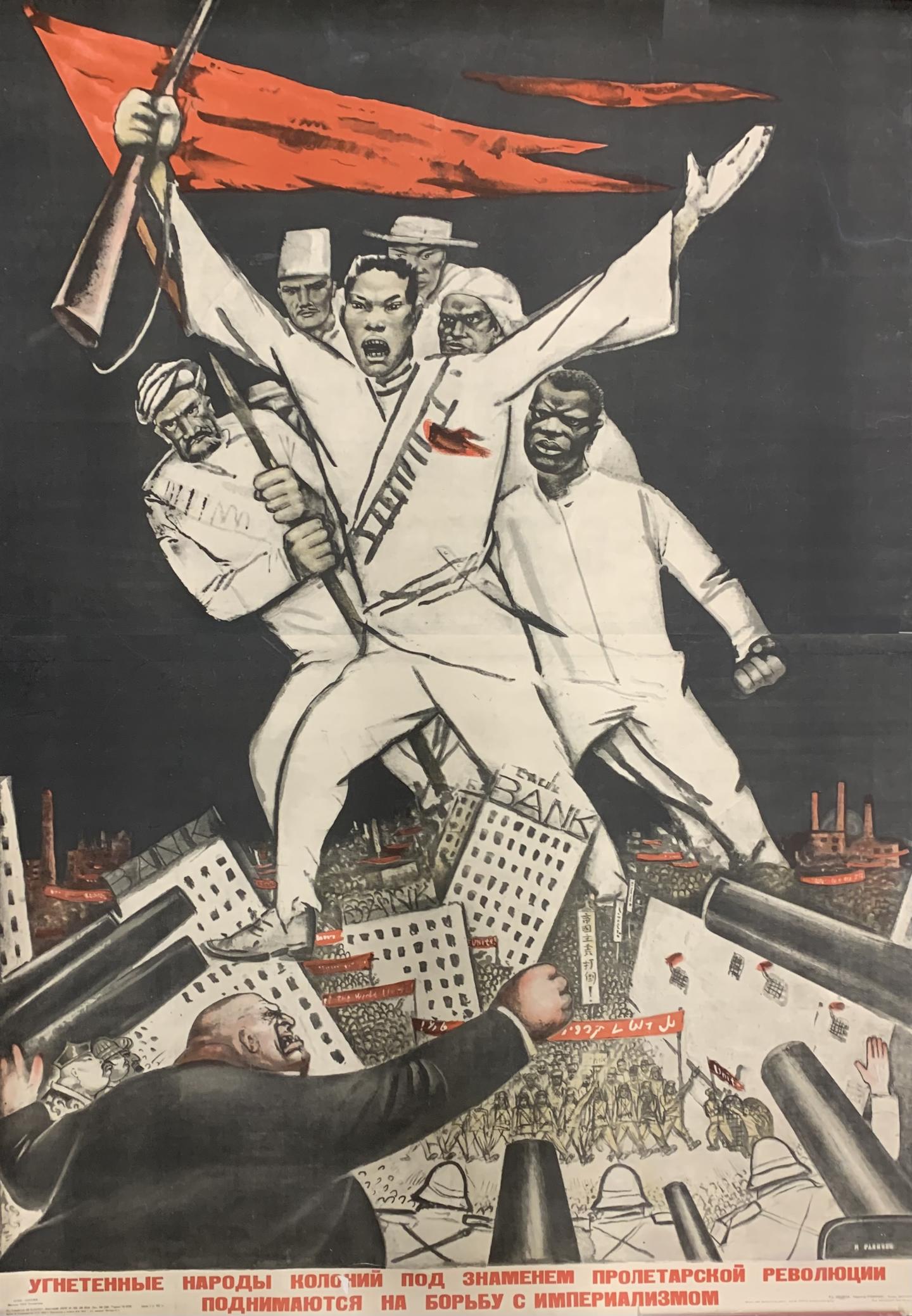
Münzenberg reports on the second gathering of the League Against Imperialism, held during the brief, but defining, ‘Canton Commune’ in China.
‘Growing Revolutionary Militancy Among the Colonial Peoples’ by Willi Münzenberg from International Press Correspondence. Vol. 7. No. 72. December 22, 1927.
The Second Brussels Conference of the League Against Imperialism.
The Communist International has always taken the greatest interest in the colonial problem. The Communist International was the first, and is today the only workers’ International which is attempting to solve the colonial problem in a truly revolutionary sense. The Second International and all its affiliated parties have constantly refused to proceed to a revolutionary solution of the colonial problem. It is not surprising, therefore, that in the various countries leading members of the social-democratic parties were, and are even today, at the same time members of the bourgeois governments, and as such cannot do other than conduct a bourgeois imperialist colonial policy. MacDonald as Prime Minister of the King of England chose air bombs in order to bring the gospel of his socialism to the insurgents of Mesopotamia.
The revolutionary movement broke out in its strongest and most comprehensive form in the largest semi-colonial area, in China. The combined efforts of the leading imperialist countries and the Chinese white Generals in their pay succeeded in damming and driving back the revolutionary movement for the time being. But the latest events in China, the capture of Canton and the peasants’ revolts, which are constantly spreading, prove that the Chinese revolution may have been thrown back, but that it is not crushed. Once it gets under way the Chinese revolution is bound to merge into a proletarian revolution. It is true, the one-time revolutionary Kuomintang has completely changed its attitude. Today it is no longer a revolutionary factor but has become a counter-revolutionary factor.
But in China, just as in India, in Arabia, Syria, as well as in Africa, gigantic forces are growing up which are opposing oppression by foreign imperialists as well as capitalist oppression in general. It is true the social revolutionary forces are still hidden in the background, in part pushed back by national revolutionary groups and persons who only in the course of a great revolutionary movement will be pushed on one side.
In the Anti-Imperialist League which was founded at the beginning of the present year in Brussels, there have come together mainly national-revolutionary organisations and groups which united with the representatives of a greater number of really revolutionary, but also a number of pacifist bourgeois organisations of the old capitalist countries.
For us as Communists there can be no doubt as to our attitude towards this Anti-Imperialist League: either the false, un-Leninist attitude of the Opposition, which describes this League straightaway as a plaything as does Zinoviev in his new 21 conditions or the true Leninist attitude, that is, to support within the League a number of proletarian-revolutionary minded classes and groups and to promote their influence in the League.
The Second International has chosen the same point of view as Zinoviev, and has refused to support or to affiliate to the Anti-Imperialist League. It is true it puts forward as its reason for so doing that the Anti-Imperialist League is nothing else But a Communist, a purely Russian organisation. The tacticians in the Second International have exceedingly regretted the derision of the Executive of the Second International. The consequences of the decision have been that not only the social-revolutionary organisations and groups united in the League have opposed the Second International, but that especially the leaders of the strongest national-revolutionary movements, as those of China, Syria, Arabia and India have turned against the Second International in an even more passionate manner and have characterised the decision of the Second International as “a support of the capitalist-imperialist governments”.
It was the venerable old leader of the Indian National Congress Nehru, who spoke in the sharpest terms against the Second International and scathingly denounced the policy of the Second International, particularly that of MacDonald, as being an immediate support of the British imperialist policy in India.
Emir Arslan, the representative of the Arab-Syrian National Congress, one of the leading men of the Arab-Syrien emancipation movement, devoted a whole speech to the rejective attitude of the Second International and poured withering scorn upon the social democracy.
It was a member of the Second International Schmidt of Amsterdam, who brought in the resolution against the Second International which was then unanimously adopted with the support of numerous social democratic representatives, as the English member of Parliament Wilkinson, and also Bridgeman, Lefèbre (Holland) etc.
The discussion at the second Conference of the League regarding the Second International and the latter’s support of imperialist policy showed that the national-revolutionary and social-revolutionary forces in the colonial and semi-colonial countries are already strong and independent enough to go their own revolutionary way, separated from the socialist leadership, and if the social democratic parties stand in the way of this development, to oppose them also. The course of this discussion proves in the most striking manner the correctness of our view that it cannot be the task of the Communists to stand apart from the Anti-Imperialist League, but that it is necessary to collaborate in the Anti-Imperialist League and to support and to promote all those forces in the League which are compelled by their economic position to strive not only for a national-revolutionary hut also for a proletarian revolution
How far the revolutionary attitude even among the national-revolutionary groups in the colonial countries goes, is proved by the fact that the second Brussels Conference pronounced unanimously and with all sharpness against the Kuomintang Party as a counter-revolutionary organisation.
In the question of India also the Conference went far beyond the moderate proposals of Nehru and adopted a decision demanding the complete independence of India and its separation from the British Empire.
Stimulated by the Brussels Congress and the Anti-Imperialist League, strong organisatory nuclei of anti-Imperialist Leagues, consisting in the main of social revolutionary elements, have been formed in numerous countries in the course of the last few months.
In India the task of organising the Anti-Imperialist League has been undertaken by the Bombay Trades Council, which has affiliated en bloc to the Anti-Imperialist League. Similar efforts to make the trade unions the bearers of the Anti-Imperialist League in India are in progress in other towns.
Among the 50 big affiliated bodies now belonging to the Anti-Imperialist League, more than one half are important trade unions in colonial and semi-colonial countries which hitherto had no international connections whatever, as for instance the South African Trades Union Congress, the Railway Workers Union in Sierra Leone, the African Trade Unions, the Mexican Trade Unions etc.
The question of the relations of the Anti-Imperialist League to the trades unions rightly occupied the centre point of the discussions at Brussels.
The Anti-Imperialist League has also achieved great progress in South and Central America, especially in Mexico, Uruguay etc.
The League also has an important section in the Philippines, which sent a special delegate to Brussels.
In the world-historically important fights of North American imperialism against Mexico and the other Latin American Republics, the anti-imperialist opposition in these countries acquires special significance, as was rightly pointed out by Professor Alfons Goldschmidt of Berlin in his report on the threatening war.
What importance the imperialist States attach to the anti-Imperialist movement and League is proved, among other. things, by the severe persecution of the movement which has already set in. The British government has caused to be issued through its expert for foreign policy, Augur, a particularly lying pamphlet. The British government has prohibited the whole Indian press from printing articles of the Anti-Imperialist League, and is proceeding against the League with every means of force.
In Holland the government has arrested leaders of the League, including Hatta, a member of the Executive, and intends to have them tried for high treason.
The Negro Senghor, the passionate champion at the Brussels Congress of the black race against the white imperialist oppressors, was imprisoned in France on account of his speeches and has died as a result of an illness contracted in prison.
The significance of the second Brussels Conference compared with the first Conference lies more in the organisatory than in the political field. The Brussels Congress, owing to the participation of numerous eminent persons and leaders, was a powerful, stirring political demonstration which awoke a strong echo in all countries. At the second Brussels Conference there were already present representatives of firmly grounded organisations of the League which have been formed in the course of the last half year in numerous countries. The organisation questions of the Anti-Imperialist League, the building up of national sections, the connections with the international Bureau, the building up of the International Bureau all these organisatory questions were the chief subject the discussions.
The Conference was unanimously of the opinion that the Anti-Imperialist League can solve its tasks only if it succeeds. in winning the millions of workers and peasants as bearers of its idea; a further guarantee that the Anti-Imperialist League will not lose itself in narrow national-revolutionary movements, but that it will help to extend the national-revolutionary movements into the proletarian revolution.
Among the members newly elected to the Executive there. is the well-known Communist leader and representative of the Indian freedom movement in the British House of Commons, Comrade Saklatvala.
The Second Brüssels Conference of the Anti-Imperialist League has contributed considerably to the organisatory consolidation and strengthening of the anti-Imperialist League and created the preconditions for a further broad development.
Brussels, 11th December 1927. In this mornings’ session of the General Council of the League against Colonial Oppression and Imperialism, the representative of the Philippines, Alminiano reported upon the struggle of the people there for freedom. He declared that he was the first representative of the Philippine people to make a report in Europe on the struggle for independence going on there. (Applause.)
The Emir Shekib Arslan the representative of the Arabian National Committee described the struggle of the Arabs for national freedom. He also reported upon the insurrectionary movement in Syria against France and appealed to all workers to support the national struggle for independence in Syria,
Herclet declared in the name of the French trades unions, above all of those affiliated to the C.G.T.U., that the French workers would fully support the struggle of the Syrians.
Salvador de la Plaza then gave a report on the struggle of Latin-America against Dollar imperialism. He described the policy of intervention and oppression pursued by the United States in Central and South America, and this policy was be coming ever more energetic. But the defence against the imperialism of the United States was also becoming stronger. The League against Imperialism was making considerable progress in Latin-America. (Applause.) The speaker then moved a resolution in the spirit of his remarks.
Professor Goldschmidt (Berlin) supported the resolution moved by the preceding speaker. He then described the situation in Central and South America and the action of American imperialism.
The representative of Indonesia then reported upon the revolutionary movement for emancipation against Holland’s colonial policy. Despite severe repression, the movement was growing and still greater struggles were to be expected in the Future.
Brussels, 11th December, 1927. At to-day’s session a representative from Tunis reported upon French colonial policy in North Africa.
Comrade Li Chen who has just arrived from China described in detail the development of the Chinese revolution from the first stage of the struggle, the block of the Chinese workers and peasants with the Chinese bourgeoisie up to the defection of the Chinese bourgeoisie into the camp of the imperialists. The Kuomintang which a year ago was the leader of the Chinese revolution, is now almost completely destroyed and is being utilised by the counter-revolutionary generals. For the revolutionary movement the Kuomintang is dead. Despite this however, the situation of the Chinese revolution is not unfavourable. The bourgeoisie can neither free nor centralise China. Above all. however, it cannot solve the workers and peasant question. Despite the most dreadful white terror the peasant masses of China are in a ferment. The proletariat is continuing its struggle. One can predict with certainty the quick advance of the Chinese revolution.
The speech of Li Chen was received with storms of enthusiastic applause, as also were the speech of Comrade Katayama and the telegram of greetings from the widow of Sun Yat-sen.
In place of Henry Barbusse, who has fallen ill, Professor Dr. Goldschmidt (Berlin) spoke upon the danger of war.
Gumede (Johannesburg) reported upon the situation in South Africa.
The session then unanimously adopted the resolutions presented in connection with the situation in China, India, Indonesia and Persia.
International Press Correspondence, widely known as”Inprecorr” was published by the Executive Committee of the Communist International (ECCI) regularly in German and English, occasionally in many other languages, beginning in 1921 and lasting in English until 1938. Inprecorr’s role was to supply translated articles to the English-speaking press of the International from the Comintern’s different sections, as well as news and statements from the ECCI. Many ‘Daily Worker’ and ‘Communist’ articles originated in Inprecorr, and it also published articles by American comrades for use in other countries. It was published at least weekly, and often thrice weekly.
PDF of full issue: https://www.marxists.org/history/international/comintern/inprecor/1927/v07n72-dec-22-1927-inprecor-op.pdf
 Revolution's Newsstand