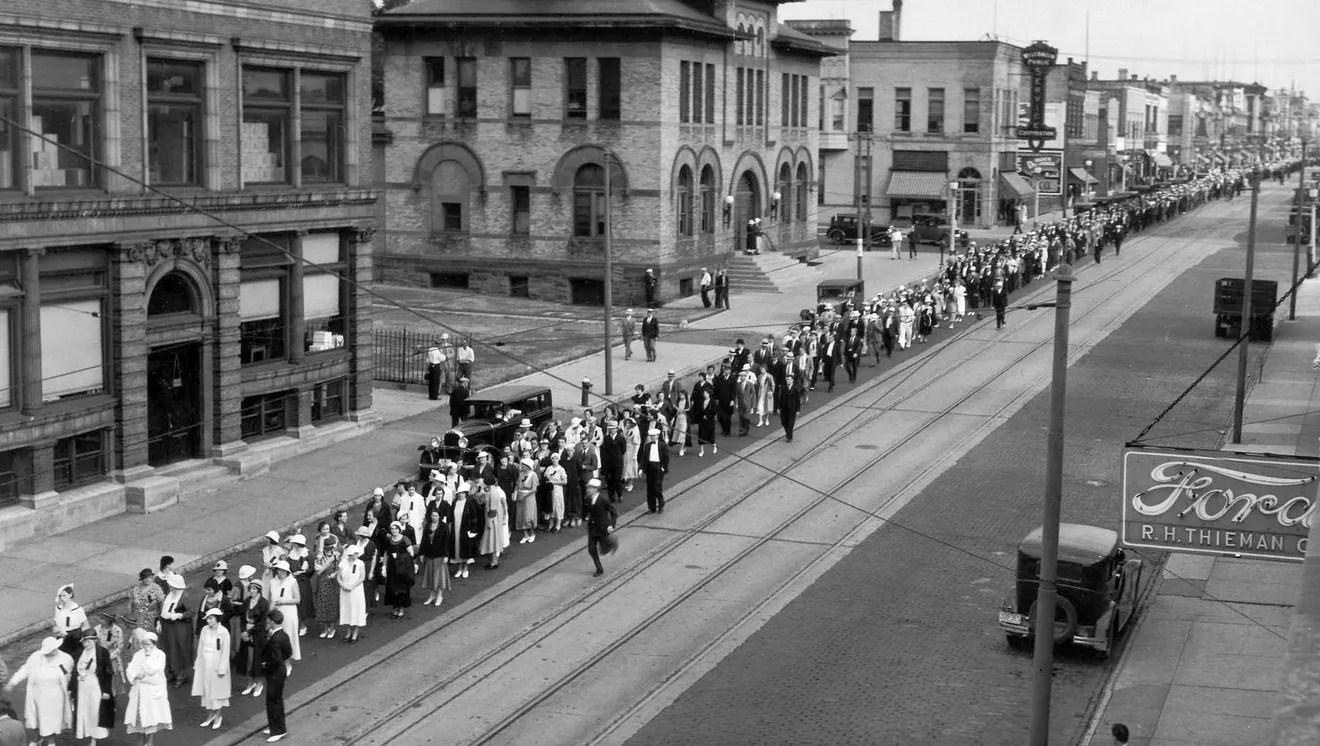
Part of the labor uprising that swept the country in the Summer of ’34, high drama as workers in the company town of Kohler, Wisconsin strike against their master, a former governor, to demand a union. Police and thugs would murder pickets Lee Wakefield and Henry Engelman, shooting dozens more, on July 27, 1934.
‘Kohler, the Killer’ by Paul Romaine from New Masses. Vol. 12 No. 6. August 7, 1934.
KOHLER, WIS. As you walk down Michigan Avenue in Chicago, the Tribune Tower Building of the “World’s Worst Newspaper” is bound to catch your eye. Upon approaching it one of the first things that attracts attention is a ground floor display room of beautiful plumbing fixtures, protected from the elements by huge plate glass windows bearing the legend, “Kohler of Kohler.” Replicas are to be seen throughout the United States by millions of workers to whom modern sanitation in the wealthiest country in the world is an unrealized dream.
Many years ago, Walter J. Kohler toured Europe, making a study of modern housing for workers and “socialized” relations between workers and their exploiters. He returned to Wisconsin and founded the “model” village of Kohler a few miles from Sheboygan. There he established his factories, his workers’ homes, and Kohler “castle,” where he lived. The whole village was laid out according to a carefully thought out plan. Everything from the ground beneath to the sky above was owned by Kohler of Kohler. All he touched turned to gold-profit in the soil, profit in the brick houses and of surplus labor time and power there was plenty. America was ridding itself of B.O.–it became a mania amongst the bourgeoisie and fancy toilets and bath tubs sold like Cointreau at the Dome. Hundreds of workers invested in homes in Kohler and it became famous throughout the U.S.A. as the model industrial town. These workers were held in the iron grip of their Master, Kohler. Their wages on payday paid an installment on one of Kohler’s houses, paid the grocery bill at one of Kohler’s stores. Kohler Castle became the citadel of industrial feudalism where the Master, tiring of all the goodness he had created, decided to enter politics.
He became the governor of Wisconsin and this eliminated for a period of years the payment of income taxes. Life was full and good for the Master. A strong company union “took care of the interests of the workers” and made strikes “unnecessary.” In 1929 the crisis of capitalism deepened and with the passing years 17 millions of American workers found themselves jobless. Kohler village went blithely on, however, immune to the cold, grey world about it. No agitators of any kind disturbed its peacefulness–not even the Reds. On the surface all was calm and bright, but beneath the placidity smouldered resentment against the company and Kohler. It seemed to the workers that they could never get out of debt, that their hours were too long, that their wages were too low.
Then came the N.R.A. and the New Deal from the slippery fingers of the Roosevelt administration. Here indeed was the panacea for all their ills, thought the Kohler workers. But the minimum wages under the code became their maximum wages and their hours of work a week, forty. With all the turmoil of the class struggle everywhere manifesting itself in the United States in strikes that sometimes even took on a political character–the capitalist press of Wisconsin pointed to the serenity of Kohler of Kohler. Here was no Harlan, Imperial Valley, San Francisco–here the antagonisms of capital and labor had been solved. Kohler leads the way!
Then at dawn, July 16–consternation in the camp of the bourgeoisie and their lying press–a picket line was thrown about the Kohler foundry! STRIKE! A STRIKE AT KOHLER!
It was almost unbelievable to the bourgeoisie. Federal union 18545 of the A.F. of L. had presented a set of 14 demands to Kohler, based on the N.R.A. code. Kohler had replied to the demands–point by point. The union rejected the reply and called a strike; 1,200 workers walked out. Their basic demands of the 14 were the recognition of the union as the collective bargaining unit, a minimum wage of 65 cents an hour, a 30-hour week and seniority rights.
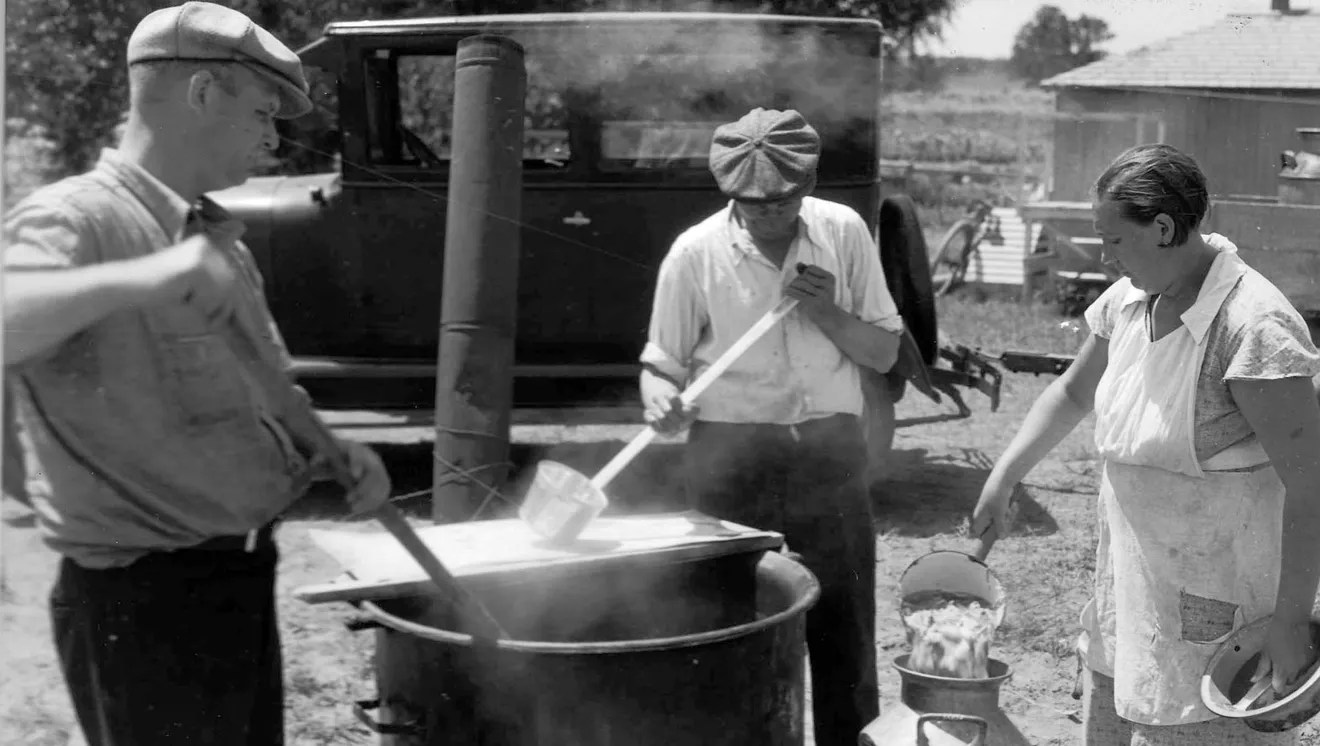
On the first day of the strike a few shadows of subsequent events were cast. The pickets derailed a coal train and would permit no coal to enter the yards of the plant. A gas barrage was the answer of the deputies, but without effect. A guard that struck a picket was beaten up by the workers and brief skirmishes took place.
The second day of the strike found a picket line that might just as well have been a high stone wall. About 500 were in the line and they carried a heavy rope from hand to hand. Walter Kohler was the only person allowed to pass through the lines. The employes who were scabbing could not leave the plant. The company had cots and food on hand, however, for their temporary residence. A locomotive that attempted to enter the grounds was stopped, street cars and autos were turned back.
On Wednesday a 24-hour picket line had been established and the Master was highly indignant. “How can there be bargaining with law violators who have never worked for us?” Meaning, of course, that employes were not picketing, which was so much nonsense. Rev. J.W. Maguire, from the regional Labor Board, was sent up from Chicago to begin maneuvers for the sell-out. He is one of the numerous God’s Men that the N.R.A. has been effectively using to break strikes.
On Thursday, because of the effective picketing that prevented coal from entering yards to supply the plant that furnished the water supply to the town, a water famine was threatened and all negotiations were directed to solve this problem, Friday, the strikers permitted one carload of coal to enter on the promise that it would be used only for the town’s water supply. The heat of the day was intense and picketing was cut down in numbers. Food entered the besieged plant under the protection of the United States mails.
Early Monday morning found the picket lines larger than ever before and the Kohler plant turning out billies which were supplied to three hundred petty bourgeois citizens and misguided workers who had been deputized. In the ensuing days picketing continued militantly; all mediation had failed. The officials became desperate in the face of the effective picketing. Kohler was raging–he’d smash the strike with armed force and show the world who owned Kohler, that he was still Master.
On the second Friday of the strike the deputies launched a surprise attack on the picket line. Sticks which many of the pickets had been carrying were taken away from them in brief skirmishes and the ropes they had used since the beginning of the strike were yanked out of their hands. At first they were amazed by this action. Most of the workers had never been in a strike before, had never felt the consciousness of their class, had never been face to face with armed agencies of the ruling class. As in so many recent American strikes, the strikers, indignant at such treatment, felt that they had been wronged, that they possessed certain constitutional rights
which had been swept aside. They didn’t quite know what to do for a moment other than to accept what action had taken place and reflect on its implications. Then three workers were evicted from the American Club across the street from the picket lines, their belongings thrown onto the street. They had been accused of union activities and aiding the action of the picket lines by messages and signals from the club. At first pickets and sympathizers were amazed–they had never seen an eviction in the little village. Their anger Their anger against the company now reached new heights. They reorganized their picket lines into solid fronts. Evening fell. Women filled their lifted skirts with rocks; men and boys crammed their pockets with rocks; giant sling-shots made their appearance; and thus armed, the ranks of the thousands of pickets and sympathizers advanced down High Street, now nick-named the “Western Front.”
A terrific barrage of stones broke every window in the south end of the foundry. The workers were on the offensive. They turned to the west and shattered the windows on that side of the foundry, the employment offices and the infirmary. On they swept to the general offices of the Kohler company. Street lights were broken all along the route of attack. At the general offices the anger and fury of the workers against their exploiters grew even fiercer–every window was smashed and the tinkling of the glass was lost amid the cheers of the workers. It was an emotional replica of the street car strike I saw in Milwaukee. Suddenly, at the height of the attack upon the general offices, the well planned strategy of the deputies went into action. They had not attempted to stop the demonstration of the pickets up to this point; they had drawn them into a trap–within range of the gas guns. Suddenly the darkened street was studded with the flares of gas bombs flying into the crowd. Billows enveloped the demonstrators. Women and children became panic-stricken. They bumped into each other blinded by the gas and darkness. Hell broke loose in a block on High Street. The street was cleared by the deputies who now numbered 500 steel helmeted protectors of capitalism in Kohler.
The pickets recovered from the gas effect in a short time and reorganized their ranks. From all streets they took the offensive and general street fighting began. Fifty black shirted husky men, who now made their first appearance in the strike, rushed from the factory gates in support of the deputies. Although armed to the teeth, they and the deputies were driven, by the attack of the workers, behind the barricades of the black armored cars that had patrolled the streets during the day. Suddenly from all sides in the darkness, gunfire met the workers, their wives and children. It came from machine-guns, rifles, shotguns. Dozens fell. The gunfire continued. The workers fell back. Gradually the firing ceased and from behind the barricades emerged deputies and company thugs with butts of guns, clubs and billies. Mercilessly they fell upon retreating workers without discrimination as to sex or age. Clubbing them, cursing them, they drove them out on the highways of the once peaceful village and Kohler of Kohler came into his own once again–for the time being.
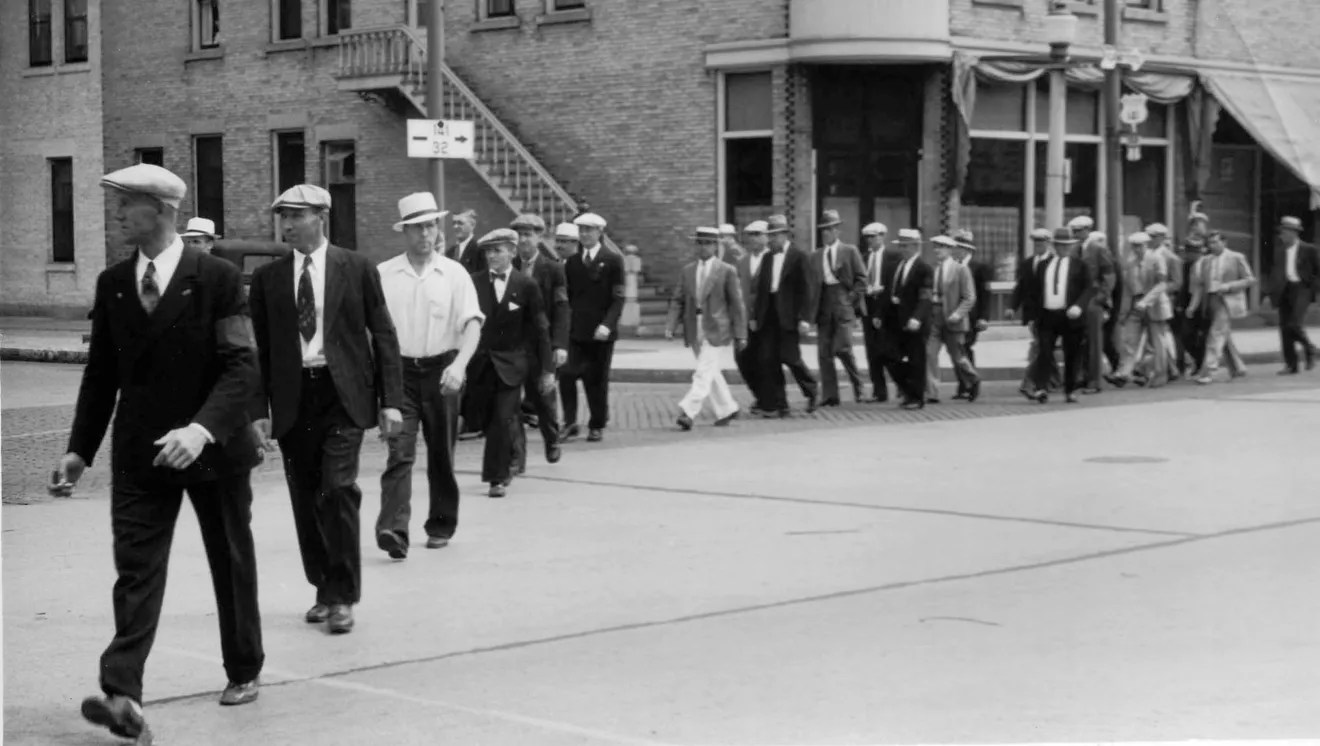
As dawn broke over the beautiful countryside of Kohler, death stalked in its wake. Within 24 hours three workers died of their wounds–Lee Wakefield, 25, Henry Engelman, 27, and Alex Weinert, 42–all riddled with bullets through the back, head and chest. Thirty-nine more men, women and children filled the hospital at Sheboygan; the youngest 13, the oldest 45. These were all the newspapers reported to the public; I found upon investigation, however, that about 150 wounded were never reported.
The National Guard was immediately called out and at this writing 750 guardsmen are stationed in a town of 1,500 residents to preserve “law and order” and protect Kohler of Kohler. Four “mediators” are being rushed from Chicago and a very “special” mediator from Washington to break the strike. Meanwhile the picket lines are again in action in front of the plant and the village is closed to entrance of “outsiders.” Nevertheless the Communist Party distributed 3,000 leaflets on Sunday in Kohler and Sheboygan, demanding the withdrawal of the national guard and meeting of the demands. The workers of Kohler have had their first lesson in class warfare and such lessons are not forgotten!
The New Masses was the continuation of Workers Monthly which began publishing in 1924 as a merger of the ‘Liberator’, the Trade Union Educational League magazine ‘Labor Herald’, and Friends of Soviet Russia’s monthly ‘Soviet Russia Pictorial’ as an explicitly Communist Party publication, but drawing in a wide range of contributors and sympathizers. In 1927 Workers Monthly ceased and The New Masses began. A major left cultural magazine of the late 1920s and early 1940s, the early editors of The New Masses included Hugo Gellert, John F. Sloan, Max Eastman, Mike Gold, and Joseph Freeman. Writers included William Carlos Williams, Theodore Dreiser, John Dos Passos, Upton Sinclair, Richard Wright, Ralph Ellison, Dorothy Parker, Dorothy Day, John Breecher, Langston Hughes, Eugene O’Neill, Rex Stout and Ernest Hemingway. Artists included Hugo Gellert, Stuart Davis, Boardman Robinson, Wanda Gag, William Gropper and Otto Soglow. Over time, the New Masses became narrower politically and the articles more commentary than comment. However, particularly in it first years, New Masses was the epitome of the era’s finest revolutionary cultural and artistic traditions.
PDF of full issue: https://www.marxists.org/history/usa/pubs/new-masses/1934/v12n06-aug-07-1934-NM.pdf
 Revolution's Newsstand