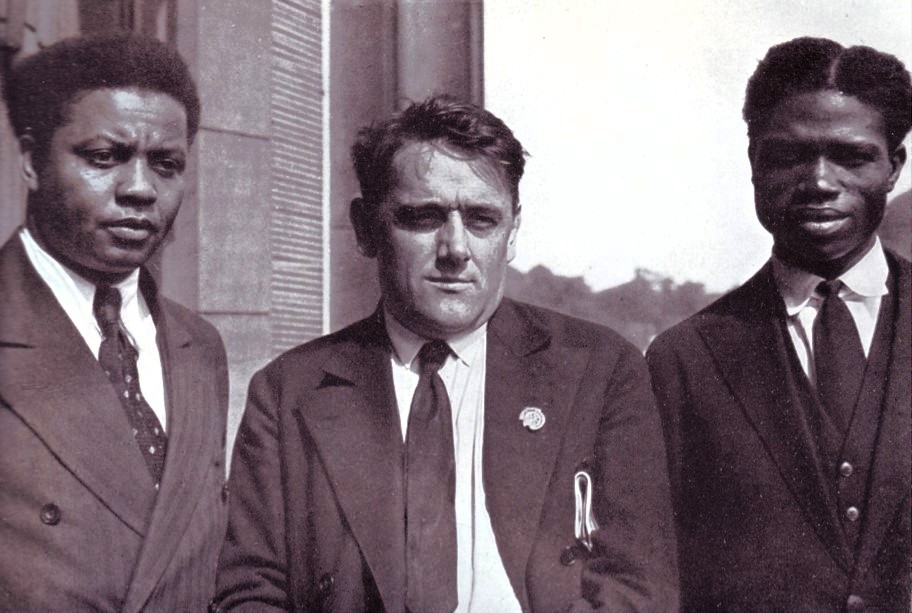
Between the historic founding meeting of the League Against Imperialism and Colonial Oppression in February, 1927 and its leadership’s first meeting that December, the alliance between the Communist and the KMT in China had been drowned in blood. Divisions which had already existed in the organization were accentuated. Münzenberg on the changed situation before the Executive meeting.
‘On the Eve of the Second Brussels Conference’ by Willy Münzenberg from International Press Correspondence. Vol. 7 No. 69. December 8, 1927.
The Executive of the Anti-Imperialist League, founded at Brussels in February last, has resolved to initiate the first ordinary session of its General Council on December 9th, the seat of the conference again being Brussels.
The General Council comprises about 50 leading politicians, economists, and artists of the most varied party politics and tendencies, united by the consciousness of the necessity of organising the fight for the freedom of the oppressed peoples and creating a great bloc of the revolutionary parties among the oppressed peoples together with the proletariat of the imperialist countries.
Besides the members of the General Council, a great number of other important delegations, from China, Syria, and the North-African colonies, have announced their intention of taking part.
The Second Brussels Conference meets under very different world-political circumstances to those prevailing at the time of the initial congress of the Brussels League in the spring of this year. At the first Brussels Congress discussion centred on the support of the Chinese revolution, then in a state of turbulent development. It was the culminating point of the meeting when, amid deafening applause on the part of all delegates and participants, Lansbury embraced Hansin Liau, the representative of the Kuo-Min-Tang, while Brockway, Secretary of the British Independent Labour Party, embraced the Chinese General Lu, both representatives of the British working class solemnly engaging to help the Chinese revolution by all means at their disposal, including strikes and the prevention of munition supplies to the British troops in China.
The snows of March had not yet melted when the oaths of February had already been forgotten by the leaders of the British Labour Parties. So as to be able to work “more freely” for the Anti-Imperialist League in England, Lansbury shortly after the February Congress retired from the post of its chairman and exchanged this charge for the presidency of the British Labour Party, conferred on him by this year’s Congress in place of MacDonald. With the help of the British troops and under the protection of the British battle-ships, the treachery of Chiang-Kai-Shek and other Kuo-Min-Tang leaders was possible in China. The Cantonese general Lu, so vociferously cheered by the Brussels Congress, was condemned to death by the hangman of Great Britain’s dummy, Chang-Tso-Lin, without anything being done in England to prevent it.
It will be the first and foremost duty of the new Brussels Congress to demand the actual realisation of the international resolutions and obligations of all sections of the Anti-Imperialist League. In England there is a section of that League. The League has frequently made public protests and the attitude of its members is undoubtedly more sympathetic than that of various party-friends of theirs in the Second International on the Continent, who have not only done nothing in support of the Chinese, or of any other, revolution, but have done their utmost to beat down and suffocate the revolutionary movement.
The Anti-Imperialist League, however, must demand more of its members than a merely platonic declaration of love for the oppressed and enslaved peoples; it must demand the most serious and energetic Parliamentary fight in support of the revolutionary struggle of emancipation in the subjugated countries.
The Second Brussels Conference, moreover, will have to assume an attitude to the Chinese organisations and parties and seriously to revise its attitude towards the Kuo-Min-Tang. In its manifesto and its resolutions, the Brussels Congress established a series of rules and principles, to apply to all organisations and movements supported by it. The leaders of the Kuo-Min-Tang altogether altered their attitude in the social and national revolution, so that their present attitude towards all these problems has no longer anything in common with their attitude in the spring. The centre of the Kuo-Min-Tang went over to an open support of the counter-revolution and has made itself jointly responsible for the endless series of sanguinary acts of terror which crowd the last few months and have, without exception, been directed against the really revolutionary masses of workers and peasants. Madame Sun-Yat-Sen, the chief reporter on the present situation in China, is bound to criticise this state of affairs and to draw corresponding conclusions in her report on the relations between the Kuo-Min-Tang and the Anti-Imperialist League.
The temporary defeat of the Chinese revolution was certainly a most fatal loss for the Anti-Imperialist League. The latter was founded under the impression of a vigorous advance on the part of the revolutionary Canton army, which in an unparallelled series of victories had carried its banner from Canton until close to the walls of Shanghai.
In spite of the Chinese defeat, however, the Brussels Congress awakened an echo in the semi-colonial and colonial countries, such as no organisation or movement have aroused since the Communist International.
Little more than half a year has passed since the Brussels Congress and to-day its manifesto has been translated into dozens of languages, being received with the same enthusiasm and hopefulness by the workers of India and the dock-labourers of Canton, by the down-trodden black proletarians of South Africa and the enslaved Indos of the Mexican steppes. In South Africa, the South African Trade Union Congress announced its adherence to the Brussels League, and the negro organisations will be represented at Brussels on December 9th by La Guma and Gumede.
At the invitation of the League, Richards, Secretary of the Railwaymen of Sierra Leone, hastened to Moscow to the October celebrations of the Soviet Republic and took his place beside Clara Zetkin and Krupskaya on the presiding board of the Congress of the Friends of Soviet Russia. In the North-African colonies vigorous and energetic bureaus of the League have been established, a considerable delegation from which will take part in the Brussels Congress. The Egyptian National Party has transmitted the General Secretariat of the League its thanks for the League’s intervention on the occasion of the last conflict with Great Britain. In the form of handbills, newspapers, and pamphlets, the Brussels decisions have been reproduced in thousands of copies in Arabic. In Holland, the Dutch police have arrested Mohammed Hatta, member of the Executive of the Brussels League, and have been keeping him captive for months along with other leaders of the movement in Indonesia.
It is in the Central and South American countries, however, that the Brussels Conference has awakened the most pronounced echo. Even though President Calles, conciliated by a compromise with the dollar-imperialists, is no longer on the committee of the League, a powerful section of the Anti-Imperialist League has developed in Mexico editing a paper of its own. Other actively working sections are to be found in Chile, Argentina, Uruguay, Cuba, and other South and Central American-States. The Second Brussels Conference will, for the first time, be attended by a delegate from the Philippines.
British imperialist circles, which are evincing particular nervousness and excitement in regard to the Brussels Conference and recently caused the famous “Augur”, foreign political writer to the “Times”, to publish a voluminous pamphlet against the League, arbitrarily forbade any publication in India of news and remarks in regard to the League and any publication of its press service. Nevertheless, dozens of Indian newspapers copied all the reports, publishing a special issue in regard to the Brussels Conference and developed the liveliest propaganda in its interest. The All-Indian National Congress resolved on a collective affiliation to the League, remitting £100 as its first subscription. Numerous trade unions followed its example, also becoming collective members of the League.
The movement set on foot by the Brussels Congress soon became one of the greatest and strongest movements of the last few years, so comprehensive and radical that even the social chauvinists of the Second International were forced to define their attitude towards it. At the most recent session of the Executive of the Second International, which also met in Brussels a few months ago, a night meeting was held in connection with the Anti-Imperialist League, at which men like Friedrich Adler and Wels resolved, against the sole vote of Fenner Brockway, to ostracise the League. Adler “exposed” the League in more than 20 pages in the press service of the Second International (“I.I.”). But neither “Augur” nor Adler will be able to throttle the revolutionary struggle of the oppressed peoples and the working masses.
International Press Correspondence, widely known as”Inprecorr” was published by the Executive Committee of the Communist International (ECCI) regularly in German and English, occasionally in many other languages, beginning in 1921 and lasting in English until 1938. Inprecorr’s role was to supply translated articles to the English-speaking press of the International from the Comintern’s different sections, as well as news and statements from the ECCI. Many ‘Daily Worker’ and ‘Communist’ articles originated in Inprecorr, and it also published articles by American comrades for use in other countries. It was published at least weekly, and often thrice weekly. Inprecorr is an invaluable English-language source on the history of the Communist International and its sections.
PDF of issue: https://www.marxists.org/history/international/comintern/inprecor/1927/v07n69-dec-08-1927-inprecor-op.pdf
 Revolution's Newsstand