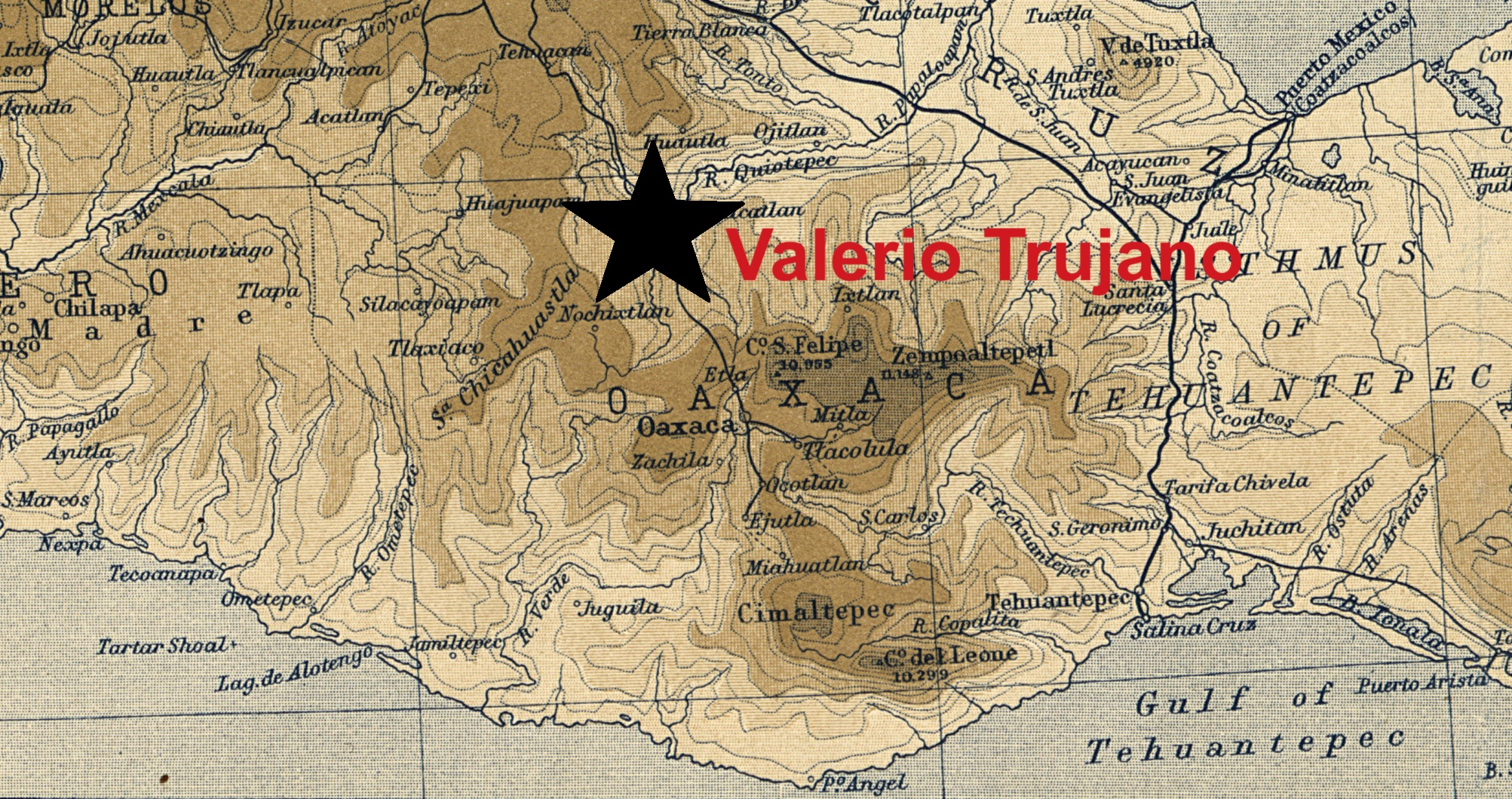
Carlton Beals journeys to the small Oaxacan village of Valerio Trujano and finds the African diaspora in this fascinating report to W.E.B. Du Bous’ Crisis magazine.
‘Valerio Trujano: Black Joy’ by Carleton Beals from The Crisis. Vol. 38 No. 5. May, 1931.
Here is a charming description of a Negro-Mexican village. Most writers and travellers in Central and South America and the West Indies very carefully omit all mention of Negro blood. They seem desperately afraid that the Negroes of all the Americas should become acquainted with each other. But Carleton Beals, one of our best authorities, has no such inhibitions and sends us this most interesting story. Ed.
OUR yellow-shirted guide rode ahead of us through the beautiful green cane meadows of Chillar and the abandoned communal lands of San Pedro Chicozapote, and on through the desolation of organ-cactus, sand and rocks of the steep-walled Cajfiada, which splits the high sierras of the Mexican state of Oaxaca.
Topping a low ridge, we straightened up gladly in our saddles, laid hold of lax reins, shook off the drowsiness of the heat and dust. The little village of Valerio Trujano lay below us, a bower of trees and houses. On beyond it stretched long meadows of sugar-cane, sloping north and east to the foot of the desolate mountains of the Mixteca Indian region. Tall coconut palms waved over the greenish church-dome. Massed about the low dwellings were buxom tempezquixtle trees (the native olive), mangos, chirimoyas, sapotes, oranges, lemons, bananas, mamayes. We wound down to the pueblo among cactus, nopales and the cardones, those gigantic gray-green candelabra, which produce yellow-white flowers and the red pitahaya fruit, The “Bad Woman” trees, with pure white blossoms and serpent tangles of jointed branches, menaced us with their poisonous spines, “which strike pain clear to the heart.”
We crossed a silver-plashing mountain stream and straggled through a lonely alameda under the yellow-gray arches of a colonial aqueduct, La Rueda (5,000 varas long, built in 1700) which carries water to the adjacent sugar-cane hacienda of Guendulain. Independence street, shouting its freedom from a nationalistic red-white-green plaque, led us into an unimproved plaza, where stood the adobe tile-roof-school, and we halted under the welcome shade of a ceiba.
The mayor conducted us to his little store for cool drinks, then along a stony cactus lane to a meal on the cool piazza of a hill-perched house. Chickens flew from the big brick charcoal stove to balustrade and table. A mouse-colored burro brayed cracked welcome. Razor-back pigs grunted theirs. Our hostess was a pleasant, slender mulatto with graying kinky hair; our host, a thin mulatto in an ash-colored shirt; our waitress, their daughter, buxom, barefoot, of compelling voluptuousness, sultry passionate features, gold-looped earrings.
The school-teacher, Angelina Chiu (part Chinese) a serious agreeable little woman, stages a festival for us. The children have turned out in their glad-rags. A tiny girl in beaded blue silk, black hair plastered smooth with tallow about her round, velvet, chocolate-colored brow, recites a monotone welcome with stereotyped gestures. The spectators are chiefly women; their men are in the fields. For the most part they are clad in gingham blue, with blue-striped rebozos setting off their dusky faces. Again I notice the predominance of Negro blood, every conceivable mixture with Spanish and Indian, here just a hint, there a black skin, kinky hair, full apricot lips.
Music strikes up—guitar, banjo and cantaro, played by three old men, the youngest, seventy-two, the eldest over eighty, magnificent, hale, bearded types. Two of them have mahogany complexions plus Negro features; the cantaro blower has kinky hair and an ash skin. The cantaro is a fat, narrow-mouthed black terra cotta jar from Coatépec. Kinky Hair blows into it lugubriously, an ominous African undertone for the tinkling strings, a sound that rises and falls like lost winds in the jungle, like the far roll and beat of a night sea.
Presently they strike up the typical song, “Los Enanos,” (The Midgets). Our old lady hostess picks a partner. They shuffle-dance to the weaving notes. Her long wide-flounced ruffle skirt swings like a ringing bell over her bare black toes, a swaying motion, graceful as a birch tree in a slight rotary wind. She wears a red embroidered huipil, bosom cut low, arms nude. One of the ancient musicians sings in full baritone:
“These Midgets aren’t from here,
They’re from the plains of Potosi;
They are, they are, they are the Midgets.”
Not a true translation, because “son” (They are) puns with “son” (tone) and corresponds to a vigorous sweep of the strings and a deep hollow blowing on the cantaro, followed by a wailing rise on the full-voiced “enanos.”
Sports complete the program, girls in blue bloomers and crimson kerchiefs; boys in gym suits. Amusing races.
In the evening there is a general dance on the dirt floor of the school house, benches cleared away. ‘The walls are decorated with strikingly talented children’s drawings and anti-alcoholic posters:
“Drink is the curse That empties the purse…”
The old musicians are on hand, more full of vim than ever. We wander in and out the open doors, under a chariot moon riding a tropic star-studded path above the restless coconut palms. We dance—waltz-time and jazz—but always round and round in dizzy whirl, a peculiar gyratory step well-adapted to unpolished floors and occasional bare feet.
The old musicians hark back to the middle of the previous century. They saw the reform of Juarez roll over the land and the French invasion place Maximilian on a stolen throne. Most of their lives they toiled as peons on the Hacienda Guendulain for a few centavos a day, bound to eternal servitude under the blazing tropic sun. Nevertheless, now, striking their bizarre music, they seemed the youngest, the most animated of the crowd.
Valerio Trujano enjoys a spirit of gay pleasure possessed by few Mexican towns. Is it the African strain? Or is it that this place is struggling to redeem itself? For Valerio Trujano is a new town. Its independence dates only from 1926. It is affirming its new liberty.
A new town but a very old settlement. Formerly its lands and houses, its people and its time, belonged entirely to the adjacent hacienda. Hacienda Guendulain, one of the earliest departimientos of the Spanish Crown, was founded in 1540. Its area extended for 81 square miles, from the rolling foothills, where the village stands, down toward singing Cuicatlan, drowsing under sheer red cliffs, and to far Dominguillo held in the fructifying embrace of Thin River—a day’s ride away. Back in the sixteenth and seventeenth centuries Negroes and Indians were brought in to work the canefields. They settled by the small stream under the tall coconuts. According to a state memorial published in 1883, the settlement contained about five hundred people, approximately its present population.
At one time in the colonial period, imported Negroes in Mexico are said to have outnumbered the Spanish whites. The Negroes, on several occasions, joined hands with the Indians to stir up serious revolts. Alarmed, the Crown henceforth forebade further black immigration. In most places in Mexico, the Negro strain has been vanquished, weeded out, assimilated, overwhelmed by brown-skin Indian. Not so in Valerio Trujano. Though the Negro blood dates back to the sixteenth century, it has endured. Why? Perhaps because of propitious semitropical climate. Perhaps because of the village’s long status of isolating servitude. Perhaps because Valerio Trujano was a created settlement, while all the towns around about were already old and Indian and had their mores determined long before the arrival of the Spaniards.
Thus, racially Valerio Trujano is a place apart, and the spirit of its life is in many ways unique. But in the character of its twentieth century problems, it is thoroughly typical of rural Mexico. In the earlier days of its history, when part of the hacienda, it had its Mayor, Regidores and Sindico appointed by the owner of the Hacienda. Its inhabitants were serfs, like the old musicians. They could not move away. Now, the village, like so many others in Mexico, has achieved its emancipation; but it is an emancipation that still must be fought for, a constant nerve-racking struggle. Perhaps that is why the fiestas of Valerio Trujano seem so much more intense and hilarious.
Up to the recent revolution, the dwellers in Valerio Trujano largely held aloof from the bloody national struggles of the past century, which in other places brought about racial levelling. But ill-treatment under Porfirio Diaz caused them to stir and to be reaped to violence in the flame of the 1910 revolution. Some of them followed the revolutionary hosts to death and victory. But not immediately were their sacrifices rewarded.
Not until 1926 was the village finally accorded complete independence, being then recognized as a free town entitled to manage its own affairs and shape its own fate. It was given a meager slice of land from the hacienda, including the area occupied by the houses, a few scant acres of bottom land, the rest uncultivated hill-slopes, in all less than two hundred acres for a population of half a thousand. The cane fields of the hacienda come right up to the first houses in the village.
The new town set eagerly to work to make the most of its slender possessions. Every inch of cultivable land was set out to cane, beans, corn. Little by little, through simple irrigation works, the village is sowing the hill lands, never before cultivated in four centuries and probably never tilled by human hands since time began.
But in spite of this enthusiasm, the newly attained independence involves bitter sacrifices. The owners of the hacienda never have reconciled themselves to the new status of the village or the loss of even this insignificant acreage. From the outset, they tried to restore the place to its ancient servitude. With the support of a small pro-hacienda party—about thirty village householders, some of whom were given arms—the proprietors have fought the village every step of the way. Particularly they have opposed the federal school. None of the hacienda party send their children to be educated. Those belonging to this party get work on the hacienda (minimum wage seventy-five centavos a day) for twelve hours under the hammering May and June sun, during the cane-cutting season. Those fighting for the independent status are boycotted in every way and get no work; and as their lands are so meager, this is a serious restriction. The hacienda has a light plant, but refuses to distribute light or power to the town. The owners of the hacienda lobby incessantly in the state capital and in Mexico City.
A bitter, sometimes deadly feud. Blood has frequently drenched the black soil. The villages, but yesterday having lost their centuries-old shackles, wield pitifully limited resources. Their obligations are heavy. During the revolution and the earthquakes of 1928, the city hall fell into partial ruin. The roof is sagging dangerously. The building needs complete overhauling. The school must be supported. To combat the hacienda’s lobbying, the villagers must repeatedly send commissions to the state authorities and to Mexico City. This calls for heavy expenditures at the expense of needed communal improvements.
In spite of the villagers’ efforts, the hacienda, supported by a previous governor, gained control of the first administration. The results were funereal. The hacienda mayor tried to put the school out of business. School taxes vanished into his personal pocket. He stole materials bought to improve the school and the city hall, to build himself a house and outbuildings. He made utterly no accounting of town funds. Confident of being maintained in dictatorial power by the state government and the hacienda (which spent over three thousand dollars for this purpose), he was not worried over a four-hundred peso shortage in the treasury or his other pecadillos. Did not his tiny minority party carry guns, provided by the hacienda?
But in spite of all efforts, the hacienda lost control. A new governor appeared in Oaxaca City, who recognized the people’s choice. General Tiburcio Cuellar, head of the volunteer Social Defense for all this region, suddenly took notice of the little pueblo, and supplied key men with arms and took away the weapons of the hacienda party.
The corrupt puppet mayor, now fearing the wrath of the villagers, threw himself under a train.
The villagers set to work with new enthusiasm. At great sacrifice, they reassembled materials for the school— the city hall can wait; cement for the floor, timbers for an open-air theatre. The hacienda still lobbies, and the villagers must still send commissions. But they are putting every faith in the children; and parents, with scarcely clothes to cover their own bodies, have provided their children with sport clothes, and watch boys and girls playing games together—this in a district bitterly opposed to coeducation. Four hundred pesos may seem a laughable amount to have lost, but in Valerio Trujano with its fierce struggle for existence, where every penny is wrung from the soil with anguishing toil, it represents an inroad into the bare necessities of life.
The villagers have dreams of some day having more of the fullness of life and of creating a town clean and proud and free. They talk of harnessing the water tumbling down through the heart of the plaza and installing a light plant which will serve not only Valerio Trujano but surrounding villages and which will provide mills to grind their corn and cereals. They feel the pulse of a new world, and, strangely enough, their aspirations are not essentially different from those of the rest of mankind.
But in the governmental reaction which has swept over Mexico in the past year or so, their struggle is likely to become well-nigh hopeless. The central government has turned its back on the agrarian problem. The villagers can hope for no additional lands to make life more than a barren struggle for existence. It is more than likely that the hacienda will regain its sway over the village. And much of the work of the energetic and self-sacrificing little school-teacher will be blotted out. But not for long can such a re action endure. For though the parents may weary in the struggle, the children have been given a new freedom and new vistas which will beckon them on. They have this in common with thousands of other villagers the length and breadth of Mexico, and no government can hope to endure which do es not in some measure fulfill their aspirations.
Fortunately this cloud of temporary failure has not yet rolled over Valerio Trujano. The spirit of gaiety that greeted us carried over till the following morning. We danced until two. At four-thirty the old musicians and the school-children woke us from deep sleep by the delicious strains of the customary mananitas and accompanied us for several miles out of town, The three old ex-serfs, as if chanting their freedom after so many years of slavery, stroked and blew at their instruments with more vim than ever. And the last act of the mayor before we spurred away toward the red cliffs of Cuicatlan in the rose-colored dawn, was to fill our saddle-bags with roast chicken and coconuts, that we might have food and drink on our long hot climb up the towering eastern ridges.
The Crisis A Record of the Darker Races was founded by W. E. B. Du Bois in 1910 as the magazine of the newly formed National Association for the Advancement of Colored People. By the end of the decade circulation had reached 100,000. The Crisis’s hosted writers such as William Stanley Braithwaite, Charles Chesnutt, Countee Cullen, Alice Dunbar-Nelson, Angelina W. Grimke, Langston Hughes, Georgia Douglas Johnson, James Weldon Johnson, Alain Locke, Arthur Schomburg, Jean Toomer, and Walter White.
PDF of full issue: https://archive.org/download/sim_crisis_1931-05_38_5/sim_crisis_1931-05_38_5.pdf
 Revolution's Newsstand