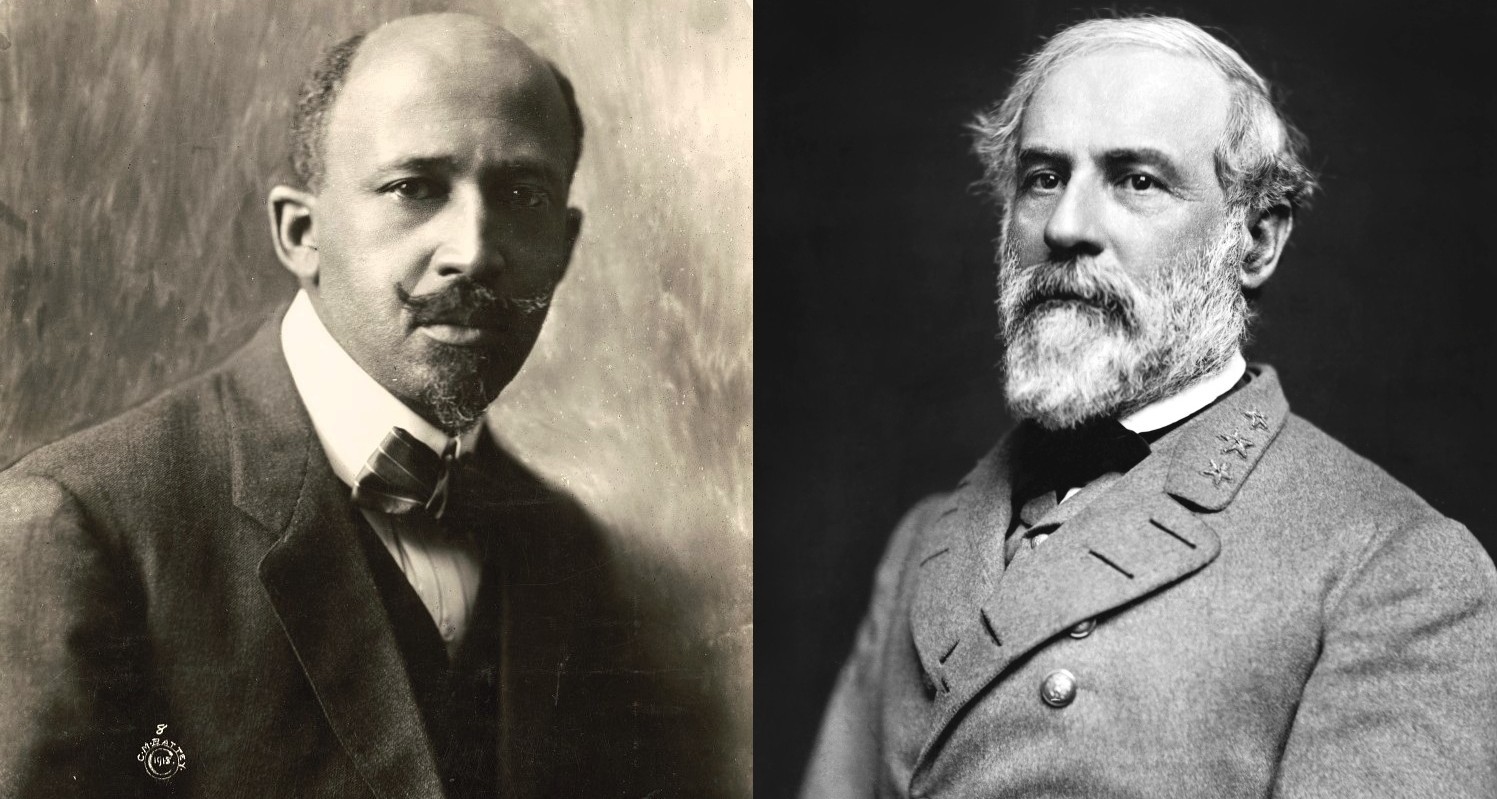
Corresponding with 1920s reaction, in part a response to the newly aggressive Black urban movement, along with militant, immigrant-led labor organizing, Robert E. Lee aristocratic slaver and traitor to the Republic he made an oath to protect, was resurrected as a paragon of ruling class nobility and white, Christian virtue. Dozens of new statues and monuments celebrating the losing general and his co-conspirators, most egregiously the artistic abomination and colossally tacky natural desecration of Georgia’s Stone Mountain, were erected in this period. Lost Cause revisionism was becoming, north and south, the de facto understanding of the Civil War. The Confederacy was defeated military in 1865, but was never destroyed politically or socially. That failure, recognized by Du Bois in 1928, remains the central failure in U.S. history. We are now, and will continue, to pay that price in matters large and small. The Civil War never really ended, and until the victory over the old Confederacy and its recent version is total, the war continues.
‘Robert E. Lee’ by W.E.B. Dubois from The Crisis. Vol. 35 No. 3. March, 1928.
EACH year on the 19th of January there is renewed effort to canonize Robert E. Lee, the great confederate general. His personal comeliness, his aristocratic birth and his military prowess all call for the verdict of greatness and genius. But one thing—one terrible fact—militates against this and that is the inescapable truth that Robert E. Lee led a bloody war to perpetuate human slavery. Copperheads like the New York Times may magisterially declare: “‘of course, he never fought for slavery”. Well, for what did he fight? State rights? Nonsense. The South cared only for State Rights as a weapon to defend slavery. If nationalism had been a stronger defense of the slave system than particularism, the South would have been as nationalist in 1861 as it had been in 1812.
No. People do not go to war for abstract theories of government. They fight for property and privilege and that was what Virginia fought for in the Civil War. And Lee followed Virginia. He followed Virginia–not because he particularly loved slavery (although he certainly did not hate it), but because he did not have the moral courage to stand against his family and his clan. Lee hesitated and hung his head in shame because he was asked to lead armies against human progress and Christian decency and did not dare refuse. He surrendered not to Grant, but to Negro Emancipation.
Today we can best perpetuate his memory and his nobler traits, not by falsifying his moral débacle, but by explaining it to the young white South. What Lee did in 1861, other Lees are doing in 1928. They lack the moral courage to stand up for justice to the Negro because of the overwhelming public opinion of their social environment. ‘Their fathers in the past have condoned lynching and mob violence, just as today they acquiesce in the disfranchisement of educated and worthy black citizens, provide wretchedly inadequate public schools for Negro children and endorse a public treatment of sickness, poverty and crime which disgraces civilization.
It is the punishment of the South that its Robert Lees and Jefferson Davises will always be tall, handsome and well-born. That their courage will be physical and not moral. That their leadership will be weak compliance with public opinion and never costly and unswerving revolt for justice and right. It is ridiculous to seek to excuse Robert Lee as the most formidable agency this nation ever raised to make 4 million human beings goods instead of men. Either he knew what slavery meant when he helped maim and murder thousands in its defense, or he did not. If he did not he was a fool. If he did, Robert Lee was a traitor and a rebel—not indeed to his country, but to humanity and humanity’s God.
The Crisis A Record of the Darker Races was founded by W. E. B. Du Bois in 1910 as the magazine of the newly formed National Association for the Advancement of Colored People. By the end of the decade circulation had reached 100,000. The Crisis’s hosted writers such as William Stanley Braithwaite, Charles Chesnutt, Countee Cullen, Alice Dunbar-Nelson, Angelina W. Grimke, Langston Hughes, Georgia Douglas Johnson, James Weldon Johnson, Alain Locke, Arthur Schomburg, Jean Toomer, and Walter White.
PDF of full issue: https://archive.org/details/sim_crisis_1931-08_38_8/page/279/mode/1up?q=confederacy+monument
 Revolution's Newsstand