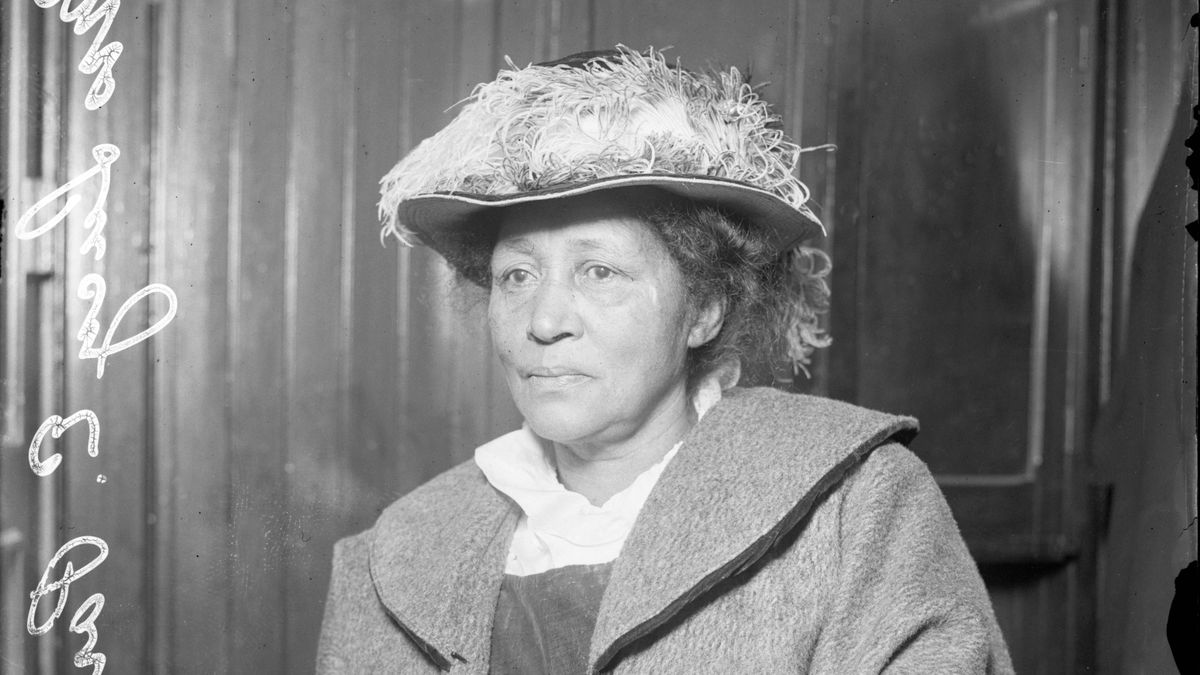
A visit to the north Chicago home of the elderly Lucy Parson and memories of Haymarket.
‘Lucy Parsons’ by Jane Benton from Working Woman. Vol. 6 No. 5. May, 1935.
“IT’S a lucky thing it was raining so hard, or you wouldn’t have found me home. I was going to a lecture,” said Lucy Parsons. At her late age she is still young with the vigor of the awakening working class. When I said that I was a representative of the Working Woman magazine she welcomed me heartily into her humble house, which is located at the end of a long, typical working-class street on Chicago’s Northwest Side. We sat in large, worn but comfortable chairs, opposite a table full of green plants. She talked of the beginnings of working-class organization in the last century, and of the Haymarket frame-up which caused the martyrdom of her husband.’
An Organizer
“I was a dressmaker by trade,” she said, “and organized the dress and cloakmakers. The women were hard to organize in those days–fifty years ago. It was a new idea, but we succeeded in building up a strong organization that has since then merged into the international union.
“My husband was a printer. For a time he was employed by the Chicago Times. He organized the printers, both men and women. He organized the first English-speaking central body in Chicago–the Chicago Central Labor Union. He was editor of one of the first labor papers in this country, the Alarm.
“I suppose you know that in 1886 the great battle for the eight-hour day was won. The Chicago Central Labor Union called a general strike of 80,000 people, a strike that paralyzed the city. On May 3 several strikers were shot and clubbed brutally by the police. On the next night, May 4, a protest meeting was called at the Haymarket, where the farmers used to market their hay. This meeting was well attended and was very orderly and peaceful. My husband was one of the speakers. We left early because we had our two little children with us and did not want to take them home in the crowd. We stopped for a chat and some refreshments. Suddenly we heard sounds of the riot a block away, and saw the police wagons rushing by. Later we learned that the leaders of the union had been framed for throwing a bomb among the police.
“My husband came to the court of his own free will and said, ‘I am Parsons. I am absolutely innocent of this bomb-throwing. I am an American and my forefathers helped to establish this republic. I have come to ask for a fair trial before a jury of my peers that I may prove my absolute innocence.’
“When the trial took place we could see that no justice was possible because the newspapers were simply wild with lies. Look up some of the Chicago papers of that date and you will see. They claimed that the city was going to be bombed and blown up by the workers. We arranged lecture tours, we raised money–we fought the case clear through to the United States Supreme Court but they claimed that they had no jurisdiction over it.
“Now I will tell of a fact that I do not think I have ever mentioned before. It is an example of how the newspapers inflamed public opinion against the innocent defendants:
“A few days before November 11, the day of the execution, public opinion was changing very rapidly in Chicago in favor of the defendants. We went to Springfield and tried to get a commutation from the governor. We had a splendid defense committee and this committee got permission from the chief of police to allow tables to be put along the streets so that anyone who wished to petition for a commutation could sign his or her name. We had a great many tables placed on the streets in the Loop and people stood there by the hundreds signing the petitions. signing the petitions. All classes of people–not only workers, but some wealthy, some middle-class–all believing in the innocence of the accused men. Everything was going along fine. We thought certainly we could get a commutation.
“On Tuesday morning it came out in the papers that Lingg had tried to blow up the jail and had blown his head off. Public opinion shifted like the wind. The papers said the anarchists were going to blow up the jail, and the police took the tables from the streets and no more petitions could be signed.
“It was for the purpose of changing public opinion that the explosives were deliberately planted in Lingg’s cell by the police. This is how I know. On Monday morning the prisoners were taken from the upper tier of the jail to the lower tier and locked in cells. We, their wives and relatives, could only talk to them across a passageway barred off by iron bars, and they were ten feet away from us, and the police walked up and down and listened to every word we said. It was impossible for Lingg to get any explosives in there. Anybody would know that.
“Chicago capitalists, among them, Marshall Field, called on Mayor Harrison who had expressed the belief that the accused had nothing to do with the throwing of the bomb, and tried to get him to suppress the truth about the case. The innocent man died by hanging on November 11, 1887.
“’Let the voice of the people be heard,’ were the last words of my husband. One of his companions on the gallows, August Spies, said, ‘There will come a time when our silence will be more powerful than the voices you are strangling today.’
Lucy Parsons spoke with calm strength. “It is up to us, the women, to fight side by side with the men. We are the losers when our men are killed. We must organize all the women.”
Lucy Parsons walked slowly, on aging feet. She helped me on with my coat. Then she kissed me goodbye and said, “Be sure to come back again whenever I can be of help.”
The Working Woman, ‘A Paper for Working Women, Farm Women, and Working-Class Housewives,’ was first published monthly by the Communist Party USA Central Committee Women’s Department from 1929 to 1935, continuing until 1937. It was the first official English-language paper of a Socialist or Communist Party specifically for women (there had been many independent such papers). At first a newspaper and very much an exponent of ‘Third Period’ politics, it played particular attention to Black women, long invisible in the left press. In addition, the magazine covered home-life, women’s health and women’s history, trade union and unemployment struggles, Party activities, as well poems and short stories. The newspaper became a magazine in 1933, and in late 1935 it was folded into The Woman Today which sought to compete with bourgeois women’s magazines in the Popular Front era. The Woman today published until 1937. During its run editors included Isobel Walker Soule, Elinor Curtis, and Margaret Cowl among others.
PDF of full issue: https://www.marxists.org/history/usa/pubs/wt/v6n05-may-1935-Working-Women-R7524-R1-neg.pdf
 Revolution's Newsstand