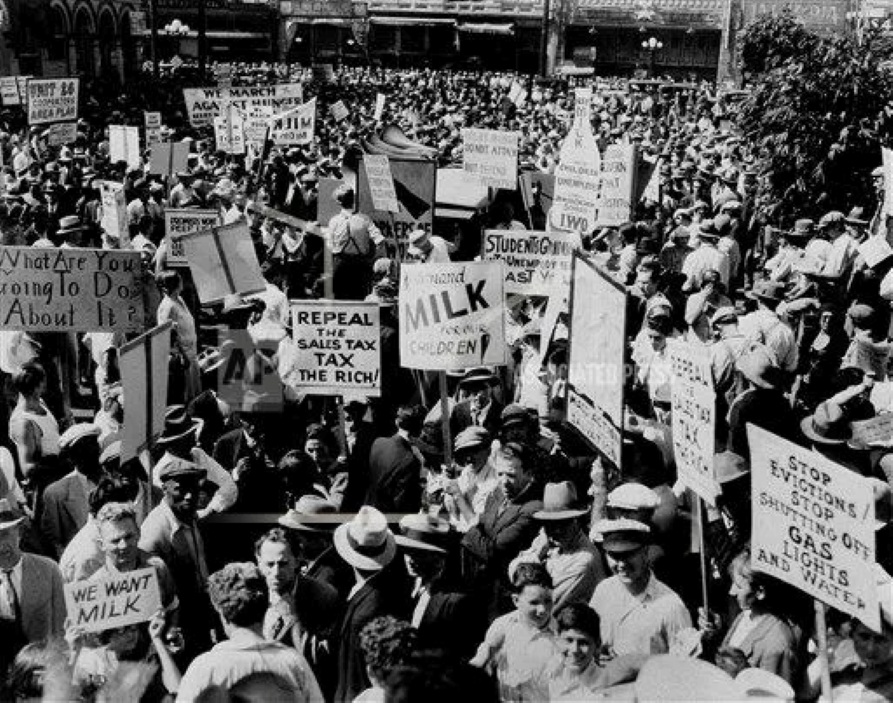
A sales taxes is a tax on the working class. Early in the Great Depression income and to the state shrank dramatically, and yet the Empire still needed a Navy. The choice was to tax wealth, or create a sales tax and bleed the workers. Roosevelt choose bleeding the workers. The L.R.A. reports.
‘The Sales Tax: To Save Incomes of Rich and Rob the Consuming Masses’ by Labor Research Association from The Daily Worker. Vol. 10 No. 121. May 20, 1933.
TO SAVE INCOMES OF RICH AND ROB THE CONSUMING MASSES
Roosevelt’s Sales Tax Program Would Tax Food and Clothing, and Pass Manufacturers’ Excise On to Toiling Masses, to Pay $220,000,000 Annual Interest to Bondholders
During the election campaign, Roosevelt held out as a bait for the masses the fact that he was “in favor of graduated income, inheritance and profit taxes and against (sales) taxes on food and clothing. whose burden is actually shifted to the consumers of these necessities of life on a per capita basis rather than on the basis of relative size of personal income.”
But now that he is president, Roosevelt includes among his methods to raise $220 million for the financing of his “public works” program, the very proposal which he previously admitted would take its toll mostly from the consuming masses.
The sales tax, as we know, is advocated by members of the capitalist class to escape heavier taxes on their incomes, gifts and estates. The sales tax is a tax on goods consumed, in the main, by workers and farmers. It thus becomes another effort to burden workers who still have any kind of a job or ability to purchase at least some of the necessaries of life.
To Save the Incomes of the Rich.
As with Hoover’s sales tax proposal six months ago, capitalist newspapers, such as the New York Herald Tribune the Hearst press, etc., are conducting an intense campaign to assure the passage of the Roosevelt tax. Thus Hearst’s New York American, May 16, 1933, declares that it has been advocating such a tax “for many years” and that it would reduce “burdensome and restrictive personal and corporate income taxes,” “He aimed to sabotage the income tax which chisels so deeply into his own fat purse,” wrote the Washington correspondent, Paul Y. Anderson, in explaining Hearst’s backing of the sales tax.
And to these forces of reaction has been added the voice of William Green. “Confirmation, in substance, of the report that President Green of the American Federation of Labor had told President Roosevelt that a sales tax would be acceptable to organized labor in financing a public works program, was given May 17 at Federation headquarters,” says Federated Press dispatch from Washington. Thus once again, the A.F. of L. leadership joins hands with capitalists and their government with Roosevelt, Hearst, and the like, in attacking the standards of the working class.
Taxing Food and Clothing.
The $220 million which it is proposed to raise by means of a sales tax is to be obtained by levying commodities on a percentage basis–at about 1 1-8%, it is claimed. But the share extracted from the consumer-workers would actually be much more. For instance, the price of a five-cent commodity, such as matches, would be raised at least one cent. This makes an increase to the consumer of 20% instead of the mere 1.1-8% (or the amount yet to be determined) which the manufacturer pays. We have the example of Illinois which has imposed a 3% sales tax. Under it, the Illinois Federation reported, “Persons of limited means who are obliged to make their purchases in small amounts are being compelled to pay a ‘tax’ of 20% or even more. Thus the working people of Illinois are being required to pay far in excess of the 3% provided by the law.” And some commodities may actually be raised as high as 100%! The difference, of course, is pocketed by the manufacturers and the businessmen.
Clothing, shoes, stockings, furniture, cleaning material, oil, household utensils of all kinds, medicine, ice, coal and a thousand and one other commodities necessary to the existence of the worker’s family are to be taxed. Such practices are not unknown to the workers of this country. The war period, it will be recalled, brought with it “luxury” taxes. Prices of soft drinks rose from 5 to 7 and even 10 cents. The same would now apply to articles which are prime necessities–stockings, medicine, shoes and a host of others.
Double Taxation.
When it is remembered that a number of states, New York, Vermont, Arizona, and others already have passed sales taxes, and that still others have such legislation pending, it will be realized that a double burden is to be the lot of the American workers unless they defeat the present bill. The New York Times, May 16, 1933 admitted this saying that “passage of a Federal sales tax would result in ‘doubling up’ for many States where turnover taxes were already in force.”
The workers, who are poor and living from hand to mouth, and buying in small lots, always pay more proportionately for what they buy than the rich. The workers will thus pay a heavier tax than the wealthy. In fact, a workers family whose cost of living uses up nearly the full amount of its income, as is increasingly the case, will actually be paying a tax upon nearly every cent of its income. The rich, on the other hand, whose incomes are of course much larger than what they spend, are exempt from the tax on this part of their incomes. And the richer the person, the greater the exemption. More, with over 17,000,000 jobless workers, a sales tax would add further to the ranks of unemployed by decreasing purchasing power. That is, with less being purchased, less would be produced and consequently, fewer employ Roosevelt claims it is necessary to pay interest and principle on the $3,300,000,000 bonds which he proposes to float in connection with his “public works” program. In other words, the workers themselves are to be forced to pay for this construction program which holds out to them the very dubious promise of employment for a few thousand.
Financing Military Public Works.
Yet at the same time, Roosevelt’s Secretary of the Navy, Swanson, proposes a battleship construction program which amounts to almost the same figure as it is expected to extract from the workers–$230,000,000. The 1933-34 military appropriation stands at the staggering figure of $565 million, or nearly 21⁄2 times this figure. The capitalist effort to saddle the masses with a load that very properly belongs to the capitalist class itself, thus becomes even more apparent. For that class received between seven and eight billion. dollars in dividends and interest payments in 1932, the fourth year of the crisis. A mere 20% tax on this would provide over $1,400,000,000—a sum which would cover the $320 million revenue expected from the sales tax, would restore the 15% wage-cut to federal employees, restore the recent cut in veterans benefits and leave $700,000,000 to be distributed in cash relief to unemployed. And $1,050,000,000 could easily be raised from personal income and estate taxes upon the capitalists.
But do you hear of any such proposals being suggested by Roosevelt, the man who in pre-election times demagogically declared for “graduated income, inheritance and profit taxes…”? You do not. Because the Roosevelt government, like every capitalist government, in line with its central function of protecting the incomes and property of the rich parasites, attempts to place upon the toilers of this country, the responsibility for carrying out its anti-labor campaigns.
The previous efforts to put over the sales tax in the first and second sessions of the 72nd Congress, went down to defeat. They failed because of the rising indignation and rebelliousness of the masses, the threat of mass pressure. The present Roosevelt sales tax proposal can likewise be defeated. The workers must be aroused to protect their interests from the ever-present onslaught of the capitalist class and its government. They can best do this be following out such a campaign as outlined in the Dally Worker, which has been their champion in this, as in other struggles.
DEVELOP ACTIONS AND PROTESTS AGAINST FEDERAL SALES TAX
The sales tax means a rise in the cost of living.
The sales tax means a new indirect wage-cut.
The sales tax means a smaller loaf of bread.
The sales tax means less milk for your baby.
The sales tax means that the poor support the unemployed while the bosses pay little or nothing.
The sales tax-inflation—this is the Roosevelt new deal—a policy of taxing the poor to guarantee the profits of the rich.
Demand that the rich be taxed to pay for public works and to support the unemployed.
The Roosevelt Public Works Program is to carry thru a large navy construction program under the guise of helping the unemployed.
Demand a Public Works Program to build workers’ homes, recreation halls, hospitals, etc.
Demand immediate relief and Federal Unemployment Insurance at the expense of the bosses.
Workers, employed and unemployed, organized and unorganized, Negro and white, call mass meetings in every locality to protest against the sales tax and adopt resolutions to be forwarded to the congressmen of your congressional district.
Hold meetings of your organization and forward your protest immediately!
Call meetings in your neighborhoods to demand increased relief and unemployment insurance. Workers in the factory—raise your voices against the sales tax Which will drive down your living conditions. Only immediate mass protests and actions of the toiling masses will defeat the proposed sales tax.
Send copies of all protest resolutions to the press.
The Daily Worker began in 1924 and was published in New York City by the Communist Party US and its predecessor organizations. Among the most long-lasting and important left publications in US history, it had a circulation of 35,000 at its peak. The Daily Worker came from The Ohio Socialist, published by the Left Wing-dominated Socialist Party of Ohio in Cleveland from 1917 to November 1919, when it became became The Toiler, paper of the Communist Labor Party. In December 1921 the above-ground Workers Party of America merged the Toiler with the paper Workers Council to found The Worker, which became The Daily Worker beginning January 13, 1924. National and City (New York and environs) editions exist.
PDF of full issue: https://www.marxists.org/history/usa/pubs/dailyworker/1933/v010-n121-NY-may-20-1933-DW-LOC.pdf
 Revolution's Newsstand