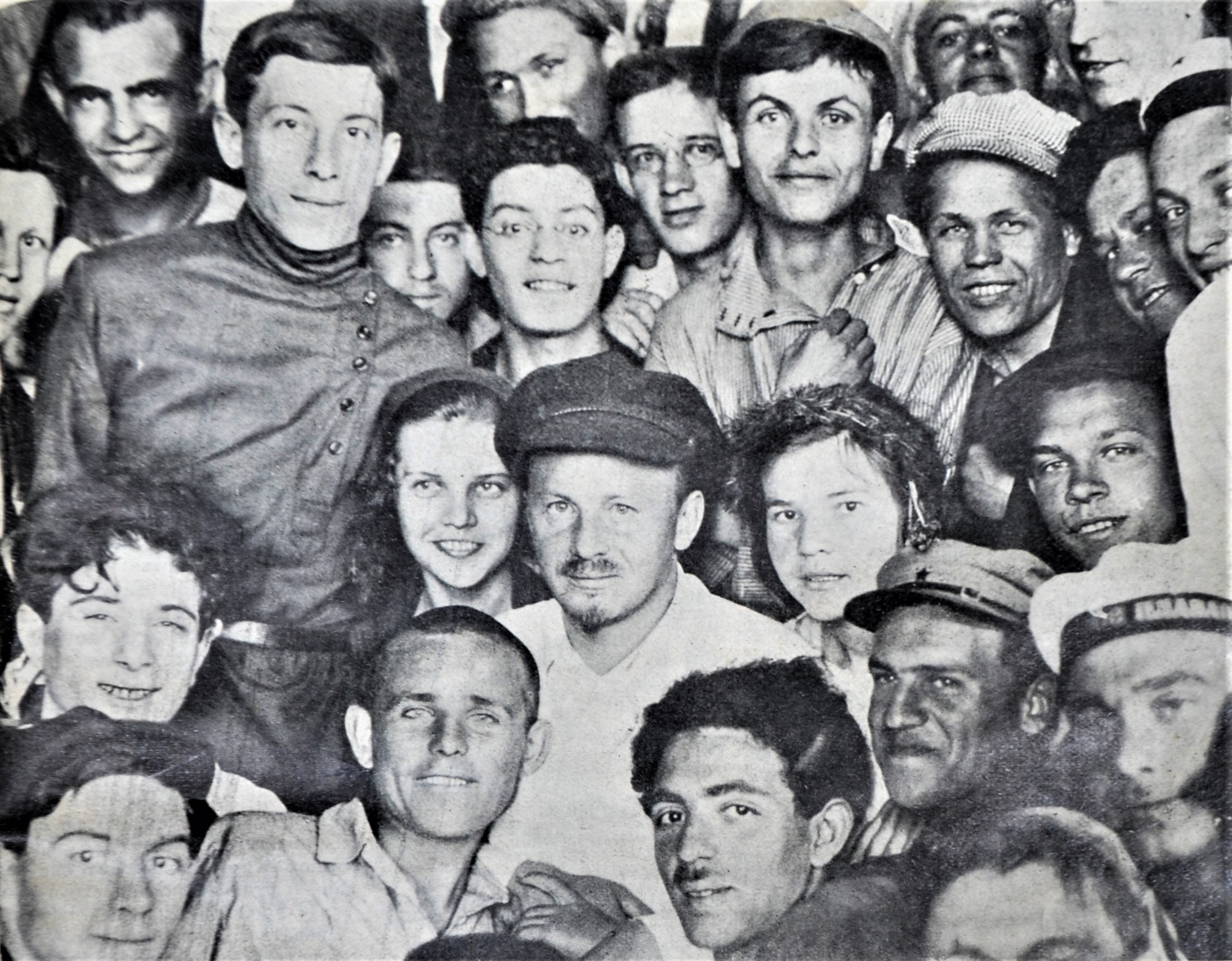
Bukharin’s response to the Opposition’s theses on Work in the Village and relations with different classes of peasantry at the 15th Party Congress.
‘For the Leninist Line in the Question of our Policy in the Village’ by Nikolai Bukharin from International Press Correspondence Vol. 7 No. 70. December 12, 1927.
Economic Perspectives in the Village (The first 11 Theses of the Opposition on the Peasant Question).
1. Dictatorship or Thermidor? Achievements or Counter- Revolution? Where is the Right, and where the Left? In the tenth year of the proletarian dictatorship in the Soviet Union paragraph 2 of the theses of the Opposition reads as follows:
“The Opposition sees and recognises all the vast changes which have taken place as a result of the October revolution. The dictatorship of the proletariat, the nationalisation of industry, of the transport service, of credit, the socialization of trade, the foreign trade monopoly, the co-operatives all this creates the possibility of the successful building up of socialism. This work of construction has already achieved considerable successes.”
Thanks to this oppositional gentleman, we are found worthy to hear that the Opposition “sees”, and even “recognises”, the October revolution…Every credit is due to the opposition for noticing such a “trifle”. It does however, seem rather remarkable that the Opposition has been obliged to recognise and to “observe” the “vast changes which have taken place as a result of the October revolution”. It must be admitted that the formulation itself (“sees” and “recognises”) is somewhat unhappy. Truly, we cannot envy people who have to emphasise that they do not pass over the October revolution. We thank them kindly! And finally, we hear that we have a proletarian dictatorship, and even that the building up of socialism has already mal with “considerable success”.
This is all very gratifying. But we hear at the same time something else. And this is very different indeed. We are told that Thermidor has been victorious with us. Apart from the lack of education evinced by this analogy, we gather rightly that what is meant is the victory of counter-revolution. We are told that our State, at its present stage, is a State of Alexinsky, of Kerensky, and Pereversev; that is, a bourgeois State oppressing the proletariat. We are told that people are better off under Hindenburg. We are told that the pre-war order has been restored in works and factories. We are told that the Party and the Soviet Power are degenerating at the hands of the kulak and the NEP-man. And we are told many other things in the same strain.
What does all this mean? What “achievements” are referred to? Is it not clearly comprehensible to everyone that, if we have to record the victory of counter-revolution (“Thermidor”), then the proletarian dictatorship has already ceased to exist? Surely every Young Pioneer can see that if the pre-war order has been restored in our factories, and the government represents the policy of the kulak and the NEP.-man, then we have neither a socialist industry nor a workers’ government?
Surely everyone with a speak of intelligence must grasp that if it is preferable to live under Hindenburg, then it is impossible to speak of any “achievements” whatever?
We are confronted by two series of oppositional assertions; one in favour of the existence of the proletarian dictatorship being recognised as a fact and the other against such a recognition, and for Thermidor.
What then is the permanent opinion of the Opposition? The best criterion is its actions. The Opposition violates Soviet law; it organises street demonstrations (against the proletarian dictatorship), here using one of the highest forms of struggle; it does not shrink from slanderously denouncing the Soviet government to the foreign bourgeoisie; it flies from Soviet freedom of the press down into cellars, or abroad like the Mensheviki and the Social Revolutionaries. These are all facts. And facts, as Lenin ‘ked to say, are obstinate things. And finally the Opposition builds up its second party. It is not clear that one can do this (assuming at least an elementary portion of political honesty) only if one has decided against recognising that we have a proletarian dictatorship in our country, and for “Thermidor?”
Here it is of no use to talk of mere “tendencies” (the usual line of retreat of the Opposition when it encounters the firmly serried ranks of the workers). Why not?
For the following reason: The Opposition maintains that degeneration permeates the whole of our social economic fabric. It is in the workshops and factories (directors and management), in the economic organs, in the Soviets, in the Party, in the C.C., in the government. More than this, the Opposition makes express mention of Thermidor, that is, of the victory of counter-revolution, of the shifting of classes of the classes holding power. But politics are “concentrated economics”. If “Thermidor” has already been victorious in the question of power, this means that the quantitative processes of degeneration in the sphere of economics have reached such a point that “at the top”, that is, at the seat of power, the victory of counter-revolution is obvious. Otherwise all talk about Thermidor (that is, about counter-revolutionary upheaval) is obvious nonsense.
And when we, that is, the whole Party, say that the assertions about Thermidor are a calumny of the Party, of the Soviet Union, and of the working class in our country, then we are accused of “glossing over actual facts”. Truly, the Opposition has become entangled among the brambles; truly it has already sunk with one foot in the Menshevist swamp.
Even the social democrats cannot help admitting our successes “in general” (progress of productive forces, etc.). But the social democrats are of the opinion that our successes are at bottom the successes of a unique type of capitalism existing along with a power of rich peasants and NEP.-man. In the capitalist Countries (especially the richest) they reverse the process. and stick socialist labels to the powerful industrial trusts (Hilferding). Cur Opposition joins in the same song on the Soviet Union, and so far degrades itself as to praise the bourgeois order. (“Better under Hindenburg”.) Is it not time to call a halt before it is too late?
Such weighty assertions are not to be juggled with. Both the dictatorship and Thermidor cannot be referred to as co-existent. This vacillation to and fro between two fundamentally antagonistic standpoints is more worthy of drunken jesters. And such jests can lead to no good. It is necessary to stop this playing with the political “twilight of the gods”.
II. Is it the same with us as with the Capitalists, or different? Leninism or Trotzkyism in the Agrarian Question?
The vacillations between dictatorship and Thermidor become equally, apparent on other points.
The logic of things compels the Opposition to adopt an inevitably un-Leninist standpoint in the question of the course of development in the village. The theses of the C.C. is as follows:
“The dictatorship of the proletariat in the Soviet Union alters fundamentally the conditions, and with it the course of the development, of agriculture, for it creates a fundamentally new type of agricultural relations, a new type of class regrouping in the village, and a new direction for the development of economic forms.” (Theses of the C.C. on the work in the village. § 1.)
To this Comrade Smilga declared at the Plenum of the C.C.:
“Instead of a Leninist standpoint we have a Bukharinian one, maintaining that within capitalism matters are this way or that, but among us it is fundamentally different…” Your theses again differ also in this respect that they contain no figures; a mere judgment is formed, and a wrong judgment according to which with us everything is fundamentally different’ as compared with other countries.”
The theses of the Opposition maintain, however, that paragraph 1 of the theses of the C.C. are untrue “in this absolute form”. Further, the theses maintain, with a zeal worthy of more success, that the question of “Who whom?” has not been answered, that there is an obvious process of differentiation going on, etc. etc.
We must make the actual subject of the dispute perfectly clear, and not permit the Opposition to transform one question into another with its usual juggling.
Above all: What is there untrue in paragraph 1 of the theses of the C.C.? The Opposition declares:
“The fact of the proletarian dictatorship alone does not transform capitalism into socialism. The dictatorship of the proletariat opens up the period of transition from capitalism to socialism. This transition has been best characterised by Lenin in his Taxation in kind. The Leninist characterisation of this period of transition, with its inner class struggle, with its interweaving of capitalist and socialist elements, with its question of ‘Who whom?’ all this is transformed in the theses of the C.C. into a vulgar, opportunistic declaration confounding the NEP. with Socialism.”
We see that 1. The C.C. “confound the NEP. and socialism”, and 2. “The fact of the dictatorship alone” is not yet socialism.
The first assertion is pure nonsense. The NEP. is the “new economic policy”, and not a state of society. It corresponds to the period of transition which is not yet socialism, but comprehends in itself various stages of development. The second assertion is perfectly correct, but has nothing to do with the case. For the theses of the C.C. do not maintain that: “The dictatorship of the proletariat is socialism”. The theses of the C.C. state that the dictatorship of the proletariat changes the conditions of development, the course of this development, its type, the type of regroupings, the direction of development. A moment’s thought will show that the period of transition is referred to.
In paragraph 7 of the theses of the C.C. we read:
“7. Seen from the social class viewpoint, the process of agricultural development is characterised at present by the struggle between the socialist and capitalist tendencies. This struggle gives its special stamp to the process of differentiation in the village, which possesses under present conditions sharply accentuated characteristic features.”
This struggle gives its special stamp to the process of with the question of whether a class struggle is going on the village or not (these are elementary A.B.C. truths); nor has the dispute anything to do with the question of whether the dictatorship alone means socialism or not (another elementary A. B. C. truth). The subject of the contention is the question of whether the dictatorship of the proletariat and the socialisation of the key positions create other possibilities of development, another type of this development in the village, than exist under capitalism.
The negative reply to this question (Smilga: Theses of the opposition) is at the same time the crassest possible form of the negation of Leninism. Let us assume that with us the village develops precisely as under capitalism: The middle peasant is washed away, the kulak works his way to the surface, the middle peasantry is proletarised and dissolved, the opposite poles are growing and nothing more than this.
How would it be possible, in this case, to build up socialism jointly with the main mass of the peasantry, the majority of which are opposed to the immediate socialisation of their production? How can Lenin’s co-operative plan be defended which reckons on the transition “to the new order by the simplest, easiest, and (for the peasantry) most accessible means?” (Lenin). Does this not mean looking to the kulak for support? But the proletarians have no undertakings of their own. In so far as they are not already combined with the village poor in productive collectives, they can and must be protected from the employers, and their ranks must be organised. But their individual undertakings cannot be fitted into the structure of socialism, for no such undertakings exist. The middle peasant is becoming extinct, and no hopes can be set on him. What is left? Nothing whatever. Everything turns out to be a Utopia, Lenin’s plan disappears along with the “central figure of agriculture”.
The theses of the Opposition deliberately distort the views of the C.C. in their insistence that the C.C. believes in the “idyll” of a “uniform” (!) growth of prosperity among all the strata of the village. Such utterly nonsensical assertions can only be attributed to the complete irresponsibility of loud mouths who do not even want to reflect on the actual issue.
The same paragraph 7 of the theses of the C.C. contains the following on the differentiation in the village:
“The peculiarities of this class regrouping result from the altered social conditions. These peculiarities consist of the fact that our type of development, as opposed to the capitalist type, which is expressed by a weakening of the middle peasantry, whereby the extreme groups of the village poor and the rich peasantry increase, is characterised by a process of strengthening the middle peasant group, accompanied by a certain and at present still continuing growth of the kulak group at the expense of the better situated part of the middle peasantry, and by a decrease of the groups of the poor peasantry; one part of the poor peasantry is proletarised, whilst the other and greater part rises gradually into the group of the middle peasantry.
These peculiarities are the inevitable result of the inner antagonisms of the economic development under the present conditions of the dictatorship of the proletariat.”
Does this look like the uniform growth of prosperity among all groups, or like that “idyll” of which the Opposition speaks? Even mendacity must have its limits.
The fundamental difference of opinion between the Party and the Opposition (not the imaginary, but the real one), consists of the fact that the Opposition assumes that with us everything is going in the village, as under capitalism, whilst we state that this is not in the least the case (otherwise it would be nonsense to speak of the struggle between the socialist and capitalist elements in the village for what socialist elements exist in the village under capitalism?). In the opinion of the Opposition the whole course and the whole type of the development of the Soviet Union is the same as in Germany, France, etc. By this the Opposition itself excludes the possibility of building up socialism in the village under the guidance of the town, and confines itself to protecting the interests of the village poor, at the same time opposing this protection to the building up of socialism.
III. Town and Country. Who Leads Whom?
The question dealt with has still another aspect. Lenin wrote:
“However often the petty bourgeois democrats, calling themselves socialists and social democrats (Chernov, Martov, Kautsky, Longuet, MacDonald & Co.) may bend the knee before the goddesses of ‘equality’, of ‘universal suffrage’, of ‘democracy’, ‘pure democracy’, or ‘consequent democracy’, this will not cause the economic and political fact of the inequality between town and country to disappear.
It is a necessary fact in the capitalist society in general, and during the transition from capitalism to communism in particular.
Town and country cannot be equal. Under the historical conditions of the present epoch the village cannot be equal to the town. It is inevitable that the town leads the village. It is inevitable that the village follows the town. The sole question is which of the classes in the town will be successful in gaining the leadership over the village, and what forms will this leadership take.” (Complete works, Russian ed. Vol. XII. p. 442.) The emphasis is Lenin’s.
This alone suffices to show that in our proletarian State we must expect the course and type of development of the town to differ sharply from that of the village. Those who assume (with Smilga and the oppositional theses), that in our State everything proceeds precisely as under capitalism, have not grasped the leading role of the proletarian town. (Only when “Thermidor” reigns among us, and only then, will the village develop “as under capitalism”.)
The Opposition has never grasped this, and for this reason I wrote in my pamphlet against Ustryalov:
“It is much to be regretted that even Communists sometimes forget the fundamental methodology required in the analysis of the various most important spheres of economics, for instance agriculture. These people are of the opinion that it is possible to indicate the general lines of development without taking into account the village in its relation to the town, agriculture in its relation to industry, transport, and credit. They imagine some isolated village, standing alone like a sphinx, and subject to special laws of development of its own, without the slightest connection with the laws of the development of the whole national economy.
This paltry standpoint has been annihilated more than once by the inexorable blows of Marxist criticism but it springs up again like a stand-up doll, and continues to proclaim its immanent’ absurdity in a persistent if thin voice. Even at its present reappearance it finds those who are willing to play its accompaniment. No other than Lenin himself demanded, in his commentary on Kautsky’s book, that this analysis should be undertaken on the basis of “general development.”
In writing this I had the Opposition in mind. Before this, I had already dealt with this point in my pamphlet: “The Way to Socialism:”
“It is impossible to imagine a state of things in which the village develops entirely independently of the town. We have already stated that as a result the growth of the productive forces of the country the influence of the town on the development of our agriculture is becoming more and more decisive. And the pulse of the city, its proletarian industry, its banking system, its legislation, etc., all this turns more and more in the direction of the village, that is, all this serves as a powerful support for the middle and poor peasantry, a support against the strata of the rich peasantry.”
This was written some years ago. And now when the theses of the C.C. say the same, the Opposition has the impudence to maintain:
“This is true. But the Party ought to know that this is a thesis of the Opposition, and that at first it encountered violent resistance on the part of the C.C. Now the C.C. has appropriated this thesis.”
What have you to say to such “friends of truth” and to their “modesty?”
But the Opposition, having acknowledged the leading role of industry, has become involved in utter confusion. For either socialist industry leads the village, in which case the development of the village cannot be in principle the same as under capitalism. Or the reverse is the case: If our development is the same as the capitalistic, then we cannot speak of the leading role of the town.
Or perhaps Thermidor has decided these questions? If you thinks so, say so, but stop this foolish game.
With regard to the “backwardness of industry” and the like. (paragraph 3, closing passage, theses of the Opposition), even the proverbial cat cannot but laugh, to say nothing of the adult workers.
IV. The Tactics of the Party. Manoeuvres. Who is Revising Lenin?
The following paragraphs of the oppositional theses are devoted to the tactics of the Party and the antagonisms arising from. “Enrich yourselves”. Here a surprising degree of inte lectual poverty and futility comes to light.
Before dealing with the passages themselves, I should like to make a small observation. The authors of the theses, seeking to compromise the line of the Party, state:
“Lenin once wrote: ‘Were we to manoeuvre on the Bukharin method, we might very well ruin a good revolution.’ (Works. Vol. XV. p. 145.) At the present time we are involuntarily reminded of these words of Lenin.”
Lenin was right here, as ever. But why do the authors forget that the Bukharin here spoken of was the Bukharin who at that time made common cause with Trotzky? Why do they conceal the fact that on this same page of Lenin’s works, page 145 of the XV. volume, we read:
“Comrade Trotzky says that the peace (the Brest peace. N.B.) will signify betrayal in a new sense of the word. I maintain that resort to mere phrases is an entirely wrong method of argumentation.” (Ibid. The emphasis is mine. N.B.)
Trotzky accuses Lenin of betrayal. In spite of this, Lenin only replies to the effect that he only finds phrases in Trotzky’s arguments. From this time onward. Bukharin rejected the phiraseological policy of Trotzky. But Trotzky, even now, has still nothing to bring forward but mere phrases and an accusation of betrayal brought against the whole Party and the C.C. In vain, completely in vain, you refer to the XV. volume!
The authors of the oppositional theses have spared no labour in quoting again and again Boguscheysky and all the other passage which they have already quoted hundreds of times. But they do not accord one word to Kamenev’s “village enriching itself”, to Zinoviev’s readiness to “bend” before the economic needs of the peasantry, to the non-Party organs above and below, or to various other matters. The authors of the theses are obviously well aware that they lie when they almost speak of the negation of the class struggle, etc. This has been proved dozens and hundreds of times, and such “arguments” are only laughed at.
There is however one “objection” to which we must devote some attention: Why were we told this at the XIV. Party Conference and at the XV. Party Congress, and now that? (We may remark in parentheses that the heroes of the Opposition voted for the decisions of the XIV. Party Conference.)
It is not so difficult to comprehend this if we approach the question in the right manner, and if we take as starting point certain elementary premises, especially that premise which points out that tactics must change according to changed objective conditions and class relations. The estimate made of these changes will be found in the following passage of the theses of the C.C.:
“Viewed from the class standpoint the Party is able to record a growth and consolidation of the proletariat, a consolidation of the alliance with the middle peasantry on the basis indicated by the XV. Party Conference and the XIV. Party Congress, and finally an increased offensive against private capital. This process has been accompanied by an increase of agricultural production, an organisatory growth of the agricultural labourers’ unions, the organisation of poor peasant groups, and the revival of the Soviets. These prerequisites create the possibility of reaching wider strata of the poor and middle peasantry by means of the co-operatives, of further increasing the systematic influence exercised upon the peasantry, and of making a decisive attack on the kulak on the basis of the successes which have been attained towards the strengthening of the alliance between the proletariat and village poor on the one hand, and the middle peasant on the other.”
The realisation of the decisions of the XIV. Party Congress consolidated the shaky alliance with the middle peasantry; this is a great achievement of proletarian policy. But precisely this has not been grasped by the Opposition (which saw in the decisions of the Party Congress a policy favouring the kulak), and it does not grasp even yet that unless this task is accomplished we cannot go forward with perfect certainty, jointly with the middle peasantry and with increased support from the poor peasantry, against the rich peasantry. All who believe the decisions of the XIV. Party Congress to have favoured the kulak will be equally unable to grasp the import of the theses to the XV. Party Congress. This is perfectly natural. But why make a virtue of one’s own blindness, and criticise from the standpoint of the blind those who see?
The Party, in reinforcing the economic key positions, in consolidating the alliance with the middle peasantry, and in thereby creating much wider possibilities for offering real aid to the village poor, is really marching forward, and will not concern itself about the outcries of “treason”, Thermidor”, and the like. The Party follows the progress of the rich peasantry with the most careful attention, but does not shriek that we are on the “decline” (only petty bourgeois can suppose that the rich peasant is now beginning to control our ever growing and consolidating socialist town); it rather creates the practical prerequisites for the actual struggle, and wastes no time on empty phrases no longer able to deceive anybody. “The economic forces in the hands of the proletarian Russian State”, wrote Lenin, “suffice completely to secure the transition to communism. What is lacking? It is obvious what is lacking. There is a lack of necessary culture in that stratum of communists who control the administration.” (Compl. works, Russian ed. Vol. XVII. p. 43.)
This was said at the XI. Party Congress, almost six years ago. Today we are masters of much greater “economic forces” than at that time. If anybody is revising Leninism, it is the Opposition, for it is the Opposition which utterly confuses all relations, and crowns its opinion of the development of the Soviet Union by an absurd and calumnious outcry on “Thermidor”. It is a dangerous game to replace real politics by such phrases.
International Press Correspondence, widely known as”Inprecorr” was published by the Executive Committee of the Communist International (ECCI) regularly in German and English, occasionally in many other languages, beginning in 1921 and lasting in English until 1938. Inprecorr’s role was to supply translated articles to the English-speaking press of the International from the Comintern’s different sections, as well as news and statements from the ECCI. Many ‘Daily Worker’ and ‘Communist’ articles originated in Inprecorr, and it also published articles by American comrades for use in other countries. It was published at least weekly, and often thrice weekly. Inprecorr is an invaluable English-language source on the history of the Communist International and its sections.
PDF of full issue: https://www.marxists.org/history/international/comintern/inprecor/1927/v07n70-dec-12-1927-inprecor-op-alt-scan.pdf
 Revolution's Newsstand