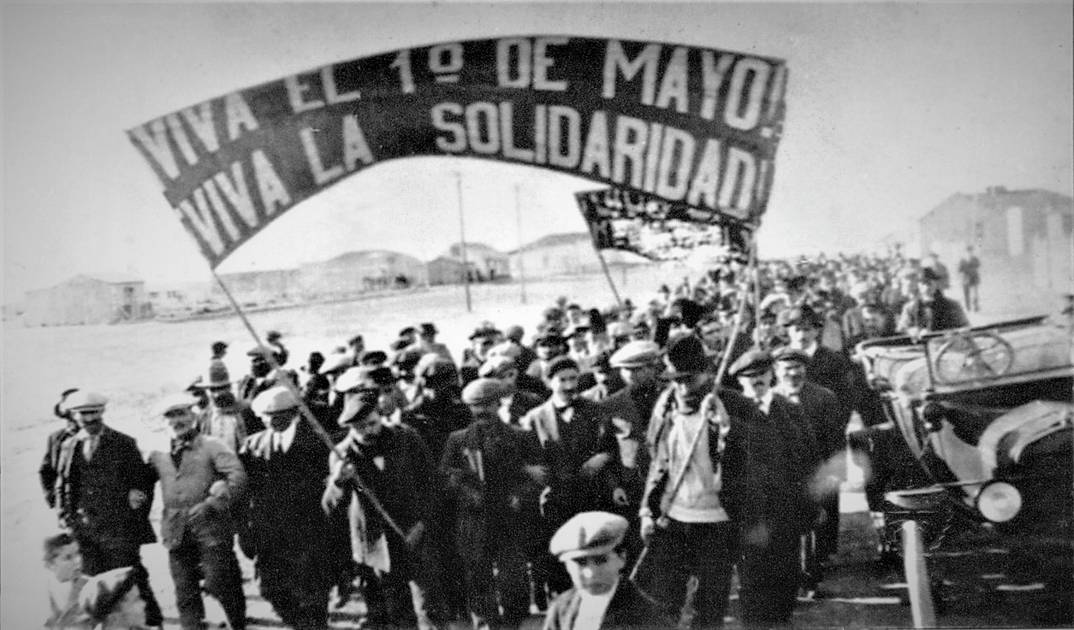
An editor of the Chicago-based I.W.W. Spanish-language paper Solidaridad provides a treasure of information on the syndicalist and Communist movements and their relations in Spain, Argentina, Chile, Cuba, Brazil, and Mexico.
‘The Class War in Spanish Speaking Countries’ by Frank J. Guscetti from Industrial Pioneer. Vol. 1 No. 2. March, 1921.
SPAIN
THE CLASS STRUGGLE IN SPAIN is growing more intense every day and the issue between the workers and the capitalists with their political parties of various shades and their armed forces is getting ever sharper. The development of a more intensive labor organization in the Peninsula during the last few years is a very interesting study. Spain got its full share of war contracts, and gold flowed toward it during the last few bloody years to an extent unheard of even in the days of the preciously laden galleons of old. Most of this trade went to Barcelona, as the most important industrial and commercial center of the Peninsula, while Bilbao and Valencia also shared in war prosperity.
We see today the Spanish peseta at its lowest point, declining as fast in exchange value as the currency of vanquished and victorious countries that took part in the war. As a consequence, the Bank of Barcelona finds it necessary to suspend payments, marking the gravest financial crisis in the history of the country, with the Bank of Spain unable to come to its rescue. In the meantime, the bourgeois press harps on the fact that the Catalan capitalists had opposed increased export duties during the height of war orders on the plea that they were to devote their profits to expanding and bringing up to date the various manufacturing industries concerned, in the interests of a transformed and modernized industrial Spain. Even the regionalist, Senator Cambo, leader of the Catalan separatists, now echoes the cry: “What has become of the enormous gains of the war period?” And no answer is forthcoming, except financial ruin and social chaos, longer bread-lines than ever before and misery on all sides among the workers and the middle class.
And while the crisis has developed, the new civil governor of Barcelona, with the effective aid of the gunmen forming the so-called “Sindicato Libre,” or “Free Union,” has, according to the bourgeois press, wiped out of existence the powerful movement of the “Sindicato Unico.” Not only active members of the Syndicalist movement, but even lawyers, as in the case of the liberal deputy Leyret, who had defended Syndicalist cases in the courts, have been attacked and shot down openly in the streets, thus actually practicing what the bosses’ associations and their controlled press have for so long accused the Syndicalists of doing.
To set the matter right, let us note here that the “sindicato unico” is not a definite organization but a form of organization, first proposed and provided for in the 1918 Congress of the Regional Confederation of Labor of Catalonia, which originated in Catalonia and later spread to other parts of Spain and to Portugal, and which today is earnestly discussed in Uruguay as well as other Spanish-language countries. The term “sindicato unico” is applied to the close grouping of all local and craft units into a “single union” in each industry, or a single mixed union where one industry predominates. So effective did this form of organization become, that it stirred the Asociacion Patronal of Barcelona, the local merchants’ and manufacturers’ association, to utmost activity in combating it, brought on a prolonged series of strikes and lockouts, caused the reorganization of the bosses in a national federation, resulting in a long list of incarcerations and persecutions as well as deportations, effected the pact between the Syndicalist and the Socialist unions in September, and was indirectly responsible for the organization of the assassins and freebooters called the “Sindicato Libre,” who have endeavored to institute a reign of terror without hindrance from the authorities.
We have just received a letter from the general secretary of the Confederacion Nacional del Trabajo, asking us to give publicity to the infamies of the Spanish bourgeoisie, in which he tells us that the union is not only holding its million members, but is constantly growing in numbers and power all over Spain. He says, among other things: “Our unions have been declared illegal and we are being shot down openly in the streets by bands of outlaws under the protection and in the pay of the authorities and the bosses’ associations. Hundreds of our comrades have been detained in military camps and prisons and in dungeons, and thousands are conducted over the highways of the country, on foot, in mid-winter, resulting in the death of several, that we know of. These infamies, more fully dwelt on in our manifesto to the international proletariat, have forced us to ask for the moral support of the proletariat of the whole world, and in order that our fellow workers the world over may take immediate steps toward refusing to handle any and all goods proceeding from, or destined for Spanish ports. You are perhaps aware of the fact that we are defending ourselves in the fight that has taken on the character of open war without quarter. The spirit of our confederates, numbering over a million, and constantly growing, is good; we are more determined than ever in the struggle, which, though practically confined to Catalonia during the past two years or so, has now extended to and is general in Asturias, the Levant or Valencia region, Andalucia, Aragon and Vizcaya, in which regions our ideas are taking concrete form and growing remarkably, especially among the peasantry and agricultural workers.”
From “La Vie Ouvriere” we learn that dispatches to the bourgeois press from Barcelona say that “22 terrorists,” among them the “meneur syndicaliste” Angel Pestana, have been incarcerated in the Montjuich of infamous memory. These “terrorists” of the capitalist press dispatches are apparently but militant Syndicalists of the National Confederation of Labor of Spain, and it is quite likely that the 22, or some of them, have been taken from the concentration camp of Mahon, in the Balearic Isles, to be kept more securely, or to be the easier done to death in the dungeons of Montjuich.
It is to the Mahon prison camp, on the isle of Minorca of the Balearic group, that a number of the best known militant Syndicalists were taken about December 1st, 1920, when the new civil governor began to get in his work. Among the group was Salvador Segui, perhaps the ablest tactician of the Spanish Syndicalist movement, formerly secretary of the Regional Confederation of Labor of Catalonia during its period of phenomenal growth, 1918-1919, who has been jailed a number of times before. He is a captivating speaker and a deep student of the labor movement.
The Union General de Trabajadores, or General Union of Workers, is entirely dominated by prominent members of the Socialist Party, and has been ever since its organization in 1888. During the last few years it has been losing its foothold in the same degree that the C.N.T. has made rapid gains. It is fast being driven to join forces with the C.N.T. and dump the politicians overboard.
After the pact of September, 1920, with the Socialistic U.G.T., it was the splendid outline of fundamental principles urged by Segui that cleared up the situation, not only as regards the pact with the Socialist unionists, but also as regards the Russian revolution and the Communists. He pointed out the necessity of the U.G.T. separating itself from the party, and asserted his belief that only the workers in their union organizations could realize the ultimate fruits of the class struggle, and that, necessarily, any other element or organization stood in the way. He pointed out that the Socialist Party is but the latest expression of the radical parties of the bourgeoisie, and that true Syndicalists must therefore oppose it, emphasizing the fact that the failure of the present regime of capitalism is essentially the failure of parliamentarism, regardless of shades or colors, Socialist or Communist, that the Communists would have to expend much energy disputing political control, while the syndicates are alone eminently fitted to carry out the revolution and assure its ultimate success. The workers’ syndicates must exercise dictatorship, admitting that such is necessary in the period of transformation, as they alone will have a mission to perform, since upon them will rest the responsibilities of production and distribution. While stressing the duty of defending the Russian Revolution at all costs, Segui, with most of the C.N.T., believes it important to note the fact that they are not obliged in any way to submission to Soviet Russia, which would mean acceptance of all the methods employed by the Russian Communists. The revolution in Spain, they say, will without doubt be quite a different thing from the one that took place in Russia.
However, the C.N.T. voted at its December, 1919, Madrid congress to affiliate with the Third International. Here is the resolution, adopted unanimously:
“The National Committee, as a resume of the ideas expressed by the different comrades who spoke on the question in the session of December 17th, with reference to the subject of the Russian Revolution, propose the following:
First: That the Confederacion Nacional del Trabajo declares itself the firm defender of the principles which gave form to the First International, sustained by Bakounine.
Second: That it declares its provisional adherence to the Third International, because of the revolutionary character of its present directorate, and until the organization and holding of the International Congress in Spain, which is to lay the basis upon which will be founded the real International of the workers.”
Continued persecution prevented the C.N.T. from carrying out its plans and sending out its intended call for an international Syndicalist congress.
The Confederacion Nacional del Trabajo de Espana, or National Confedaration of Labor of Spain, was organized on September 14th, 1911, at Barcelona, by delegates representing 28,000 organized workers, mostly grouped in local and autonomous unions, the big majority being located in the Catalonia region. It was founded at the height of the reactionary Canalejas regime, with widespread protests against threatened international war over Morocco, and with big strikes on every hand. A demonstration after the congress, in protest against the rule of reaction, resulted in wholesale imprisonments and brutality against the new-born Confederation, and it has been in the thick of the fight ever since, so much so that it had neither time nor opportunity to hold a congress until December, 1919, during a momentary lull in the unrelenting fight against it on the part of the Spanish master class.
On the 18th of December, on the eve of the parliamentary elections, a statement was published in certain liberal newspapers of Madrid in which the C.N.T. declared that it would consider the agreement entered into with the U.G.T. in September,
1920, as null and void. It accused the U.G.T. of open treason, because at a moment when decisive and energetic action could have put an end to the governmental oppression from which the militant members of the advance guard of the labor movement had been suffering for two years, the Socialist Party, influencing the U.G.T., preferred to divert the union’s attention to political interests, instead of uniting in joint action, which the crisis required. It stated that thereby the Socialist Party prevented the movement of protest from attaining the desired end. The Socialistic U.G.T. was charged with collaborating with the bourgeois element and with opposing the action of the Syndicalists.
The statement terminated with the following unequivocal and ringing paragraph: “We re-affirm our anti-parliamentary convictions, and we ask all workers not to vote, not to help to forge the chains which will be put around our necks, even if these chains be gilded, as are those which the Republicans, the Radicals, and the Socialists hold out to us.
“We call upon the proletariat of the world to aid us in our struggle against Spanish persecution and political intrigue.”
ARGENTINE
That the reign of unparalleled reaction, which began with the tragic second week of January, 1919, during the revolutionary general strike, has spent its full force and is receding, is evidenced by the holding, undisturbed by the authorities, of the first extraordinary congress of the non-conformist wing of the F.O.R.A. (Federacion Obrera Regional Argentina, or Argentine Regional Workers’ Federation), the liberation by order of the national executive toward the end of December of nearly two score political prisoners, and the congress and changing of the P.S.I. or Partido Socialista Internacional into the Communist party.
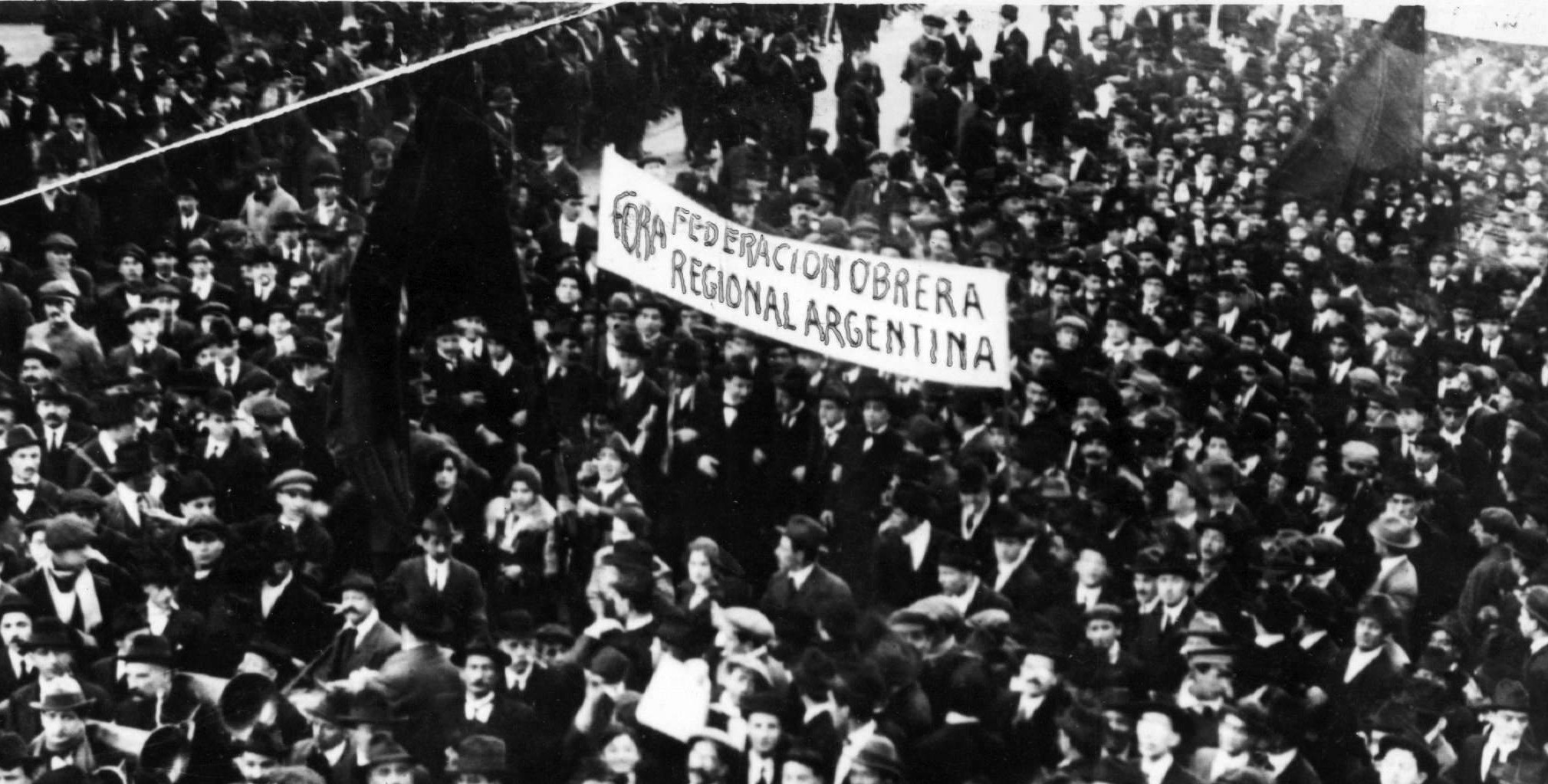
There were 193 delegates present, representing 192 affiliated unions and 56 autonomous or independent unions, in attendance of the congress of the non-conformists of the F.O.R.A., formerly known as the “F.O.R.A. of the Fifth Congress,” or “Quintistas”, but now calling itself the F.O.R.A. Comunista, which it seems, has not borne out the high expectations of many of its partisans and participants. A lack of fixedness of purpose and much uncertainty of methods and tactics, if not indeed of principles, prevented better and more lasting results. As much as the regular F.O.R.A., sometimes called “of the 9th congress” or “of the 10th congress”, merits criticism in parts and on occasions, our ardent fellow workers of the new F.O.R.A. Comunista must learn that criticism alone or a predisposition to insisting on individual plans of action instead of on a common and constructive program, will get them nowhere.
One concrete accomplishment seemed to be the adoption of a universal card and dues stamp, but later reports seem to modify this by apparent agreement that local unions will still retain their own books and stamps.
The delegate of the independent union of the Marine Transport Workers of South America, (I.W.W.), Fellow Worker Jose S. Pica, presented a plan of organization covering all industries and closely following the I.W.W. chart, which was very well received indeed, and favorably and widely commented upon in the radical and labor press.
Included in the liberated political prisoners are Garcia Thomas, Hermenegildo Rozales and Atilio Biondi, formerly editors of the anarcho-syndicalist daily, Bandera Roja, (The Red Flag), who were sentenced in July, 1919, to six years’ imprisonment, after their paper had been suppressed and a notable trial and appeal had taken place. But the Siberia of the Argentine Republic, the penal settlement of Ushuaia, in the Antartic regions of Tierra del Fuego, still holds its hostages of the class war in the antipodes, among them the undaunted Radowiski, whose very interesting story I would like to present here, but must postpone on account of lack of space and time.
The formation of the Communist party now gives Argentine three Socialist or Communist Parties. A majority of the municipal council of the capital city, Buenos Aires, which contains one-fifth of the population of the nation and is of larger proportionate importance commercially and industrially, are Socialists of one shade or another.
Just a few words about the F.O.R.A.: It was first organized in 1901, and adopted a declaration of principles resembling in a general way the preamble of the I.W.W. In its fifth congress, in 1905, there was a partial split between those who devoted their attention almost exclusively to the eight-hour day movement and those who were after the organization of the workers for the overthrow of capitalism, the latter winning out. In the 9th and 10th congress, the intransigeants took a more extremist attitude than ever, while a majority supported the so-called moderates, who have since been in control, and who have surely built up a powerful organization. In an open letter published some time ago, in reply to critics, Secretary Sebastian Marotta claims 80,000 affiliated members for the regular F.O.R.A., apportioned in 534 syndicates. The strongest single union in the federation is the F.O.M., or Federacion Obrera Maritima, (Maritime Workers Federation), made up mostly of coastwise and ferry boats plying the river Plata and tributaries. The efforts of the shipping interests to break up this the strongest union in South America, has forced strike after strike upon it, of incredibly long duration. They have recently come out of a strike lasting about a year, and entered the “ferryboat strikes,” in which the government took a hand against the union.
A splendid example of industrial solidarity occurred during the recent “ferryboat strike,” where twenty ferryboat workers refused to man the boat after it had been loaded by scabs. The twenty were promptly arrested for obstructing necessary public transportation in violation of a recent federal law, and were loaded on a special train on way to jail, but the train crew and the yardmen at Basavilbaso refused to move the train, and they were arrested in turn. The twenty ferryboat strikers were then put on a special car and the latter hooked to a thru train, but as soon as the crew were made aware of the incident, they also refused to move their train until the car was disconnected, which was done after some more trainmen were discharged.
The strike of the Naval Constructors’ Union against the Mihanovich shipping interests, although about a year old, still endures, and this union still is among the solid ones of Buenos Aires.
BRAZIL
In Brazil, as in practically every country in the world, labor organization has gone on apace, in spite of repressive measures, deportations and the general undeveloped condition of the country in its social and industrial life. Here, as elsewhere, intrigues and selfishness divide the workers and retard their progress.
The numerous deportations have been due to the fact that the number of the workers who rebel against the masters are predominantly foreigners, to the extent of perhaps 90%,— about 80% being Portuguese. The native workers have had their patriotism “worked on” and have responded to the treatment. A huge “patriotic campaign” has been launched in favor of cultivating the national spirit as against “foreigners”, but its very intensity and ardor is undoubtedly going to have a contrary effect. They are endeavoring to stir up the Brazilians to believe that they are being robbed and that their rights are being invaded by the foreigners, especially the Portuguese. And, unfortunately, large numbers of the workers, who are not as yet class-conscious, are responding to the anti-foreigner and patriotic campaign of misrepresentation.
But though they may be able to deport all active agitators and stir up patriotic fury to fever heat, they cannot deport ideas nor the causes of discontent. Many of us continue in our endeavors to spread the truth. But the difficulties in our path have increased and the disastrous results may be seen in some formerly promising unions. For instance, the Textile Workers Union, which in 1918 had 16,000 members, now numbers only about 3,000, the others having been raked in, by intimidation and insidious propaganda, by none other than the Catholic Union, which serves as a sort of entertainment center, maintained by subsidies of the industrial masters, assisted by the venerable pastors of the various flocks and congregations which abound in this fertile country. In these unions money seems to be plentiful, in common with dancing, singing, card-playing and praying.
The flourishing Typographical Union of yesteryear has suffered from factional differences and a general strike that failed, until now there are only about a dozen members in the local union.
Perhaps the one union that has been able to maintain itself in something like its former strength is that of the Construction workers.
In the southern districts labor conditions are more encouraging.
You perhaps already know of the Third Brazilian Labor Congress, held in May of this year, 1920. As the first congress was held in 1906 and the second in 1913, these congresses are more than a ten-day wonder. The last congress brought together a larger and more representative gathering by far than any former affair of the kind in Brazil, and promises well for future organization. The I.W.W. preamble was read at the Congress and was well received. Literature had been sent by New England members of the I.W.W. and some of it was reproduced in the labor press. The Congress turned down completely all invitations to join Gompers’ so-called “Pan-American Federation of Labor”.
CHILE
It is remarkable how international capitalism can “get away” with anything, including wholesale murder, when the spirit of the workers is not aroused. We have received various confirmations of the barbarities recorded in a recent number of this publication as occurring under the “white terror” of the Chilean bourgeoisie. News have also reached us of the torture of our Fellow Worker Jose Domingo Gomes Rojas, I.W.W. member, student and poet of widely recognized attainments. One of the forms of torture he was subjected to was having cold water dropped on him in his cell, drop by drop, for long periods. He was driven insane, and his sensitive constitution being unable to stand the strain, he died. His funeral brought out forty thousand people, of all ages and both sexes, paralyzing the industrial and commercial activities of the capitol city of Chile for the day, and tying up local transportation completely. The cortege was formed at the offices and halls of the Students’ Federation and passed in front of the palace of “La Moneda,” the seat of government, as well as in front of the tribunals of “justice”, as a protest against the occupants of these institutions, who had stirred the “patriotic” mob to acts of violence and incendiarism that marked the beginning of the recent reign of terror throughout Chile. At the cemetery additional stands had to be provided for the speakers who addressed the multitude in memory of our brave fighter and poet, who was relentlessly persecuted because of his being a member of the I.W.W. Among the speakers was one of the editors of the radical review “Numen” (Inspiration) and ex-president of the Students’ Federation, Santiago Labarca, who had been indicted but was not as yet apprehended. Police officers, learning of his presence, endeavored to reach him and arrest him, but the dense crowd would not open up the way for the police, and Labarca was enabled to finish his address and get away. But he was arrested later.
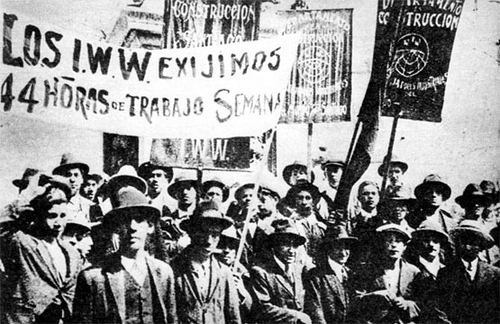
Many of those who filled the jails have been released on bond, and trials have started. Among those to whom provisional liberty on bond was denied is the former secretary and one of the main organizers of the Chilean I.W.W.—Juan O. Chamorro. A new beginning is being made by a group of earnest workers and students, as was to be expected after all the enthusiasm that went into the making of the I.W.W. here last year. They have issued two numbers of Accion Directa (Direct Action), issuing a ringing challenge to the newly inaugurated president in the first issue, advising him that he will be held strictly accountable for close adherence to his promises of free speech, free press and unrestricted right of organization. The history of the development of the Chilean I.W.W. is one of the most interesting chapters in American labor history, and we hope to give an account of it at some early date.
CUBA
The cost of living has soared upward in Cuba as in all other countries, and the financial crisis has hit the workers hard. The “forward-looking” bosses have been fearing a spontaneous uprising, and recently attempts have been made to make it appear that an uprising of the blacks against the whites was imminent. But in reality, the economic disturbances in the Wall Street controlled republic and the policy of labor repression have brought about an intolerable condition of affairs, and the “blacks” are the capitalist wretches of Wall Street, and the local capitalists and speculators in sugar and in the life of the people.
An epidemic of strikes swept Cuba during 1920, and many unions have been forced out of existence by the organized power of the bosses, backed up by the cynical government of the jackal Menocal and the sugar barons. Few workers’ publications have escaped suppression. Open assassination is being resorted to in the cane fields in the present Tiarvest to forestall any attempts at organization, as letters received direct from the cane fields and sugar mills inform us. The employees of the Havana Electric Company had their union broken up for them by the good 100% American directors and superintendents of this corporation, and these workers are endeavoring to reorganize.
American managers of such corporations as the Havana Electric in Cuba, the Armour and Swift concerns in Uruguay, Argentine and Chile, and ether similar corporations, are accumulating for all except working-class Americans of the U.S. the well-merited contempt, if not hatred, of thousands upon thousands of mercilessly exploited and hard-driven workers of the countries mentioned, to whom the very word “American” or “Yankee” is a byword of hate. It is for this special reason, as well as on general principles, that it is highly important and desirable that we lose no opportunity to show our fraternity and solidarity with our fellow wage-slaves of Cuba, Mexico and Central and South America.
MEXICO
The much-heralded congress of the so-called PanAmerican Federation of Labor was duly held in the City of Mexico as per schedule, but the representation was such as to require a change of name, if not indeed the dissolution of the pet creation of old man Gompers. Sammy was quoted as stating to a Mexico City newspaperman in an interview upon his arrival there, that the I.W.W. did not exist, but this glib generality did not satisfy nor convince the Mexicans. It is now seriously up to Sammy to prove that the high-sounding “Pan-American Federation of Labor” really exists.
The remarkable thing about the affair is, not who was there and what was done, but rather the many Pan-American countries (practically all of them) that were neither represented nor intended to be represented. Organized labor in Brazil definitely refused to have anything to do with Sammy’s pet creation; Argentine, ditto; Uruguay, the same; Cuba was only represented in two or three unions, who authorized Santiago Iglesias of Porto Rico to “handle” their representation; Chile, absent; Ecuador, absent; Peru, absent; Bolivia, absent; Paraguay, absent; Venezuela, absent; Costa Rica, absent; Nicaragua, absent; Panama, absent; Honduras, absent.
The Mexican I.W.W. has met with much success in its renewed activity in Tampico, lining up many new members and putting the Oil Workers’ Local Union on its feet again, as well as rendering valiant support to the Mexican administration and aiding materially in the regular publication of “El Obrero Industrial”, their official organ, which appears regularly each month with good industrial union and fundamental organization propaganda matter. More power to it!
The Industrial Pioneer was published monthly by Industrial Workers of the World’s General Executive Board in Chicago from 1921 to 1926 taking over from One Big Union Monthly when its editor, John Sandgren, was replaced for his anti-Communism, alienating the non-Communist majority of IWW. The Industrial Pioneer declined after the 1924 split in the IWW, in part over centralization and adherence to the Red International of Labour Unions (RILU) and ceased in 1926.
Link to PDF of full issue: https://www.marxists.org/history/usa/pubs/industrial-pioneer/Industrial%20Pioneer%20(March%201921).pdf
 Revolution's Newsstand