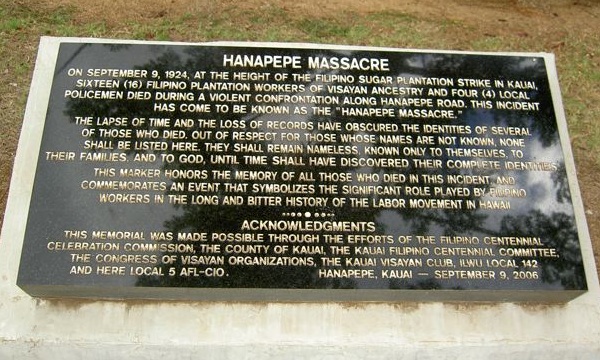
The the story of September 9, 1924’s Hanapēpē Massacre of Filipino sugar strikers on Kauai in which sixteen workers were and four police as the pickets defended themselves.
‘Workers Rebel Against U.S. Sugar Barons–16 Strikers Murdered by Hawaii Cops’ by Joseph Catlin from The Daily Worker. Vol. 2 No. 149. September 12, 1924.
HONOLULU, Hawaii, Sept. 11. Sixteen Filipino strikers and four policemen mark the dead today following a clash between the desperate sugar slaves and the uniformed tools of the sugar barons of Hawaii, at Hanepe, on the island of Kauai.
U.S. Lords Responsible.
The responsibility for this slaughter of the workers can be placed definitely on the shoulders of the American capitalists who control practically the entire market there and who have had the police instructed to shoot down every striking worker who approaches.
Distracted Filipino widows, their children following them, wander from the jails to the hospitals and from thence to the morgues in search of missing strikers, who have been forced into hiding with the exception of those occupying prison cells, hospital beds or death beds.
Police Slaughter Workers.
The clash was the result of the interference of the police in the peaceful attempts of the strikers to induce the scabbing workers to join them in the movement for better conditions and higher wages.
The Filipino sugar laborers are on the level of the worst paid and most ill-conditioned workers in the world. American capital, in its furious march towards greater profits, has wrecked the lives of thousands of the workers.
The average plantation worker receives a starvation wage of one dollar for a twelve-hour day and is supposed to get a bonus if sugar goes above five per cent. The bonus is a fake, pure and simple, as was stated by George W. Wright, president of the United Workers of Hawaii, in his recent letter to the president of the Hawaiian sugar planters’ association.
Hit Fake Bonus.
“You are forcing them (the workers) to gamble with their unpaid quota of wages on the fluctuations in the price of sugar,” he wrote. “They give their day’s labor and you pay them half a day and bet the rest of the wages with yourself that the price of sugar stays down. If it does, you win, and keep their money; if it goes up. you lose the bet and pay them back a part of the other dollar they have earned…Your bonus system is a crooked, dirty game to rob your laborers!”
Together with this dastardly plan goes the terrible housing conditions of the workers. In the majority of cases the laborers are housed in quarters packed like sardines, presenting an appearance very far from what any civilized community would permit.
Millions Made in Profits.
This has enabled thirty-two sugar plantation companies of the Hawaiian Islands, owning the California & Hawaiian Sugar Refining Corporation, which operates the Crocket sugar refinery at San Francisco, to have an extremely profitable season in 1923, notwithstanding some falling off of the island’s output. The plantation companies sent approximately 385,000 tons of their raw sugar to the Crockett refinery.
It is significant to note that Governor Wallace H. Farrington, appointed by the United States to rule the islands, is himself a large sugar baron, and it is therefore not at all surprising to find that when he was in Washington, Farrington gave glowing reports of conditions in the Pacific slave pen. The profits of the sugar lords had been Immeasurably increased by the importation of thousands of agricultural laborers from the Philippines.
It is these workers, of whom there are about 40,000 at present, who are revolting against their industrial slavery under American capitalism, who rule with the direct aid and consent of Washington officialdom, and who are being shot down for demanding that they be accorded the treatment of human beings and not of cattle.
ONE HUNDRED AND THIRTY SUGAR WORKERS ARRESTED IN HAWAII; STRIKERS MAY TAKE NEW ACTIONS. September 13, 1924.
HONOLULU, Sept. 12. One hundred and thirty Filipinos alleged to have been Involved in Tuesday’s massacre of the striking sugar workers by the police, in which 16 strikers and 4 policemen were killed, were brought into Kauai County court under a strong guard for a preliminary hearing.
The authorable, who are under the thumb of the American Sugar Interests, are preparing to file charges of murder, kidnaping and rioting against the suspects.
A full report has been sent to Governor General Wood of the Philippine Islands by the labor commissioner, and action is awaited.
In the meantime the situation, though quiet, is filled with tense expectations from both aides, and it is predicted that If summary action la taken against the workers, a more serious outbreak of the striking laborers will be brought about.
U.S. GOVERNOR IN HAWAII ORDERS SUPPRESSION OF SUGAR STRIKERS; HAS LARGE PLANTATION INTERESTS. September 15, 1924.
HONOLULU, Sept. 14. A sample of how American governors of U.S. colonies use their office to protect the interests of American capitalists, including themselves, is shown here by the activities of Governor Wallace Farrington, in his moves against the striking plantation workers.
Declaring that he was “convinced that there is an organization to prevent laborers from returning to work and that the time has arrived when we must determine whether an aggregation of leaders operating under a false idea of their authority to establish a government of their own shall prevail,” the governor today directed the attorney general to investigate and take vigorous steps towards suppressing the attempt of the Filipinos to better the conditions under which they are slaving.

This is not at all surprising when it is known that Farrington is one of the biggest owners of sugar plantations in Hawaii. His interest in “law and order” is the Interest he has in maintaining the profits he squeezes from the labor of his slaves.
HAWAII SUGAR SLAVES CLAIM BETTER WAGES by Lawrence Todd. September 16, 1924.
By LAURENCE TODD
Dept, of Labor Knows Nothing About It
WASHINGTON. Sept. 15. Scores of Filipino strikers on the sugar plantations of Hawaii have been shot down by company gunmen and police, and hundreds more are crowded into jails, because these workers were not satisfied with wages ranging around a dollar per day.
The U.S. Department of Labor, conciliation division, knows nothing about the affair, and its spokesmen direct all inquirers to “write to the Governor of the Territory” for information.
Gompers Investigates as Usual.
After a brief study of the list of casualties in this latest skirmish between the strikers, armed with bare fists and hunger, and the gunmen and police, equipped with riot guns and rifles, the American Federation of Labor of flee here has decided to start an investigation in Hawaii. Cabled requests for immediate action are being sent to affiliated unions in Honolulu.
Some two years ago the labor department sent John Donlin, president of the building trades department of the A.F. of L., and four other men as a special commission, paid by the Hawaiian territorial legislature, to investigate and report upon the question —is the existing supply of plantation labor in Hawaii sufficient? The com mission found that the Filipinos who numbered 25,000 or more, and the Koreans, who had mustered some 2,000 laborers to help break the strike of the Japanese workers, were sufficient, with the Japanese, to operate the plantations.
Filipinos Organize.
When the Japanese realized that they had been beaten, despite their strong unions, in the fight for a living wage in the sugar industry, many thousands of them turned to the building industry and to truck farming, and discovered that they were better off than when serving the sugar kings. The Filipinos, at the bottom of the economic scale, began to organize, and about a month ago many thousands of them went on strike for wages equal to those already paid the Koreans.
The plantation owners, assisted by local and territorial officials, inaugurated a reign of terror, according to reports sent here. Strike leaders were virtually besieged in their homes; strikers were forbidden to approach them; all meetings were forbidden; guards were given orders to shoot at sight any striker? who might approach them.
The first result of this outlawry by the sugar kings has been the murder of 20 strikers, and wounding of a great number, and the jailing of hundreds, while widows and children are distracted with grief and fear. Scenes recalling the Ludlow massacre in Rockefeller’s suppression of the Colorado coal strike of 1913-14 are reported. Racial antagonisms, cultivated by the plantation owners between the Japanese, Koreans and Filipinos, have kept the strike from becoming general.
The Daily Worker began in 1924 and was published in New York City by the Communist Party US and its predecessor organizations. Among the most long-lasting and important left publications in US history, it had a circulation of 35,000 at its peak. The Daily Worker came from The Ohio Socialist, published by the Left Wing-dominated Socialist Party of Ohio in Cleveland from 1917 to November 1919, when it became became The Toiler, paper of the Communist Labor Party. In December 1921 the above-ground Workers Party of America merged the Toiler with the paper Workers Council to found The Worker, which became The Daily Worker beginning January 13, 1924. National and City (New York and environs) editions exist.
PDF of full issue: https://www.marxists.org/history/usa/pubs/dailyworker/1924/v02a-n149-sep-12-1924-DW-LOC.pdf
 Revolution's Newsstand