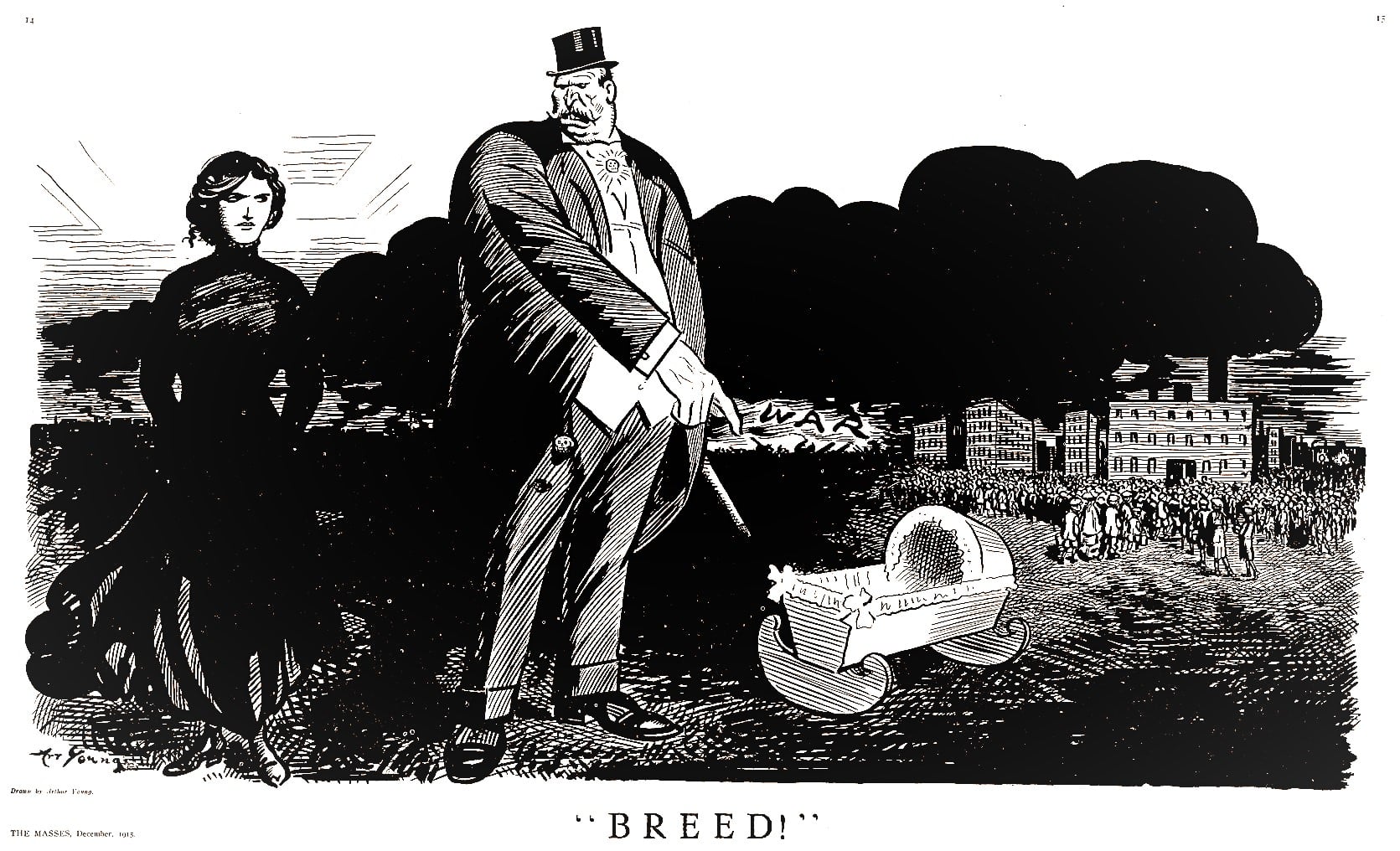
Another example that the U.S. Socialist movement had, in many way–though certainly not all–a substantially more nuanced, serious, and expansive debate on fundamental issues of women’s oppression than the early Communist movement-seeing women’s oppression socially, culturally, AND economically. It was almost unheard of for a male comrade in the early Communist movement to be called out for sexism, while the Socialist Party had a whole women’s-written literature devoted to the problem–of course with its own political limitations. But the difference is noticeable. Here, a 1914 rich essay from revolutionary Industrial Socialist Caroline Nelson on the distinctions between ruling class and proletarian interests in the struggle for women to control their own bodies and child-bearing.
‘Neo-Malthusianism and The Control of Child-Bearing’ by Caroline Nelson from International Socialist Review. Vol. 15 No. 4. November, 1914.
LARGE families and poverty go together. The rich and well-to-do have few children. It is the workers, and the poorest at that who have children they cannot care for. They simply bring their little ones into the world to become cheap slaves in the labor market. Ignorant people, of course, believe that it is an incident in the scheme of things that the poor have more children. The plain fact about it is that the leisure class practices artificial sterilization. They determine how many children to have; or to have none at all.
But the moment one begins to suggest that the workers should do the same thing, society holds up its hands in horror, and screams “race suicide,” as though it were not worse to produce children doomed to poverty and suffering than to refuse to bear any. When parents bring children into the world that they cannot support, nature eventually punishes the whole race.
An international society has been formed in Europe under the name of Neo-Malthusianism, for the purpose of teaching the workers to control child-bearing. It is also called the modern Malthusianism, and first appeared among the French peasants. As we know, Malthus the English theologian, rested his theory on the ground that man increased faster than the earth’s productiveness to support him. He pointed out that the working class increased in proportion to its lack of sustenance. To avoid a final calamity he advocated late marriages and wars and pestilence to kill off some of the poor. His idea was raw and barbaric, but it satisfied the capitalist class. The central idea was that man should consciously control the birth rate. To say that this is immoral, is equal to saying that man should not use his reason and will power. Those, of the Roosevelt type, who preach the immorality of birth regulation praise the mass murder of wars with a clear conscience.
As long as the French ruling class practiced Neo-Malthusianism within their own border lines, so long did press and pulpit keep silent about it; but as soon as the working class took it up, then there arose a terrible howl. The howl was so loud that the authorities of learned men and official dignitaries investigated the matter. After a careful consideration they decided that there was no real danger in the modern Malthusianism; that at its best it could only help the individual worker economically, while it contained no real social danger. This silenced public opinion.
The French workers held no public meetings to discuss the subject, but privately the idea penetrated the whole mass by word of mouth, pamphlets and leaflets. “Think for yourself, do not place children in the world that you cannot support” was the cry. All went well until the capitalists found that women and children became scarce for their factories.
Women and children play the chief role in the industrial life of France. And it was the factory owner that first woke up to the fact that his cheap labor source had been cut short. It hit him squarely in the pocketbook. Ruin stared him in the face. In his frightened imagination he saw his factories empty, and he immediately called on the state to set its machinery in motion, but alas ! no state has yet the power to compel parents to reproduce their kind. Starvation and jail has no effect on the worker in that case. Here is where he can get the ruling class to crawl on its knees. Here is a strike that can’t fail. No eloquent fool can say to the workers, “This is a mystic dream of despair!” To regulate the production of labor-power, is to regulate profit, and render the profit monger helpless. This is not a matter of hope built on theory, but a matter of education of the simplest kind.
The French statesmen grew nervous about it. The ever handy statistician told in plain figures that the French nation would disappear in 50 years. Had the dear French workers ceased to love their country? All the literature about Neo-Malthusianism was confiscated by law. The advocators were arrested. The liberal press, whose editors had no children, preached about the honor due to parents with a large family. The priest, whose religion forbade him to be a parent, thundered against the wickedness of bearing only one or two children. The whole brood of ruling class mouth-pieces was set in motion to save the workers from this dreadful sin. The result was that the control of child-bearing took deeper root. The farmer and the worker went to church with their wives, and heard the priests thundering. “They may be right,” they would say, “but we can’t afford to have any more children.”
Where everything eke fails, baits must now be thrown out to married folks. In Germany, where they need much food for cannon, there has long been a reward for families with many boys. France adopted the reward idea not only for boys but for girls as well. The only thing, however, that the French ruling class accomplished through all its agitation against Neo-Malthusianism was to spread it among all other nations. Everybody heard about this movement in France, and the net result is an international society.
In Sweden the society publishes a journal called The New Moral. There the ground was prepared by Knut Wicksell and Anton Nystrom. Wicksell is a revolutionist and a proletarian.
In Denmark, the editor of the syndicalist paper, “Solidaritet,” has written a book on the subject, which pictures to the dullest mind the tragedy of irresponsibly crowding children into the world. Christian Christensen was born in the slums of Copenhagen of a large family. He speaks from sad experience. When he was only ten years old he was sent to work in a match factory, where he in common with the other children he was thrashed by the grown workers whom they attended. He organized the boys together with those in the surrounding factories, and one day they posted a notice in the factory that there was a strike of the children and that they would not go back to work until they got a raise in wages without thrashings. The manager was away and came rushing back. The men could not work without the children so the factory had to close down. The manager granted the children’s demands and posted a notice to the effect that no one would be allowed to punish the child workers. The men then refused to go back. They were strongly organized with cash in their treasury. They shamelessly offered the boss the difference in the wages of grown-up workers, until he could supplant the striking boys with other, unorganized children who would take their beatings and say nothing.
But the kiddies were such good pickets that the grown scabs couldn’t get near the factory. A big building was under construction next door and the workers on it stood by the children and furnished them with bricks. The parents of the striking children were also against them. A brave boy got a licking at home one morning and then was taken by his mother to the boss to receive another licking. Then he was ordered to work. His comrades on the picket line heard his shrieks as the blows rained down on him, but in a short time his head was seen sticking out over a board fence, and he cried out, “Here I am again; no scabbing for me, Hurrah!”
Now, Mr. Lyngsie, president of the unskilled trade workers’ union, to which the match-workers belonged, solved the problem by appealing to the authorities to break up the boys’ union. They promptly dug up a law which forbade the organization of any minors, without having six adult men at the head. The poor boys were all under age. Christensen who was the head of them and who had the books and the cash in his possession, was called into court. While he was gone the police went to his home and carried off the books and cash. The cash was for strike benefit, and there was about two hundred crowns. This ended the children’s strike and organization, broken up by the demand of the adult workers. That is the kind of class-consciousness that the craft unions have produced in Denmark.
No wonder the youthful Christian early learned to have no faith in the craft unions. When he became a man he eagerly threw himself heart and soul into Neo-Malthusianism.
It does not take a philosopher to see that having many children renders working class parents almost helpless in the hands of their masters. When they go on strike the children’s cry for bread drives them back. Machinery becomes so perfected that children drive fathers out of their jobs. The children, in turn, have no chance to become thinking men and women. They are not equipped for any kind of a battle for life. They are a thousand times worse off than the jungle child. They are not born because their parents want them, but of an irresponsibility that is inexcusable in the 20th century.
The Swedish ruling class has passed a law forbidding the Neo-Malthusianists to help the workers practically along this line. But they carry on the educational work just the same. And in a few years this thing is going to loom large upon the horizon in every country. It is the duty of every worker to spread this teaching among his class. We may find that it will give us additional strength in our ceaseless war on the Profit System.
The International Socialist Review (ISR) was published monthly in Chicago from 1900 until 1918 by Charles H. Kerr and critically loyal to the Socialist Party of America. It is one of the essential publications in U.S. left history. During the editorship of A.M. Simons it was largely theoretical and moderate. In 1908, Charles H. Kerr took over as editor with strong influence from Mary E Marcy. The magazine became the foremost proponent of the SP’s left wing growing to tens of thousands of subscribers. It remained revolutionary in outlook and anti-militarist during World War One. It liberally used photographs and images, with news, theory, arts and organizing in its pages. It articles, reports and essays are an invaluable record of the U.S. class struggle and the development of Marxism in the decades before the Soviet experience. It was closed down in government repression in 1918.
PDF of full issue: https://www.marxists.org/history/usa/pubs/isr/v15n05-nov-1914-ISR-riaz-ocr.pdf
 Revolution's Newsstand