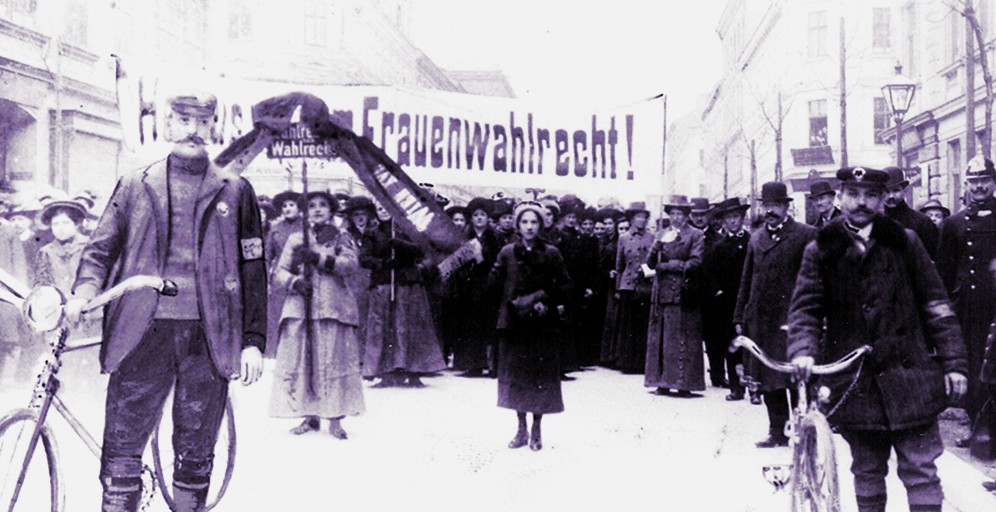
Veteran Austrian educator, and revolutionary, Marxist Isa Strasser on the campaign initiated by the workers’ movement in Austria’s new ‘republic’ to reverse the archaic 1852 anti-abortion law in that conservative, Catholic country. Strasser, long a women’s organizer in the Socialist movement, was an original dissident internationalist in 1914, later to participate in the Austrian revolutions of 1918, and help found the Austrian Communist Party (KPÖ’), as well as the Third International in 1919. She became an editor of the KPÖ’s paper, “Die Rote Fahne,” the head of the KPÖ’s Women’s Central Committee, and elected member of the Executive of the Comintern’s Women’s Section. Removing with her husband, the also important comrade Josef Strasser, to Moscow for Comintern work in 1923, they both became non-aligned oppositionists, were relieved of posts in 1928 and returned to Austria in 1929. There they first corresponded with Trotsky and the Left Opposition before associating themselves with the Council Communists movement and comrades like Anton Pannekoek, remaining politically active the rest of their lives. Arguably, their most important contributions after the break with the official Communist movement were their substantial, incisive, on-going analysis of the role and politics of Austro-Marxism, among the best contemporary critical examinations of that school of politics.
‘The Fight Against Compulsory Motherhood in Austria’ by Isa Strasser from International Press Correspondence. Vol. 2 No. 86. October 6, 1922.
As in other states, there exists in Austria a law which threatens with punishment the interruption of pregnancy. According to paragraphs 144-148 of the Austrian penal code “women who are guilty of the crime of procuring abortions will be liable to punishment by imprisonment up to five years”. Of course the law, as everywhere else, has not had the effect of restraining the women from the “Crime” mentioned in the act. On the contrary, the number of artificial interruptions of pregnancy has increased in Austria from year to year. Thus a Viennese doctor, Professor Haberda has established, that in the last 20 years the number of miscarriages dealt with in the hospitals of Vienna has mounted from 400 to 4500 a year. He calculates, however, that out of every 100 miscarriages, on an average 74 are cases of artificial abortion.
How great has been the growth since the war, of the practice made punishable under these clauses has not yet been ascertained statistically. Observations and experience, reports from midwives and doctors show however, that it must be enormous. All this is intelligible enough when one considers how terrible the living conditions of the Austrian working class have been since the war, how thoroughly incapable the democratic republic has proved itself to prevent the misery of women and children.
Already before the war, Vienna had the sad reputation of being known as the “City of Tuberculosis”. In the year 1920, however, double the number of women (4057) died from this malady and the number of death cases from tuberculosis has doubled since 1912. Thus in 1920, 1024 young persons died of tuberculosis. In 1920, out of the school children who were examined 90,000 were greatly undernourished. Out of 56,000 children under school age only ten percent were not undernourished. Rickets and Tuberculosis among little children have not diminished, but increased since 1920 in spite of the activities of foreign relief.
In March 1921, the Social Democratic women introduced a motion demanding the abolition of paragraphs 144-148. They demanded immunity for the woman who interrupted pregnancy if she did so before the expiration of the third month and with the help of a physician. The proposal should have come up for discussion in April but was put off by the party conference on account of pressing taxation, measures, and up to the present it has not been carried through. Today there is little prospect of it being accepted by Parliament as the Christian Socialists have introduced a fervent agitation against the proposal in which they pretend to see an attempt against the sacredness of the family and other “superior” virtues.
The manner in which the agitation for the abolition of “enforced motherhood” is conducted, is characteristic of the nature of the present Social Democratic women’s movement. They most anxiously avoid raising at big meetings, at Municipal Councils and in Parliament, the problem of abortions along with the questions of mother and child protection and the reform of midwifery which are inseparable from it. And with good reasons; the ruthless exposure of the complete failure of “democracy” in this sphere of vital importance to the proletariat is not at all compatible with political aims of Social Democracy. They are also much too tactful to demand today, from a state which is in such a plight as Austria, any serious relief against the sufferings of mothers and children.
Moreover, is there not the “League against enforced Motherhood” which has made it its task to fight against the abortion paragraphs? This League is a bourgeois organization; it repudiates the class struggle. “If only the offending paragraphs which rob the woman of the right of independent control of her own body were removed”, so runs the fable of the “theorist” of the League, the author Ferch, “then the child would be the love bond of the sexes, the woman would become a mother, but according to her own will and under conditions, which would cause happiness and love and the child to thrive and blossom”. Now the Social Democratic Party as such is theoretically supposed to be in favor of the class struggle, and repudiates in theory, birth limitation as a means of relief. But since such opinions as expect the liberation of humanity through conception preventatives and abortions are very apt to divert the workers from the class struggle and to hamper their revolutionary independent activity, and as this is actually the first concern of the Social Democrats they express the warmest sympathy for the League against Compulsory Motherhood. They do everything in order to bring Social Democratic women into its ranks as members, and support its propaganda in the press and at meetings. All that is achieved by this, however, is that while on the one hand, the League against Compulsory Motherhood, this harmless pacifist union, grows and flourishes, on the other hand, the Christian Social Women’s Movement is gathering in members, who, disappointed with Social Democracy are streaming to it In diverting the women from the political struggle one only succeeds in strengthening reaction. Nothing whatever is accomplished which could lead to the abolition of the paragraphs. Only those powers are consolidated thereby, which see in the abolition of enforced motherhood an attack upon bourgeois order and who at the same time regard as luxuries, and refuse the most modest measure of state care for mothers and children, which, if it could not prevent, could at least mitigate the fear of child birth.
International Press Correspondence, widely known as”Inprecorr” was published by the Executive Committee of the Communist International (ECCI) regularly in German and English, occasionally in many other languages, beginning in 1921 and lasting in English until 1938. Inprecorr’s role was to supply translated articles to the English-speaking press of the International from the Comintern’s different sections, as well as news and statements from the ECCI. Many ‘Daily Worker’ and ‘Communist’ articles originated in Inprecorr, and it also published articles by American comrades for use in other countries. It was published at least weekly, and often thrice weekly. Inprecorr is an invaluable English-language source on the history of the Communist International and its sections.
PDF of full issue: https://www.marxists.org/history/international/comintern/inprecor/1922/v02n086-oct-06-1922-Inprecor.pdf
 Revolution's Newsstand