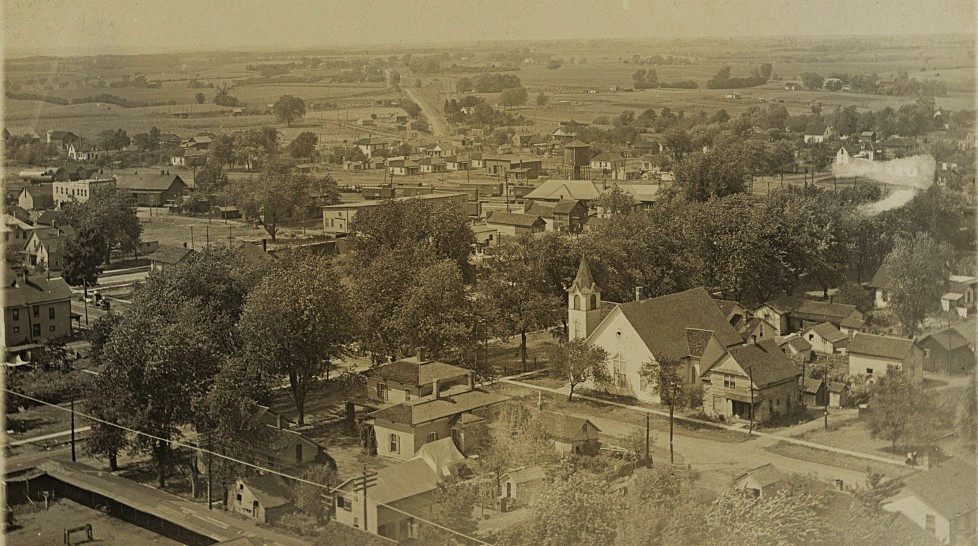
Small, isolated U.S. towns reliant on the whims of a single industry make for misery. The story of Albia, Iowa; a labor camp with more churches than people.
‘Albia, Iowa is Forced to Kneel Before King Coal’ by David Coutts from The Daily Worker. Vol. 2 No. 29. February 14, 1925.
ALBIA, la., Feb. 12. This town is the center of the coal mining territory in southern Iowa. Coal is king here. All around are mining camps with villages with from 200 to 6,000 population. The present industrial depression, together with railroad rate discrimination and competition with the non-union fields of West Virginia, and Kentucky, has caused great suffering in this territory.
Most of the mines are only working part time, some one or two days a week, and still others less than that. One camp with 200 people has waited for over a year for the mine to start up—they still wait, suffering but stolid.
Life In the Mining Camp.
About seven miles out from Albia is the village of Hiteman with 800 population. A street car, just one, connects it with Albia. There is neither city water, gas, sewers nor sidewalks, except before a few houses where prosperity had smiled for over a mouth at some time in the distant past. Many of the “homes” seem to have been put on the installment plan, others show resourcefulness and ingenuity in making much out of little. From the outside the miners’ shacks, in the large majority of cases’ look like the town of “Lost Hope.” Inside, however, the women folks contrive to bring comfort and cleanliness that seems unbelievable.
In Hiteman they have a pre-high school as well as a grade school. There are six churches, at one time there were 13, and every fraternal society in the land seems to have a lodge there. There are so many knights and ladles, kings’ daughters, worshipful masters, noble grands and kleagles in that small village that no knight-errant of St. George could ever hope to keep track of them. Nothing short of six emblems. Including the masonic or columbus knights will ever get you anywhere in Hiteman and that often means a job.
Miners’ Union a Shadow Now.
The terrible struggles that the mine workers have gone thru in the past to build up and preserve their union, which in the camps was the social and educational center of activity, filling their lives with dignity, resolution, fraternity and culture development. Now the union has become a sort of necessary burden upon them, empty when they would fill their lives with pleasant association; dry when they would drink from the fountain of music and mirth. Their union that was so much to them has now become a shadow. The church cannot fill the void in their lives and so they join not one but many fraternal societies that are supposed to be somewhat elusive. These give him dignity, sociability, fraternity, music and mirth.
The women become “king’s daughters” or join some other order with a “high” sounding name, but they still tend to the comforts of the “king” and the chief attraction at all gatherings, as in the times when the union was the social center; when John was simply John and not king kleagle. When struggle comes the union once more takes on substance and is the center of activity in the camps. Titles are laid on the shelf and John is once more brother and comrade in the fight for all.
Discouraged—Not Yet Rebellious.
The long drawn out struggle against oppression, unemployment and poverty has dampened the splendid fighting spirit of the coal diggers. Danger and hardship continues without respite. Part time keeps him in poverty and unemployment, like death, stalks him at all times. “There are ’too many mines and two hundred thousand surplus miners” it has been said, therefore, the coal digger is without hope and so the union becomes a shadow, the six-hour day a dream and the miners, together with every member of the working class in America is weakened and discouraged.
One mine employed 300 miners during the war, now but 20 are employed. All thru this territory are deserted homes and some camps with 50 or 100 houses have been abandoned.
Coal is being shipped into this territory from other fields. The railroad “brotherhoods” at Ft. Dodge have a coal depot, their members are active salesmen for coal from their non-union fields in West Virginia. More coal sold, more dividends on their investment in the Brotherhood Bank. Mephistophelian brothers who for dollars and cents condemn the soul of the miners to the damned.
Bolsheviks’ Message of Hope.
A series of meetings have been arranged by the Party in this territory starting with Albia on Wednesday, Feb. 26, at the Woodman Hull; Centerville on Thursday, Feb. 26 at the Labor Hall, over Brody’s Store or north side of square, and meetings at Mystic, Cincinnati and Brazil yet to be arranged.
Speakers will be David Coutts, active member of Omaha Stone Cutters’ Union, and J.E. Snyder, district organizer of the Workers Party. Admission will be free and the subject of the speakers will be unemployment, child labor, “Open Shop Drive,” and a Workers’ and Farmers’ Government.
PDF of full issue: https://www.marxists.org/history/usa/pubs/dailyworker/1925/1925-ny/v02b-n029-NYE-feb-14-1925-DW-LOC.pdf
 Revolution's Newsstand